Feeds:
Posts
Comments

Archive for the ‘Medititions’ Category


Ian Britton

We continue with St. Gregory the Great’s treatise entitled Pastoral Care or Pastoral Rule (Regula Pastoralis). As it is Christmas Day, the meditation will be short, and I’ll let the text speak for itself. It is sufficient to say that the weight of government, particularly ecclesiastical government, frequently has a deleterious effect on the mind and spirit. As well, today’s section from Book I, Chapter 4 is certainly a stern warning against participation in Church politics.

That for the most part the occupation of government dissipates the solidity of the mind.

Often the care of government, when undertaken, distracts the heart in various directions. One is found unequal to dealing with particular things, while with confused mind divided among many. Whence a certain wise man providently dissuades, saying, “My son, meddle not with many matters.” (Sirach 11:10)

The mind is by no means collected on the plan of any single work while parted among various. When it is drawn abroad by unwonted care, it is emptied of the solidity of inward fear. The mind becomes anxious in the ordering of things that are without, and, ignorant of itself alone, knows how to think of many things, while itself it knows not. For, when it implicates itself more than is needful in things that are without, it is as though it were so occupied during a journey as to forget where it was going. Being estranged from the business of self-examination, it does not even consider the losses it is suffering, or know how great they are.

For example, Hezekiah did not believe himself to be sinning, when he showed to the strangers who came to him his storehouses of spices. (II Kings 20:13) However, he fell under the anger of the judge, to the condemnation of his future offspring, from what he supposed himself to be doing lawfully. (Isaiah 39:4) Often, when the means are abundant, and many things can be done for subordinates to admire, the mind exalts itself in thought. It fully provokes to itself the anger of the judge, though not breaking out in overt acts of iniquity. For he who judges is within; and that which is judged is within.

So, when in heart we transgress, what we are doing within ourselves is hidden from men. but yet in the eyes of the judge we sin. Neither did the King of Babylon then first stand guilty of elation (Daniel 4:16, et seq.) when he came to utter words of elation. Even before, when he had given no utterance to his elation, he heard the sentence of reprobation from the prophet’s mouth. He had already wiped off the fault of the pride he had been guilty of, when he proclaimed to all the nations under him the omnipotent God whom he found himself to have offended.

But after this, elevated by the success of his dominion, and rejoicing in having done great things, he first preferred himself to all in thought. Afterwards, still vain-glorious, said, “Is not this great Babylon, that I have built for the house of the kingdom, and in the might of my power, and for the honour of my majesty?” (Daniel 4:30) Which utterance of his, as we see, fell openly under the vengeance of the wrath which his hidden elation kindled. For the strict judge first sees invisibly what he afterwards reproves by publicly smiting it. So, him He turned even into an irrational animal, separated him from human society, changed his mind and joined him to the beasts of the field, that in obviously strict and just judgment he who had esteemed himself great beyond men should lose even his being as a man. Now in adducing these things we are not finding fault with dominion. Rather, we are guarding the infirmity of the heart from coveting it, lest any that are imperfect should venture to snatch at supreme rule, or those who stumble on plain ground set foot on a precipice.

Read Full Post »


StGregoryTheGreat

Today, we continue with St. Gregory the Great’s treatise entitled Pastoral Care or Pastoral Rule (Regula Pastoralis). I think it would be a good thing as Advent draws to a close for clergy, particularly those currently holding episcopal office or pending consecration, to measure themselves against the Pastoral Rule.

For those of us who endured the long collapse of the Protestant Episcopal Church in America, we experienced an episcopate that turned 180 degrees from these rules, particularly when it came to seeking prosperity and property. Having spent many hours in many courts as either counsel or an expert witness, I know firsthand what havoc a breach of this next pastoral rule (Book I, Ch. 3) wreaks on the lives of the faithful, whether clergy or lay people. This chapter is particularly apt as we approach the Feast of the Incarnation.

Of the weight of government; and that all manner of adversity is to be despised, and prosperity feared.

So much, then, have we briefly said, to show how great is the weight of government, lest whosoever is unequal to sacred offices of government should dare to profane them, and through lust of pre-eminence undertake a leadership of perdition.

From this St. James affectionately deters us, saying, “Be not made many masters, my brethren.” (St. James 3:1). Indeed, the Mediator between God and man Himself-He who, transcending the knowledge and understanding even of supernal spirits, reigns in heaven from eternity-on earth fled from receiving a kingdom. For it is written, “When Jesus therefore perceived that they would come and take Him by force, to make Him a king, He departed again into the mountain Himself alone.” (St. John 6:15) For who could so blamelessly have had principality over men as He who would in fact have reigned over those whom He had Himself created? But, because He had come in the flesh to this end, that He might not only redeem us by His passion, but also teach us by His conversation, offering Himself as an example to His followers.

He would not be made a king. He went of His own accord to the gibbet of the cross. He fled from the offered glory of pre-eminence, but desired the pain of an ignominious death. He did this so that His members might learn to fly from the favours of the world, to be afraid of no terrors, to love adversity for the truth’s sake, and to shrink in fear from prosperity.

Why? Because prosperity often defiles the heart through vain glory, while adversity purges it through sorrow. In prosperity the mind exalts itself; but in adversity, even though it had once exalted itself, it brings itself low. In prosperity man forgets himself; but in adversity, even perforce and against his will, he is recalled to memory of what he is. In this prosperity, even good things done aforetime often come to nothing, but in adversity and humility faults even of long standing are wiped away.

For commonly in the school of adversity the heart is subdued under discipline, while, on sudden attainment of supreme rule, it is immediately changed and becomes elated through familiarity with glory. So it was that Saul, who had before fled in consideration of his unworthiness, no sooner had assumed the government of the kingdom than he was puffed up. (I Kings 10:22; 15:17-30) Desirous of being honoured before the people while unwilling to be publicly blamed, he cut off from himself even him who had anointed him to the kingdom.

Likewise, David, who in the judgment of Him who chose him was well pleasing to Him in almost all his deeds, as soon as the weight of pressure was removed, broke out into a swelling sore. (II Kings 11:3, et seq.) Having been as a laxly running one in his appetite for the woman, David became as a cruelly hard one in the slaughter of the man who was her husband. David, who had before known pitifully how to spare the bad learned afterwards, without impediment of hesitation, to pant even for the death of the good. (II Kings 11:15). For, indeed, previously he had been unwilling to smite his captured persecutor. Yet, afterwards, with loss to his wearied army, he destroyed even his devoted soldier. And in truth his crime would have snatched him farther away from the number of the elect, had not scourges called him back to pardon.

Read Full Post »


Pastoral Rule

This week, I began re-reading an older copy of The Christian Priest Today by the late Archbishop Michael Ramsey. It is an excellent work with much to consider, both for clergy and lay people. The book is informative and inspirational for all contemplating Holy Orders, the newly ordained, and for those who have been “around the block” once or twice.

The book references St. Gregory the Great’s treatise entitled Pastoral Care or Pastoral Rule (Regula Pastoralis). I confess that I had not read this remarkable book, and I have become thoroughly side-tracked from my initial reading of Abp. Ramsey’s book. The fathers of the Church are always timely, and I thought I would periodically post some of the text here from A.D. 591 as we prepare enter into A.D. 2018.

That the unskillful venture not to approach an office of authority.

No one presumes to teach an art until he has first, with intent meditation, learned it. What rashness is it, then, for the unskillful to assume pastoral authority, since the government of souls is the art of arts! For who can be ignorant that the sores of the thoughts of men are more occult than the sores of the bowels? And yet how often do men who have no knowledge whatever of spiritual precepts fearlessly profess themselves physicians of the heart, though those who are ignorant of the effect of drugs blush to appear as physicians of the flesh!

But because, through the ordering of God, all the highest in rank of this present age are inclined to reverence religion, there are some who, through the outward show of rule within the holy Church, affect the glory of distinction. They desire to appear as teachers, they covet superiority to others, and, as the Truth attests, they seek the first salutations in the market-place, the first rooms at feasts, the first seats in assemblies Matthew 23:6-7, being all the less able to administer worthily the office they have undertaken of pastoral care, as they have reached the magisterial position of humility out of elation only.
For, indeed, in a magisterial position language itself is confounded when one thing is learned and another taught. Against such the Lord complains by the prophet, saying, They have reigned, and not by Me; they have been set up as princes, and I knew it not Hosea 8:4. For those reign of themselves, and not by the Will of the Supreme Ruler, who, supported by no virtues, and in no way divinely called, but inflamed by their own desire, seize rather than attain supreme rule. But them the Judge within both advances, and yet knows not; for whom by permission he tolerates them surely by the judgment of reprobation he ignores.

Whence to some who come to Him even after miracles He says, Depart from Me, you workers of iniquity, I know you not who you are Luke 13:27. The unskillfulness of shepherds is rebuked by the voice of the Truth, when it is said through the prophet, The shepherds themselves have not known understanding Isaiah 56:11; whom again the Lord denounces, saying, And they that handle the law knew Me not Jeremiah 2:8. And therefore the Truth complains of not being known of them, and protests that He knows not the principality of those who know not Him; because in truth these who know not the things of the Lord are unknown of the Lord; as Paul attests, who says, But if any man knows not, he shall not be known 1 Corinthians 14:38. Yet this unskillfulness of the shepherds doubtless suits often the deserts of those who are subject to them, because, though it is their own fault that they have not the light of knowledge, yet it is in the dealing of strict judgment that through their ignorance those also who follow them should stumble.

Hence it is that, in the Gospel, the Truth in person says, If the blind lead the blind, both fall into the ditch Matthew 15:14. Hence the Psalmist (not expressing his own desire, but in his ministry as a prophet) denounces such, when he says, Let their eyes be blinded that they see not, and ever bow down their back Psalm 68:24. For, indeed, those persons are eyes who, placed in the very face of the highest dignity, have undertaken the office of spying out the road; while those who are attached to them and follow them are denominated backs. And so, when the eyes are blinded, the back is bent, because, when those who go before lose the light of knowledge, those who follow are bowed down to carry the burden of their sins.

Read Full Post »

Fifteen Years


Avocado

On an ordinary day, the parish priest has to be pretty darned adept at multitasking. This is particularly true from about Thursday through Sunday evening for reasons that run from the sublime to…well…the ridiculous. Indeed, in one case, I was called out to perform “an emergency house blessing”. Needless to say, the furniture and household appliances were not floating in midair.  In fact, the queer noises that were causing so much concern came from a family of squirrels that had chewed their way into the attic and were given to gamboling and such at odd hours of the day and night. The “roof rabbits” were blessed along with the rest of the house. (Note to brother clergy: do keep a flashlight in your Mass kit for those hard-to-reach parts of the house to be blessed.)

Over time, there have been many “call-outs” at all hours for reasons awful, grave, not-so-grave, ordinary and even downright humorous.  One learns, though, that something that may be seem trivial can have great weight.   That’s the reason that putting on the dog collar involves going when called, often in several directions at once.  It means blessing each individual holy card for an hundred school children while trying to pray in a shrine church.  I watched a friend do this at a Franciscan Monastery while suffering a bout of malaria.  He never complained and had a smile for each little World Youth Day pilgrim, every one of whom seemed to have dozens of holy cards, rosaries and statues of obscure saints in their back packs.  It had a profound effect one me, and is a picture I try to keep in mind whenever I deem myself to be “overworked” or put upon

Today, however, has surpassed many others for weekend excitement. We had an early meeting of the Virginia Army Cadet staff to prepare for summer camp. We got an enormous amount of administrative work done in a short time, and the advanced team went out to the site where we will hold our August mini-camp: three days of ropes course, land navigation, hiking, swimming and marksmanship training. The “confirmed” arrangements were, in fact, not. The camp had never heard from us.

Following a flurry of e-mails, phone calls and some perhaps un-priestly discourse, We got that buttoned down, and I was able to move on to producing tomorrow’s service bulletin, our parish secretary having left several weeks ago in a huff over “substandard printer cartridges”. This hurdle was overcome amidst a parade of visitors-all very, very welcome, mind you, but the clock tiketh. In the meantime, several ladies of the church were cooking chili to be sold tomorrow and at synod. The aroma is extraordinary, especially since lunchtime had slipped by unnoticed.

Readjusting, I somehow have come up with noted for an homily on I St. John 4:16. No warranties express or implied, particularly now that I have read it. I am now “in production” on the class handouts for tomorrow’s class on Revelation, and praying that the thunderstorm that has just moved in doesn’t knock out the power before I can get them copied. Otherwise, it is a 6:00 a.m. special tomorrow.

So it is that I remembered that I was ordained priest fifteen years ago on St. Columba’s Day, June 9, 2002, by the late Archbishop Robert Sherwood Morse.  On June 23rd, the opening day of our diocesan synod, I will mark 16 years in Holy Orders, having been “deaconized” on that date in 2001 by the very same Abp. Morse.

To be sure, it has been a busy stretch with parish work, a decade in military chaplaincy, graduate theological studies and weekends just as busy or busier than this.  Sometimes, on long nights at the hospital, those missed holiday dinners, birthdays and anniversaries, and in the midst of tragedy great and small, one wonders how to keep all of the balls in the air.  Prayer of course.  But, in addition to more grace than any man deserves,  I have had the unfailing love and support of family, especially my wife Elizabeth.

Even on the days when multitasking stretches me thin, it is a joy to be able to serve the people of God and to be an “advance man” for our Lord.   I do have two small requests, though.

First, pray daily for your parish priest.  We need it.

Secondly, on Sunday morning after Mass, please don’t ask, “What do you do the other days of the week.”

It’s just not nice to annoy the priest.


Read Full Post »


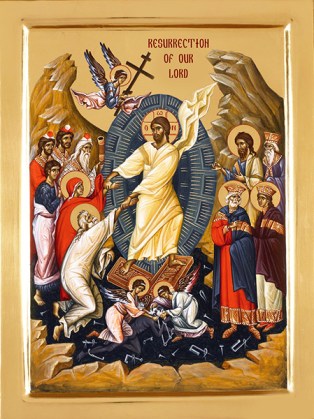
resurrectioniconemail

CHRIST our Passover is sacrificed for us : therefore let us keep the feast,
Not with [the]* old leaven, neither with the leaven of malice and wickedness : but with the unleavened bread of sincerity and truth. 1 Cor. v. 7.

CHRIST being raised from the dead dieth no more : death hath no more dominion over him.
For in that he died, he died unto sin once : but in that he liveth, he liveth unto God.
Likewise reckon ye also yourselves to be dead indeed unto sin : but alive unto God through Jesus Christ our Lord. Rom. vi. 9.

CHRIST is risen from the dead : and become the firstfruits of them that slept.
For since by man came death : by man came also the resurrection of the dead.
For as in Adam all die : even so in Christ shall all be made alive. 1 Cor. xv. 20.

[Glory be to the Father, and to the Son : and to the holy Ghost;
As it was in the beginning, is now, and ever shall be: world without end. Amen.]*

ALMIGHTY God, who through thine only-begotten Son Jesus Christ hast overcome death, and opened unto us the gate of everlasting life; We humbly beseech thee that, as by thy special grace preventing us thou dost put into our minds good desires, so by thy continual help we may bring the same to good effect; through* Jesus Christ our Lord, who liveth and reigneth with thee and the Holy Ghost ever, one God, world without end. Amen.

Read Full Post »


HolySaturday

At length the worst is over. Loving and reverent disciples have embalmed and buried His lifeless body. The timid have been rendered brave by His crucifixion. Joseph has gone in boldly unto Pilate and begged His body. Nicodemus has brought a large quantity of costly ointment.  St. John and “the Marys” have rendered their assistance.  Though it was but a simple funeral, it was the most solemn burial that has taken place on earth. Meanwhile Jesus had passed with the penitent thief to Paradise.

Prayer

During this Lent I have tried to watch with Him, and to follow Him. May my faults be all buried with Him, and may I be raised in Him from the death of sin to the life of righteousness. As the holy women sought Him in the early morning of that bright Easter Day, so must I seek Him in His Blessed Sacrament.  I pray that He, the living Saviour, who is the Life of His people, may draw me to Himself, and then Himself draw near also to me, to cleanse, to quicken, and to strengthen me by His Presence, by His Body and Blood, that in Him I may live a new life of goodness, cheerfulness, and charity.  Amen.

For the Vigil

All was silent round the tomb of the King. Even the women had long since gone, and nothing now was heard except the step of the Roman soldiers, and the rattle of their weapons, as they paced up and down upon their watch. Suddenly the earth is shaken, the keepers are affrighted and become as dead men, Jesus arises from the dead, the Saviour from sin, the Conqueror of death, and of him that had the power of death, the bonds are burst, and an angel rolls away the stone that His loved ones may see the place where the Lord lay.

“Now is Christ risen from the dead, and become the firstfruits of them that slept.” And as by man came death, by man has also now come the resurrection from the dead.

Prayer

Quicken me, O Lord Jesus, that I may walk with Thee in newness of life, and that when I die I may rest in Thee, and so through the grave and gate of death may pass with all Thy saints to a joyful resurrection, through Thy Mercy. Amen.

Read Full Post »


Carry the Cross

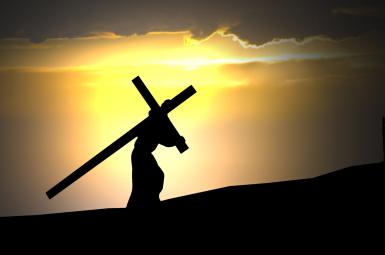
Jesus was condemned by the Jewish council.  He was and given up by Pilate first to be scourged, and then to be crucified.

Today He hung upon the cross, His head crowned with thorns, His hands and feet nailed, His failing eyes dimmed with blood, His parching throat raging with thirst.

As yet He has not spoken, except one cry which, with eyes lifted up to heaven, He uttered when, with a harsh shock, the cross had been fixed in its place, “Father, forgive them, for they know not what they do.”

His Mother and the disciple whom He loved stand below, together with St. Mary Magdalene, but at the word of Jesus that disciple took Mary unto his own home, returning, however, himself to Calvary. The elders around the cross are mocking and taunting Him: not sparing even His dying pains, and the thieves join with them therein. But the prayer and the patience of Jesus have their effect on one of them, and he is enraptured with the promise that that very day he shall be with his Saviour in the rest of Paradise.

Darkness has been gathering around, startling the watchers and the crowd, and now from the midst of that darkness bursts suddenly forth a great and exceeding bitter cry, “My God, My God, why hast Thou forsaken Me?” Peace, however, to some degree returns, and He asks for water. Then comes the first cry of victory achieved, “It is finished.” Then comes the exclamation of perfect peace, “Father, into Thy hands I commend My spirit.” He bowed His head, and gave up the ghost.+

A soldier pierced His side, and the fountain was opened for sin and for uncleanness.

Prayer

Wash me, O my Savior, in Thine own blood, and as Thou didst lay down Thy life to redeem me from all iniquity, help me now to crucify the flesh with the affections and lusts, that, overcoming by Thy grace all temptations. I may follow Thee in Thy path of obedience; so that my life may be blessed, and my death may be peaceful, and I may hereafter reign with Theo in the glory to which Thou art now restored, who with the Father and the Holy Ghost, art blessed and glorified, one God, world without end Amen.

Read Full Post »


the-last-supper-communion-big

When the day opened the Lord Jesus was still in retirement, probably at Bethany, with His disciples.  Soon St. Peter and St. John were sent to make ready in the borrowed guest-chamber for Him and them against His coming in the evening. This upper room became the holiest place in the holy city.

In the evening He there washed His disciples’ feet, assuring St. Peter that to be washed by Him was necessary for them. Then followed the institution of the Holy Communion, “Take, eat, this is My Body; Drink ye all of this, for this is My Blood of the New Testament, which is shed for you and for many of the remission of sins.” To them the promise was fulfilled, “He that eateth My Flesh, and drinketh My Blood, dwelleth in Me and I in him.” He spoke to them also words of most affectionate consolation, and gave the promise of the Comforter; and then followed the Hymn, the Intercession, the going forth over the brook Kedron.

Beyond this brook was the Garden of Gethsemane, and toward that place, as often before, He now journeyed. Taking the chosen three, He left them within the Garden, and passed on about a stone’s throw alone. His soul, He had told them, was exceeding sorrowful, even unto death; and He begged them to watch with Him.

The prince of this world was coming, and it was the hour of the power of darkness. The struggle with the natural, and therefore innocent, weakness of the flesh, and with Satan, who made use of it to turn Him from His purpose, then began but while He could add to His prayer, “Nevertheless, not My will, but Thine be done,” He was unconquered, and was still true to Himself, and obedient to the Father’s purpose and will.

Again and again He returned to His friends to seek sympathy from them, but they were sleeping for sorrow. At length the weary struggle was over, the offering of Himself in will had been made, and He was ready for the cross with all its injustice, cruelty, and shame.

Prayer

O Lord Jesus Christ, help me like Thyself to choose always the path of duty and of right, however bard it may be, that I may glorify Thy Name. Amen.

Read Full Post »


wednesday

At length the Lord’s ministry of teaching and healing is over, and that He may prepare Himself and His disciples for the last conflict which He is to maintain, and they are in part to witness, He and they spent this day in quiet retirement. But one of them was absent. Judas Iscariot had gone to the chief priests to inquire, “What will ye give me, and I will betray Him unto you?”

They gladly made an arrangement with him, and he readily, nay greedily, accepted their offer, and agreed to betray his Master who bad chosen him, had admitted him to His friendship, had trusted to him so as to give him the office of providing for the wants of the little company, and had lived His life of gentle innocence for the last three years in his presence. The reward they offered was small; so small indeed that the offer of it by them and the acceptance of it by him was in itself an insult to Him for whose life they were bargaining, but the covetous disciple grasped at it eagerly. It was but the fixed value of a Hebrew slave.

So, Judas, instead of resisting the temptation, gave place to the devil, and the devil entered into him. He yielded: Satan triumphed. The two were working together; and so, when the work was done, Judas hurried himself into the presence of his Judge, and went to his own place. How dangerous is a grasping, greedy, covetous spirit! What will not men sometimes do to gain money, rank, power, popularity!

The Lord Jesus Christ has been betrayed again and again since that time by those who, preferring such things before Him, have practically renounced Him that they may gain them. But sin pays very poorly. The reward of Judas was very small, and caused him no satisfaction, but the bitterest remorse, when he had received it. So it must always be. Let me watch and pray against temptation, lest perchance, like Judas, I should choose something else rather than Jesus, my Lord, and be led into sin against Him that I may gain it.

Prayer

Save me, Blessed Saviour, from the bitter remorse of an awakened conscience by helping me to choose Thee before all things, and to be faithful to Thee in all things, I humbly beseech Thee. Amen.

Read Full Post »


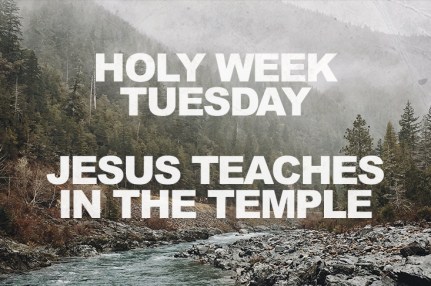
Tuesday in Holy Week

“…as he was walking in the temple, there come to him the chief priests, and the scribes, and the elders,”-St. Mark 11:27.

A leave-taking has generally something of sadness about it; but more so if anyone has from pure love and affectionate interest been striving for the good of others.  However, if they have persistently rejected his endeavors and scornfully refused his aid, the sorrow with which he parts from them in their misguided blindness, will be great indeed. Such was the sorrow which the Lord Jesus felt. We hear that “He departed and did hide Himself from them.”

First, however, He spoke to them solemnly and plainly of their hypocrisy, hardness of heart, selfishness, and spiritual pride.  He pronounced woe again and again upon the scribes and Pharisees on account of these faults.

His burning words passed at length into tones of the most tender compassion. “O Jerusalem, Jerusalem,” He exclaimed, “how often would I have gathered thy children together, and ye would not.” He would have gathered them, and they would not be gathered. Even now He pursues with tender entreaties and solemn warnings: “Ye shall not see Me henceforth, till ye shall say, Blessed is He that cometh in the name of the Lord.” Then, He turned sadly away and departed. He had still much teaching for His disciples, but as regards the people His ministry of teaching was now over. He would have gathered them, but they would not be gathered.

A day will come when, if I have never sought Him, He will thus turn away from me also. I may be as they were, moral, respectable, and outwardly religious. Yet, He turned away from them, and He may turn away from me. He turned away from them because their religion did not consist in the love of God and of man.  He turned away because they were incapable of faith and moral earnestness.  Finally, He turned away because they had the form of godliness only, and while they cared much for the praise of men they thought little of the glory of God.

Prayer

Draw me, O Lord Jesu Christ, that I may seek Theo with my whole heart, and fill me with truth and love, I beseech Thee. Amen.


Read Full Post »

« Newer Posts - Older Posts »