Feeds:
Posts
Comments

Archive for the ‘Uncategorized’ Category


george_macdonald_1860s

Some thoughts relating to the Wedding Feast of Cana by George MacDonald from THE MIRACLES OF OUR LORD

“I wonder how many Christians there are who so thoroughly believe God made them that they can laugh in God’s name; who understand that God invented laughter and gave it to his children. Such belief would add a keenness to the zest in their enjoyment, and slay that sneering laughter of which a man grimaces to the fiends, as well as that feeble laughter in which neither heart nor intellect has a share. It would help them also to understand the depth of this miracle.

The Lord of gladness delights in the laughter of a merry heart. These wedding guests could have done without wine, surely without more wine and better wine. But the Father looks with no esteem upon a bare existence, and is ever working, even by suffering, to render life more rich and plentiful. His gifts are to the overflowing of the cup; but when the cup would overflow, he deepens its hollow, and widens its brim. Our Lord is profuse like his Father, yea, will, at his own sternest cost, be lavish to his brethren. He will give them wine indeed.”

Read Full Post »

Four Last Things


heaven-hell

Over Advent, we have been pondering the “Four Last Things”-Death, Judgment Heaven and Hell.  I have been asked to post at least the sermon on Heaven which will be heard this morning, and Hell, which is next’ week’s topic.

I have never been keen on posting my sermon notes, as, frequently, the words come out in a very different form than the text. I learned years ago that if the Holy Spirit wants a different homily than the text I have prepared, I do best to go with His promptings. However, here is the written text for today, with no warranty express or implied.

SERMON FOR THE THIRD SUNDAY IN ADVENT-2016

(Given at St. Alban’s, Richmond, Virginia)


“Verily I say unto you, Among them that are born of women there hath not risen a greater than John the Baptist: notwithstanding he that is least in the kingdom of heaven is greater than he.”

-St. Matthew 11:11


Here we are at last on Rose Sunday, the Third Sunday in Advent which used to be called “Gaudete Sunday.” Gaudete is the Latin word that means “rejoice,” but with the ending that makes it a command. So we are really being commanded to rejoice.

But, we human beings have a fairly ambiguous attitude towards life after death. There is the story of a fellow talking with a woman whose close relative had only recently died. Trying to be sympathetic, the man asked this lady, “What do you suppose has become of her? The woman replied, Oh I’m sure she’s enjoying everlasting bliss – but I wish you wouldn’t talk about such unpleasant things!”

You know, you have to be sure you really want to go to heaven. People who have not much cared for God in this life – why should they want to be closer to him in the next?

Certainly in heaven there will be God and I am certain the music of Bach.  Even this will cause trouble, because a lot of people will prefer Lady Ga Ga to Bach. If heaven means we all get rewarded with the things we love best, it looks as if heaven and hell will have to be the same place: for one man’s meat is another man’s poison.

There are so many difficulties here. In fact, it’s just about impossible to form a picture of heaven, because we are bound to think in terms of space and time. Heaven is not in time and it isn’t a place. It is beyond time and space: eternal. When we think of our lives, our being, we have to think of being somewhere and at a particular time. But truly when we die and leave this world, we leave space and time too. So being, life, existence in heaven must be very different from what they are down here.

Heaven won’t be like going to church all the time. There is a lovely hymn in the English Book Hymns Ancient & Modern where it says: “So, Lord, at length when Sacraments shall cease.”  Yes, even the Sacraments will come to an end.

As you know from your Catechism in the Book of Common Prayer (page 581), “A Sacrament is an outward and visible sign of an inward and spiritual grace. So when we are in that eternal state of spiritual grace, we shall not require the outward and visible sign.”

When we speak of heaven, we are attempting to speak about our spiritual state of being beyond time and space.  So, all our language necessarily has to be metaphorical. We just can’t express supernatural realities directly in natural language.

Even Scripture itself is limited to soaring metaphors and the difficulties of expression of the most Divine in human words. We get incredible pictures of beasts with hundreds of eyes, angels and archangels, the Tree of Life and a stream flowing from the throne of God. The Bible is written in natural language, so not even the Bible can tell us completely what heaven is like and all of its glories.

There is another way of knowing. Think of this: if heaven is beyond time and space, if it is infinite, then there is a sense – though our language here is close to breaking down – in which we are there already. Or, if I may so put it, a sense in which we have been there. For if heaven is an eternal state, then to be there is to be there eternally.

We have intuitions of this truth-what the poet William Wordsworth called intimations of immortality:

Our birth is but a sleep and a forgetting: The Soul that rises with us, our life’s Star, Hath had elsewhere its setting, And cometh from afar: Not in entire forgetfulness, And not in utter nakedness, But trailing clouds of glory do we come From God, who is our home

Trailing clouds of glory.  Because God made this material world and because he was incarnate in it in his Son, we must expect the material world to contain something of the eternal world, heaven, God’s everlasting abode. This universe of ours is material, but it is not merely material.  As poet and priest Gerard Manley Hopkins put it:

The world is charged with the grandeur of God…. Because the Holy Ghost over the bent World broods with warm breast and with ah! bright wings.

Remember Our Lord promised that the Holy Ghost would bring all things to your remembrance.

This experience is not just for poets. Beloved in Christ, let me  ask you to reflect on the fact that you and I, each one of us, knows it in ourselves. Imagine you are on a weekend out in the Shenandoah Valley—out in the country near to the mountains. You awake in the pale dawn light in a silent room. It is a high room with oak beams. You go downstairs and open the door. You feel the rush of the fragrant air and from as far as you can see into that mist and the dampness clinging to the fields, there comes the calling of birdsong.

You can barely make out the watery colors of the landscape can hardly be made out. The pale disc of the sun lies behind the racing clouds.

What do you feel?  Doesn’t this give you an exquisite sensation– something like joy, something like peace: but you can’t quite put it into words exactly.  Coming at you out of the beauty of the scene, there is something like recollection.  Such experiences I think are gifts of God sent for our encouragement; they are intimations of immortality.   They are the natural presences which both hide and reveal the eternal presence of God.

Shortly after my mom passed away, I was wandering around my parent’s house one afternoon, just after lunch.  I went upstairs into the front bedroom. It was very quiet, and her things were still there.   I noticed the sunlight on the dressing table, and I had a warm, reassuring sense of presence again.  I didn’t want to leave the bedroom. As Fr. Hopkins said, it was the sense of deep down things. A reality beyond appearances.

Beloved in Christ, God leaves his footprints and fingerprints all over the place. Why do we know that music is not just melody, rhythm and harmony – but there’s something hanging around in there that excites us, that thrills us or even makes us cry? You know the feeling of these encounters. It’s one like this: “Your hair’s standing up on end, shivers going down your spine, a lump coming into your throat, even tears running down your eyes.”  It’s called an appoggiatura, from the Italian word “to lean.” And while it’s tough to define, it’s not unlike a grace note, a note in many forms of music that is ornamental yet produces beauty.

We may react like this to the Bach Double Violin Concerto. The slow movement of Schubert’s String Quintet in C – where Schubert almost stops the music altogether. The utterly sublime music of Purcell and the words from the 1662 Prayer Book that go with it: Thou knowest Lord, the secrets of our hearts: shut not thy merciful ears to our prayer.

Human beings have a need to express what is beyond them. We are possessed of a deep sense of the mysterious. This is why we developed all the arts including poetry and music. So look at one of the most famous and earliest experiences of the divine mystery; Isaiah’s vision of God in the temple when he saw the Lord high and lifted up. Isaiah’s response is to utter a few words in a certain rhythm:

Holy, holy, holy is the Lord of Hosts: the whole earth is full of his glory.

          And out of this little utterance the Church developed the most ecstatic prayer in the Mass:

Sanctus, Sanctus, Sanctus Dominus Deus Sabaoth: pleni sunt coeli, et terra Gloria tua

Holy, Holy, Holy Lord God of Hosts: heaven and earth are full of thy glory.

And these few words in a certain rhythm have captivated the great composers for centuries.

Miraculously in such works we find that what we thought inexpressible is expressed. And we understand through being overwhelmed – exactly as Isaiah was overwhelmed in his original vision. You remember his response:

Woe is me, for I am undone

We find these intimations of the eternal world everywhere. In just a line of music: sounds and sweet airs that give delight and hurt not. Or, we may find it in the voice of the hidden waterfall or the laughter of children in the yard or that feeling when you love really someone.

The presence of God is subtle. The reality of eternity is half hidden and half revealed.  Remember the couple on their way to Emmaus on the first Easter Day?  Their eyes were holden that they should not know him. Until later: He took bread and blessed it and brake and gave to them…and he was known of them in breaking of bread.

In all these ways, God seeks to reassure us and show us the reality of heaven, half hidden, half revealed in the things of this earth. As usual, St Augustine puts it better than anyone:

But, what do I love, when I love Thee? Not the prettiness of a body, not the graceful rhythm, not the brightness of light (that friend of these eyes), not the sweet melodies of songs in every style, not the fragrance of flowers and ointments and spices, not manna and honey, not limbs which can be grasped in fleshly embraces – these I do not love, when I love my God. Yet I do love something like a light, a voice, a fragrance, food, embrace of my inner man, wherein for my soul a light shines, and place does not encompass it, where there is a sound which time does not sweep away, where there is a fragrance which the breeze does not disperse, where there is a flavor which eating does not diminish, and where there is a clinging which satiety does not disentwine. This is what I love, when I love my God.

Then we find ourselves in Heaven.

Let us pray (John Donne),

Bring us, O Lord God, at our last awakening into the house and gate of heaven, to enter into that gate and dwell in that house, where there shall be no darkness nor dazzling, but one equal light; no noise nor silence, but one equal music; no fears nor hopes, but one equal possession; no ends nor beginnings, but one equal eternity; in the habitations of thy glory and dominion, world without end. Amen.


The Rev. Canon Charles H. Nalls


Read Full Post »


imagesCAOYT9DF

With the evening hours coming earlier and the darkness of the world that seems encroach at an ever-increasing degree, I thought a word or two about light, or lights in the church might be appropriate. Light is something that most people take granted. Absent the effects of a storm, we hardly give it a second thought. The need for light is fundamental, and there can be no life without light. Indeed images of light and darkness recur throughout the Bible.

In the beginning “The earth was without form and void, and darkness was on the face of the deep.” The very first action of God in creation was to say, “‘Let there be light’; and there was light and God saw that the light was good.” (Genesis 1:2-3)

In the New Testament, light is a key image particularly in the Gospel according to St. John where he describes Our Lord as “the light.” Not the light created by God, but the Creator Himself! Our Lord, too, uses the image of light to teach His disciples, when He says that we should shine as lights exposed on hilltops, and not hide our faith under buckets.  So it is appropriate that light, or lights, forma a significant part of our liturgy in the Church in accordance with Holy Scripture.

Candles in Church

Let’s begin with the Pascal Candle which can be found in most churches, and it is easy to identify. It is likely to be taller and of greater circumference than  any other candle in the church, but it the only candle to be decorated either with a decal or by being painted. From Easter to Pentecost, or Whitsunday, it will be in a prominent position in the Sanctuary near the High Altar.

The Pascal Candle is named after the PASCH, the passion, death and resurrection of the Lord. The candle is blessed at the Easter Vigil, and represents Christ the light of the world. The Easter Vigil includes the first Eucharist of Easter, and is a dramatic re- presentation of the mysteries of creation and redemption. It begins in total darkness, but ends in a flood of candle-lit glory!

Two of the Vigil ceremonies are of particular interest. First, immediately after lighting, the Pascal Candle is carried in procession through the darkened church. As the Pascal Candle approaches the Choir, the priests and congregation in turn light candles they are holding from the Pascal Candle, and, in turn, from each other. This is a powerful image of evangelism-the way in which we come to share in the living light of Christ, and also fulfill our commission to spread that light throughout the world.

Secondly, the Pascal Candle is taken in procession to the font, where, using the candle as a symbol of Christ, waters of Baptism are blessed as the candle is dipped three times into the font. This reminds us that in Baptism we enter into the tomb of death with Christ, only to rise again with Him, whose Resurrection we are about to celebrate.

After Pentecost the Pascal Candle is generally is set aside in the Baptistry for use during Baptism.  It will make another appearance in the Sanctuary from Christmas Vigil through the Epiphany.

Altar Candles and Processional Lights.

The number of candles used to decorate altars varies, but traditionally they are in combinations of two, four and six. A useful rule of thumb is that the more candles, the more important the altar is likely to be. Side, chapel and Lady Chapel altars normally have two, or sometimes four candles (two being lit for low mass, all four only being lit on high feast days). The High Altar would have anything up to six candles.  A seventh candle appears when a bishop is present.

The obvious symbolism is that the altar represents the throne of God, from which the light of Christ shines upon His gathered people. You may also find it helpful to meditate upon what the number and arrangement of the candles might suggest.

Candles carried in procession are a simple, but effective way of honoring both the cross which they accompany, and also the priest as he represents the person of Christ. Their use adds both dignity and color to the Church’s worship.

Baptism Candles

Many priests in the Anglican Catholic Church present a lighted candle to the newly baptized person or their God parents at a certain point during the rite.  The baptismal candle is lit from the Pascal Candle symbolizing that, through Holy Baptism, the newly baptized person shares in the life of the Risen Lord, represented by the Pascal Candle. The words which accompany the giving of the candle can also point out an important meaning: “Receive the light of Christ, that when the bridegroom cometh thou mayest go forth with all the Saints to meet Him … ”

Sanctus Light, or Presence Lamp

 This is a light that burns when there is any “reserved sacrament” near the altar in the Tabernacle, which is located in the center of the Altar at St. Alban’s.  The presence light is near to the Altar at the left or Gospel side. The presence light is extinguished on Good Friday after the Mass of the Pre-Sanctified as there is no reserved Sacrament in the Tabernacle.

 Prayer or Votive Candles

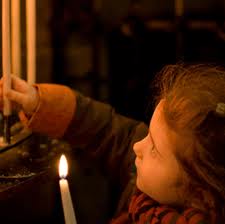
Many parishes have a stand for holding votive or prayer. If you do, or when you go into a church that does, one will usually be found near a statue/shrine of a Saint or near to the Reserved Sacrament. Lighting a candle in prayer is a powerful symbol, full of meanings.

Here are some “bright” ideas:

  • The lit candle reminds us of our Baptism, and the way that we share in the life of Christ by sharing in the life of the Church. When we depart from the place leaving the burning candle behind, we are reminded that our souls never leave the presence of God, in company with His Saints.
  • Prayer is not self-centered, it is God centered, and an important element is prayer for other people and causes. When lighting your candle, it is a good idea to light a candle for those others you want to pray for.

The candle is absolutely not a substitute for the prayer of your heart, but an accompaniment. It is a small offering which, in honoring a Saint and giving glory to God, speaks both from the heart and to the heart. Lighting votive candles in church, when asking the prayers of the Saints and thereby to the greater glory of God, is growing in popularity in the Anglican Catholic Church.

It is a devotional practice in which many millions of Christians the world over have found inspiration.

-with thanks to All Saints (ACC) Janesville, WI


Read Full Post »


church-business-meeting-68179

First, my thanks to all who worked so hard to put together the parish annual meeting, and congratulations to our new vestry members and synod delegates.  As well, to all who provided for an extraordinary post-meeting lunch, what a wonderful meal you provided.  It was a great time of fellowship and renewal for the coming calendar year of work for Christ in our parish community.

For parish news, meditations and upcoming events, please click on the link to our parish newsletter The Verger. verger12

cartoon-length


Read Full Post »

Serialized


classic-books

Over the last few years, I have begun a series of book manuscripts with the best of intentions. Several of these are re-writes or updates of old favorites such as Why I am an Anglo-Catholic, and others are entirely new.  With the exception of Prayer: A Field Guide which has been on the market for some years now and a just completed version of The Book of Occasional Offices, these all have languished unfinished despite my best intentions. (Or, at least some sort of intentions!)

I suppose that I could find endless reasons to keep procrastinating.  There is the usual stuff of the busy life: “I have a parish to look after.”  “I have chores to do.”  (Those who have seen the lawn at St. Swithun’s rectory will understand the absurdity of this latter one.) In my case, the excuses can be even more unusual, such as publisher of my last book disappointing me and my potential readers by having the audacity to to bankrupt the day of the announced release date.  I can only hope it was not my manuscript that pushed them over the edge!

So, I was staring at the directory containing these various gems in the rough and vowing to “get down to it.”  But, after a number of cups of coffee and several rounds of solitaire, nothing was happening on the old keyboard.  Along about the time I actually considered going to the gym to escape the writer’s block, a well-meaning friend send me an aphorism by St. Augustine of Hippo, “God has promised forgiveness to your repentance, but He has not promised tomorrow to your procrastination.”   Quite convicting, that, in a real and very theological way.

So, I am looking at the catalogue and deciding which of these long delayed books to put out in serial form here on the blog.   Of course, there are dire warnings about sales of the finished product being impaired, the threat of stolen ideas and any number of reasons that would lead to further procrastination.  As Nina Amir notes in Blog Your Book, the process of writing a serial version of the manuscript forces one to get the job done.  Additional or new content can make the blogged version salable in print if that is the end game.  Here, the end game is to get some of this work finished at long last, but, if there is a royalty or two, they would be most welcome.

In any event, these works will be done under the auspices of the Bp. Charles C. Grafton Institute, a tax-exempt organization.  In the next several weeks, PayPal links will appear here and on a new Grafton site if people wish to support the work with deductible contributions.  In turn, the sums received can go to bringing out print versions of the books and to defray the expenses of the websites themselves or to support other programs such as continuing clergy education or traveling seminars for parishes.

So watch this space.  Please remember that the material is copyrighted and respect the author’s work, and we’ll see whether that copy of Blog Your Book was worth the price!

Read Full Post »


Carmina.jpg

A prayer today from the Carmina Gadelica, which is a treasure trove of ancient Christian hymns and prayers from throughout the British Isles.

JESU, Thou Son of Mary,

Have mercy upon us,

              Amen.

Jesu, Thou Son of Mary,

Make peace with us,

              Amen.

Oh, with us and for us

Where we shall longest be,

              Amen.

Be about the morning of our course,

Be about the closing of our life, 

              Amen.

Be at the dawning of our life,

And oh! at the dark’ning of our day,

              Amen.

Be for us and with us,

Merciful God of all,

              Amen.

Consecrate us

Condition and lot,

Thou King of kings,

Thou God of all,

              Amen.

Consecrate us

Rights and means,

Thou King of kings,

Thou God of all,

              Amen. 

Consecrate us

Heart and body,

Thou King of kings,

Thou God of all,

              Amen.

Each heart and body,

Each day to Thyself,

Each night accordingly,

Thou King of kings,

Thou God of all,

              Amen.

Read Full Post »


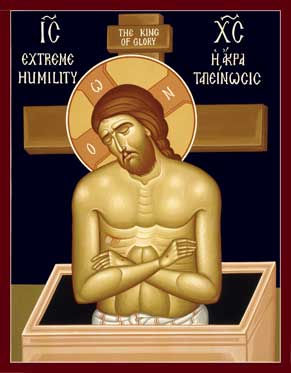
supreme-humility

Shortly after coming to St. Alban’s nearly seven years ago, I built a small chapel in an unused classroom on the far side of the building.  Over the years it has been used as a penance chapel as it has our confessional, as well as a tabernacle for the Reserved Sacrament (Altar of Repose) during Holy Week.  Otherwise, it has gone largely unnoticed.

Several weeks ago, Fr. Seraphim came from St. Simeon’s skete in Kentucky to lead our pre-Advent retreat for the diocese here at St. Alban’s.  He brought to us the powerful teachings of the Remnant Rosary. Information about this teaching, which is at once a devotion, meditation and spiritual discipline, can be found on the pages of the  Nazareth House Apostolate, of which the skete is the physical part.  It is a must visit site, and I urge all who follow the like to carefully read all of the pages and then make a generous contribution to this extraordinary work of Christ.

Now, that I have gotten the advertisement past, I want to note that a number of the retreat participants already have adopted the Remnant Rosary into their spiritual practice.  It is not easy at first to do so, but nothing that really builds one up is.  Surely, the prayers of the beads are not hard to learn, but the difficulty comes in their convicting nature.  In this upcoming season of Advent, the enormity of the Incarnation is not easy to face if taken seriously, and the Remnant Rosary calls those who sincerely pray it squarely into the sheer power of the event and of the race that Jesus would run for us-a race that led up Calvary to the Cross and beyond the grave.

So it was, over these last two weeks, I sort of “fiddled about” with the beads that Fr. Seraphim had given me and the small booklet that accompanied them.  One can “breeze” through a regular Rosary in a way that can become quite wrote and perfunctory. (One should not, of course, but familiarity can result in laxity.)  However, the Remnant Rosary invites the person that prays it into a deeply personal entry in to the Holy Mysteries.  One is called to internalize the Mysteries and to “take in” Jesus in a way that is quite profound-Eucharistic in a very meaningful way.  It is that sort of intimacy, I believe many people are uncomfortable with even though Christ invites us into that level of relationship.  One need only to examine how many people receive the Sacrament in a perfunctory manner to get my point here. (Here, I invite you to think about the “receive and run” folks who don’t even wait for the Benediction to head for the parking lot.  If, however, this describes you, stop it!)

So, after Matins, I felt sufficiently prepared to take on and engage the Remnant Rosary, and, for some reason, was drawn to the little chapel for a first attempt.  If you already pray the Rosary, the Mysteries are familiar.  The depth of the meditations, though, are not.  Taken seriously, this combination of prayer and meditation moves one swiftly from chronos (actual time) to kairos, (God time), just as the Remnant Rosary book notes.  To borrow from Fr. Seraphim, “Ultimately [this] Rosary has no goal, only depth.  The mysteries are a shoreless ocean, we are a wave ant the Rosary is the current rooted in the depths….Here we ‘see the works of the Lord and His wonders in the deep’ (Ps. 107:24).”

As I prayed the Joyful Mysteries, I happened to glance at the icon of Supreme Humility and that sense of depth cane home with incredible force.  It is a sense that the shadow of the Cross hangs across the Christmas crib, and both bind Heaven and earth together in the life of Christ.  Advent heralds Good Friday which, in torn, anticipates the Resurrection, all bound up in the life of the Master expressed throughout in Supreme Humility.

This Advent, I would invite you either to “try out” Remnant Rosary or to pray the familiar Rosary with a new attention to its depth.  Include short meditations on each bead, rather than breeze through the devoting to rest satisfied in the fact that you simply have “gotten through” another set of Mysteries.  Personalize each bead, and take in the enormity of each event.  Any worry of time spent (which should not be a concern in prayer) will simply disappear when you let down your spiritual net into the depths for a draught.  And always keep before you the vision of the Supreme Humility that has redeemed the world.


Read Full Post »


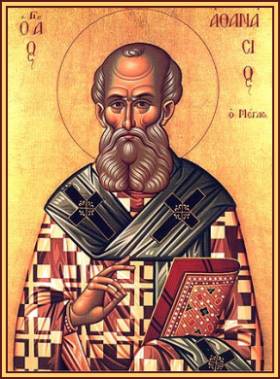
st-athanasius

On the Sunday Next Before Advent, we began a new Sunday study I have tentatively called “Approaching the Incarnation.” Amid the incredible noise of the commercial “holiday season”, we do well to step back into the quiet of a darkened hillside and contemplate the enormity of the coming Feast of the Incarnation. As God breaks into the world, we should be humbled and brought to our knees by his very purpose in doing so.

In On the Incarnation, our main Advent study text, St. Athanasius succinctly gives us the real news of Advent: “The Lord did not come to make a display. He came to heal and to teach suffering men. For one who wanted to make a display the thing would have been just to appear and dazzle the beholders. But for Him Who came to heal and to teach the way was not merely to dwell here, but to put Himself at the disposal of those who needed Him”  What a powerful thing to contemplate this Advent!  Our Lord came to put Himself at our disposal as the ones who need him most.

The saint goes on to say that the result is that,  “The Self-revealing of the Word is in every dimension – above, in creation; below, in the Incarnation; in the depth, in Hades; in the breadth, throughout the world. All things have been filled with the knowledge of God.”  Will we spend another Advent season oblivious to that total penetration of the world by the knowledge of God, and, instead, squander these weeks with the mundane, the banal or the material?

Truly, Advent is a time to understand that we have an Incarnate, living Jesus.  Truly, ours is a “…Savior [who] is working mightily among men, every day He is invisibly persuading numbers of people all over the world, …to accept His faith and be obedient to His teaching. Can anyone, in face of this, still doubt that He has risen and lives, or rather that He is Himself the Life? Does a dead man prick the consciences of men, so that they throw all the traditions of their fathers to the winds and bow down before the teaching of Christ?”

So, today, in addition to the Angelus, let us offer a Prayer of Thanks for the Incarnation

Jesus, You came to earth from heaven to take on flesh and dwell among us. You became the supreme example of God in the flesh, pouring out Your grace upon grace. In Your humanness You were victorious in the raging battle against the spiritual forces of evil when faced with temptations and trials common to all people. We stand in glorious victory as we follow Your example and hold to Your unchanging truths. We come alongside those who are grieving loss and enduring heartache in the midst of this glorious season, for it is in keeping with the season of giving, that we give ourselves in faithful prayer toward these in grief. It is in the loving name of Jesus that we pray. Amen. 

Texts for St. Alban’s Advent Study: Main-On the Incarnation, St. Athanasius; Supplemental-Living Jesus, Luke Timothy Johnson.


Read Full Post »


2-peter

Our Wednesday Bible study has moved from First to Second Peter as we approach Advent.  Verses 5-11 of the first chapter form an interesting “ladder” describing growth in the spiritual life.

The text begins, of course, in verse 5 with faith to which we are to add virtue.  To virtue, we are to add knowledge.  In turn, St. Peter admonishes that we add temperance to knowledge, patience to temperance and Godliness to patience.

This progression allows the believer to break through to “brotherly kindness”, and, finally to charity.

Keeping to this pattern leads to growth, particularly in the knowledge of our Lord Jesus Christ. Finally, as knowledge enhanced by the cardinal virtues grows, we return to the “everlasting kingdom of our Lord and Saviour Jesus Christ.”

Read Full Post »


faith-and-politics

On Tuesday, November 8th, we will go to the polls in a national and local elections.  I have been repeatedly asked to address the question of the election and the candidates. Up  to today,  I have not done so from the pulpit, but have simply urged you to remember that one doesn’t take off one’s faith at the door of the polling place.  However, simply urging people to “vote their conscience” is neither helpful, nor very brave.  It is merely a lukewarm approach that, in the end, says nothing. After much prayer and thought on the matter, I feel that I must say something more to the parish given the matters at stake in the life of our nation this year.

In 2010, I began to rewrite an old and not well-known book The Kingdom of God and American Life.  One day, it may be completed, if not published. However, I would share with you a portion of a manuscript I pray will be helpful in this mean season.

Our politics for the past several years are a thing few of us in America can be proud of. While one may still cherish faith in American citizenship, the people have become weary of mere politics and “business as usual”. A quickened conscience among many has recognized that, even under democratic forms and methods, there have somehow arisen conditions that are palpably undemocratic, and is manifesting a push in some quarters toward the control of “human well-being”, or at least a particular notion of what may constitute human well-being.

Meanwhile, masses of our people are stirring in vague unrest and striving often aimlessly after they know not what—they know only that something is wrong and they are angry. On the other hand, many persons are only bewildered spectators.

We are wise to face the fact that the social question is ultimately a moral question. It is time to recognize that its solution lies not in biological analogies, not in the exaltation of the State at the expense of the individual, nor again in the destruction of government, but in that Gospel of the Kingdom of God which means the realization of certain ideals through the highest and fullest development of our Christian personality.  There are straightforward answers and approaches open to us.

As traditional Anglican Catholics, our movement was established with, and adheres to, the Affirmation of St. Louis. In 1977 an international congress of nearly 2000 Anglican bishops, clergy, and lay people met in St. Louis, Missouri in response to actions taken by the Episcopal Church (USA), that represented a move away from the apostolic faith as understood within the Anglican tradition. The object of this Congress was to determine the actions necessary to establish an orthodox jurisdiction in which traditional Anglicanism would be maintained. Indeed, we are privileged to have as a member of St Alban’s Dr. Robert Strippy, one of the drafters of the Affirmation. The Anglican Catholic Church, along with other “continuing” Anglican bodies uphold and maintain the belief and practice set out in this important document.

Of particular importance in the upcoming election is Article III of the Affirmation setting forth Principles of Morality.  I, as a priest, can offer you nothing more succinct or useful than to reiterate the language of this section, albeit with some emphasis here and there.

First, “[t] he conscience, as the inherent knowledge of right and wrong, cannot stand alone as a sovereign arbiter of morals. Every Christian is obligated to form his conscience by the Divine Moral Law and the Mind of Christ as revealed in Holy Scriptures, and by the teaching and Tradition of the Church. We hold that when the Christian conscience is thus properly informed and ruled, it must affirm the following moral principles:

Accordingly, from the perspective of individual responsibility, “All people, individually and collectively, are responsible to their Creator for their acts, motives, thoughts and words, since ‘we must all appear before the judgment seat of Christ . . .’” This is inescapable truth.

Next, we are to uphold the Sanctity of Human Life. As the Affirmation notes, “Every human being, from the time of his conception, is a creature and child of God, made in His image and likeness, an infinitely precious soul; and that the unjustifiable or inexcusable taking of life is always sinful.”  In this and all other regards, [a]All people are bound by the dictates of the Natural Law and by the revealed Will of God, insofar as they can discern them.” There can be no compromise.

These principles carry over into all aspects of family life, the family being the cornerstone of our community and nation.  There can be nothing clearer than the statement that, “The God-given sacramental bond in marriage between one man and one woman is God’s loving provision for procreation and family life, and sexual activity is to be practiced only within the bonds of Holy Matrimony.” Again, there can be no compromise.

Do we fall short?  Of course we do. “We recognize that man, as inheritor of original sin, is ‘very far gone from original righteousness,’ and as a rebel against God’s authority is liable to His righteous judgment.”  We also recognize, though, “that God loves His children and particularly has shown it forth in the redemptive work of our Lord Jesus Christ, and that man cannot be saved by any effort of his own, but by the Grace of God, through repentance and acceptance of God’s forgiveness.”

Ultimately, it is the Christian’s abiding duty to be moral.  “We believe, therefore, it is the duty of the Church and her members to bear witness to Christian Morality, to follow it in their lives, and to reject the false standards of the world.”

Beloved in Christ, nothing could be more straightforward than this.  Are economic issues of importance?  Of course they are.  However, for far too many years we have, as a nation, been led to focus on the aphorism, “It’s the economy, stupid.”  In fact, it is not.  Rather, “It is the morality.”  Without a good, decent and moral people, there can be no just political and economic system.

Personalities are personalities, and people come ant they go.  That is the nature of the human condition, private and civil.  They cannot, and must not be our guide. I can only urge you to examine the moral principles set forth in the Affirmation, to examine your hearts, and to pray.  We must ask an honest question of any candidate for political office and any political party. Do they stand for or against those principles? Let that be the end of inquiry.

I believe that there are singular and great destinies awaiting our country if, in the face of any and every doubt, difficulty and discouragement, our people return and remain true to the ideals and purposes of the Kingdom of God.

In Christ,

Canon Charles H. Nalls

Read Full Post »
« Newer Posts - Older Posts »