Feeds:
Posts
Comments

Archive for the ‘Uncategorized’ Category


Tenebrae

We precede the Triduum with Tenebrae (Latin for “shadows” or “darkness”) which is a religious service celebrated in Holy Week on the evening before or early morning of  Maundy Thursday.   Rich in symbolism, the service of Tenebrae incorporates the use of light and darkness to invoke the spiritual reality recalled within the prayer. For instance, as the service is celebrated (on the morning of Good Friday in its earliest days), the candles used for lighting are successively extinguished so that by the end only one candle is left burning. While the church found itself in darkness, the lone candle, the light of the one who would sacrifice himself for the life of the world, would remain and be seen as the light in darkness. Hope was restored for God’s faithful ones.

Tenebrae will begin at 6:30 pm.  At St. Alban’s, we use a somewhat shorter version as included below which you may feel free to use.  For chants from the Psalter, we use the notation from the Sarum Psalter Noted.  I have set the people’s portion of the antiphons in bold.

Blessings of Holy Week,

Canon Nalls

Tenebrae of Wednesday Evening

(Mattins & Lauds of Maundy Thursday)

The following are said by each worshiper in silence:

O Lord, open thou my mouth that I may bless thy holy Name;  cleanse also my heart from all vain, evil and wandering thoughts;  enlighten my understanding, enkindle my affections that I may be able worthily, attentively and devoutly to recite these Offices, and may be meet to be heard in the presence of thy divine Majesty;  through Christ our Lord.  Amen.

O Lord, in union with that divine intention with which thou thyself on earth didst render praise to God, I offer to thee these Hours.

The Lord’s Prayer

The Hail Mary

The Apostles Creed (page 15)

 The antiphons are said in unison; the psalms are read responsively.  One candle on the stand is extinguished at the end of each psalm.

Mattins.

Nocturn I.

[Antiphon 1]  The zeal of thine house hath even eaten me:  and the rebukes of them that rebuked thee are fallen upon me.

Psalm 69 (page 421)

[Antiphon 1The zeal of thine house hath even eaten me:  and the rebukes of them that rebuked thee are fallen upon me.

[Antiphon 2]  Let them be turned backward, and put to confusion, that wish me evil.

Psalm 70 (page 424)

[Antiphon 2Let them be turned backward, and put to confusion, that wish me evil.

[Antiphon 3]  Deliver me, O my God, out of the hand of the ungodly.

Psalm 71 (page 425)

[Antiphon 3Deliver me, O my God, out of the hand of the ungodly.

 Lesson 1:  Lamentations of Jeremiah 1.1

Nocturn II.

[Antiphon 1]  He shall deliver the poor when he crieth:  the needy also, and him that hath no helper.

Psalm 72 (page 426)

[Antiphon 1He shall deliver the poor when he crieth:  the needy also, and him that hath no helper.

[Antiphon 2]  They speak of wicked blasphemy:  their talking is against the Most High.

Psalm 73 (page 428)

[Antiphon 2They speak of wicked blasphemy:  their talking is against the most High.

[Antiphon 3]  Arise, O God:  and maintain my cause.

Psalm 74 (page 430)

[Antiphon 3Arise, O God:  and maintain my cause.

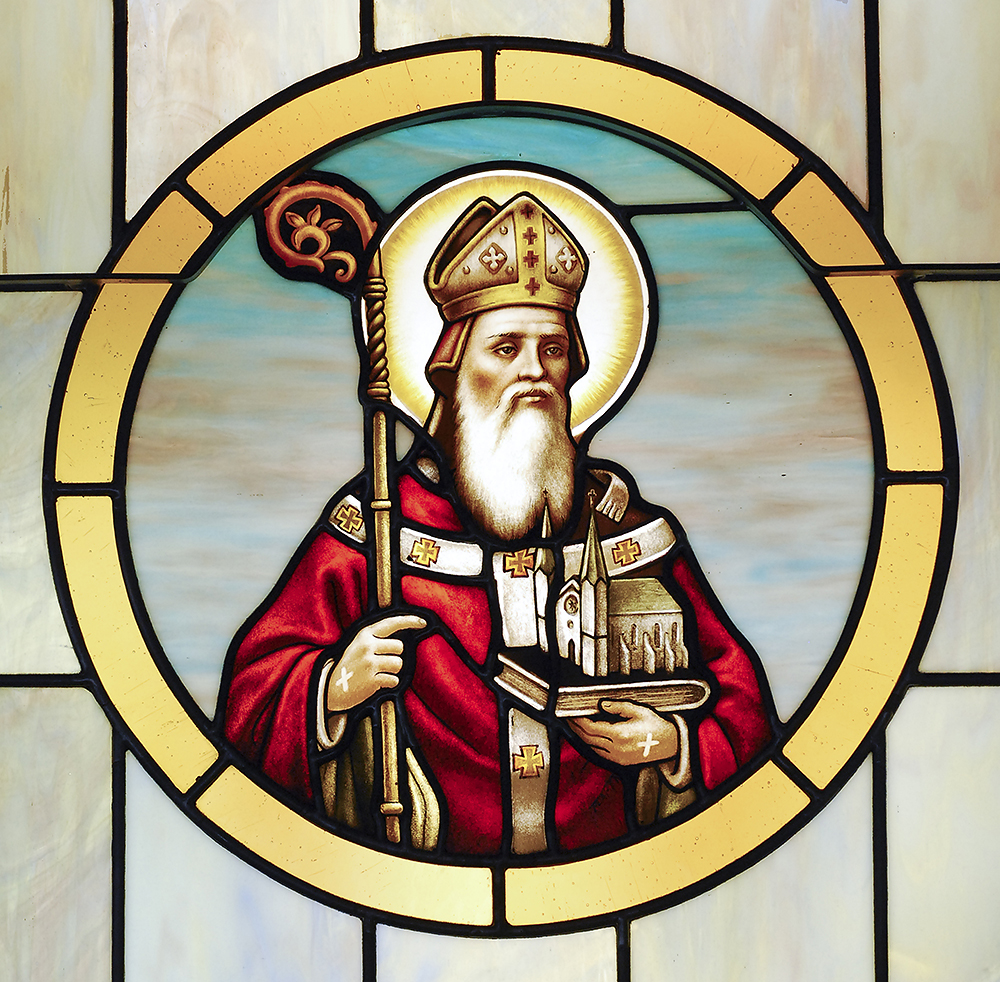
 Lesson 2:  From the Treatise on the Psalms  by St. Augustine the Bishop

 Nocturn III.

[Antiphon 1]  I said unto the fools, Deal not so madlyspeak not with a stiff neck.

Psalm 75 (page 431)

[Antiphon 1I said unto the fools, Deal not so madlyspeak not with a stiff neck.

[Antiphon 2]  The earth trembled, and was still:  when God arose to judgement.

Psalm 76 (page 432)

[Antiphon 2The earth trembled, and was still:  when God arose to judgement.

[Antiphon 3]  In the time of my trouble:  I sought the Lord.

Psalm 77 (page 433)

[Antiphon 3In the time of my trouble:  I sought the Lord.

Lesson 3: I Corinthians 11.17

  Lauds.

[Antiphon 1]  Mayest thou be justified in thy saying:  and clear when thou art judged.

Psalm 51 (page 403)

[Antiphon 1Mayest thou be justified in thy saying:  and clear when thou art judged.

[Antiphon 2]  The Lord as a lamb, is led to the slaughter, and he opened not his mouth.

Psalm 90 (page 453)

[Antiphon 2The Lord as a lamb, is led to the slaughter, and he opened not his mouth.

[Antiphon 3]  My heart within me is broken:  all my bones shake.

Psalm 36 (page 383)

[Antiphon 3My heart within me is broken:  all my bones shake.

[Antiphon 4]  Thy right hand, O Lord, is become glorious in power, who didst admonish us today to refresh ourselves in remembrance of thee.

The Song of Moses.  Exodus 15.1

I WILL sing unto the LORD, for he hath triumphed gloriously: the horse and his rider hath he thrown into the sea.

[2] The LORD is my strength and song, and he is become my salvation: he is my God, and I will prepare him an habitation; my father’s God, and I will exalt him.

[3] The LORD is a man of war: the LORD is his name.

[4] Pharaoh’s chariots and his host hath he cast into the sea: his chosen captains also are drowned in the Red sea.

[5] The depths have covered them: they sank into the bottom as a stone.

[6] Thy right hand, O LORD, is become glorious in power: thy right hand, O LORD, hath dashed in pieces the enemy.

[7] And in the greatness of thine excellency thou hast overthrown them that rose up against thee: thou sentest forth thy wrath, which consumed them as stubble.

[8] And with the blast of thy nostrils the waters were gathered together, the floods stood upright as an heap, and the depths were congealed in the heart of the sea.

[9] The enemy said, I will pursue, I will overtake, I will divide the spoil; my lust shall be satisfied upon them; I will draw my sword, my hand shall destroy them.

[10] Thou didst blow with thy wind, the sea covered them: they sank as lead in the mighty waters.

[11] Who is like unto thee, O LORD, among the gods? who is like thee, glorious in holiness, fearful in praises, doing wonders?

[12] Thou stretchedst out thy right hand, the earth swallowed them.

[13] Thou in thy mercy hast led forth the people which thou hast redeemed: thou hast guided them in thy strength unto thy holy habitation.

[14] The people shall hear, and be afraid: sorrow shall take hold on the inhabitants of Palestine.

[15] Then the dukes of Edom shall be amazed; the mighty men of Moab, trembling shall take hold upon them; all the inhabitants of Canaan shall melt away.

[16] Fear and dread shall fall upon them; by the greatness of thine arm they shall be as still as a stone; till thy people pass over, O LORD, till the people pass over, which thou hast purchased.

[17] Thou shalt bring them in, and plant them in the mountain of thine inheritance, in the place, O LORD, which thou hast made for thee to dwell in, in the Sanctuary, O Lord, which thy hands have established.

[18] The LORD shall reign for ever and ever.

[19] For the horse of Pharaoh went in with his chariots and with his horsemen into the sea, and the LORD brought again the waters of the sea upon them.

[20] But the children of Israel went on dry land in the midst of the sea.

[Antiphon 4Thy right hand, O Lord, is become glorious in power, who didst admonish us today to refresh ourselves in remembrance of thee.

[Antiphon 5]  He offered up himself because he did will it, who his own self bare our sins in his own body on the Tree.

Psalm 147 (page 522)

[Antiphon 5He offered up himself because he did will it, who his own self bare our sins in his own body on the Tree.

[Antiphon to Benedictus]  Now he that betrayed him gave him a sign, saying:  Whom I shall kiss, that same is he;  hold him fast.

            Benedictus(page 14)

One candle on the altar is extinguished at the end of every other verse.

[Antiphon to BenedictusNow he that betrayed him gave him a sign, saying:  Whom I shall kiss, that same is he;  hold him fast.

All:  Christ for our sake became obedient unto death.

The last remaining lit candle on the stand is hidden.

THE LORD’S PRAYER

Almighty God, we beseech thee graciously to behold this thy family, for which our Lord Jesus Christ was contented to be betrayed, and given up into the hands of wicked men, and to suffer death upon the Cross;  who liveth and reigneth with thee, in the unity of the Holy Ghost, ever one God, world without end.  AMEN.

The hidden candle is shown, and all leave in silence.

For your cnvenience

A Reading from the Treatise of Saint Augustine the Bishop on the Psalms

“Hear my prayer, O God; do not hide yourself from my petition. Listen to me and answer me. I mourn in my trial and am troubled.”

These are the words of one disquieted, in trouble and anxiety. He prays under much suffering, desiring to be delivered from evil. Let us now see under what evil he lies; and when he begins to speak, let us place ourselves beside him, that, by sharing his tribulation, we may also join in his prayer.

“I mourn in my trial,” he says, “and am troubled.”

When does he mourn? When is he troubled? He says, “In my trial.” He has in mind the wicked who cause him suffering, and he calls this suffering his “trial.” Do not think that the evil are in the world for no purpose, and that God makes no good use of them. Every wicked person lives either that he may be corrected, or that through him the righteous may be tried and tested.

Would that those who now test us were converted and tried with us; yet though they continue to try us, let us not hate them, for we do not know whether any of them will persist to the end in their evil ways. And most of the time, when you think you are hating your enemy, you are hating your brother without knowing it.

Only the devil and his angels are shown to us in the Holy Scriptures as doomed to eternal fire. It is only their amendment that is hopeless, and against them we wage a hidden battle. For this battle the Apostle arms us, saying, “We are not contending against flesh and blood,” that is, not against human beings whom we see, “but against the principalities, against the powers, against the rulers of the darkness of this world.” So that you may not think that demons are the rulers of heaven and earth, he says, “of the darkness of this world.”

He says, “of the world,” meaning the lovers of the world — of the “world,” meaning the ungodly and wicked — the “world” of which the Gospel says, “And the world knew him not.”

“For I have seen unrighteousness and strife in the city.”

See the glory of the cross itself. On the brow of kings that cross is now placed, the cross which enemies once mocked. Its power is shown in the result. He has conquered the world, not by steel, but by wood. The wood of the cross seemed a fitting object of scorn to his enemies, and standing before that wood they wagged their heads, saying, “If you are the Son of God, come down from the cross.” He stretched out his hands to an unbelieving and rebellious people. If one is just who lives by faith, one who does not have faith is unrighteous. Therefore when he says “unrighteousness,” understand that it is unbelief. The Lord then saw unrighteousness and strife in the city, and stretched out his hands to an unbelieving and rebellious people. And yet, looking upon them, he said, “Father, forgive them, for they know not what they do.”
 

Read Full Post »

Candlemas


presentation

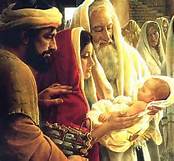
Today’s feast, known originally as the Feast of the Purification of the Blessed Virgin, the Feast of the Presentation of the Lord is a relatively ancient celebration. The Church at Jerusalem observed the feast as early as the first half of the fourth century, and likely earlier. The feast celebrates the presentation of Christ in the temple at Jerusalem on the 40th day after His birth.

Inspired by the words of the canticle (“a light to lighten the Gentiles”), by the 11th century, the custom had developed in the West of blessing candles on the Feast of the Presentation. The candles were then lit, and a procession took place through the darkened church while the Canticle of Simeon was sung. Because of this, the feast also became known as Candlemas. While the procession and blessing of the candles is not often performed in the United States today, Candlemas is still an important feast in many European countries, and we should look to recovering this great feast day this side of the pond.

O Lord Christ, yourself the temple of the heavenly city, and its light, and its surpassing splendor; Grant thatwe who in this earthly house offer to you our worship, may be brought in peace to the vision of your glory in heaven; where, with the Father and the Holy Spirit you live and reign, one God, now and ever. Amen.

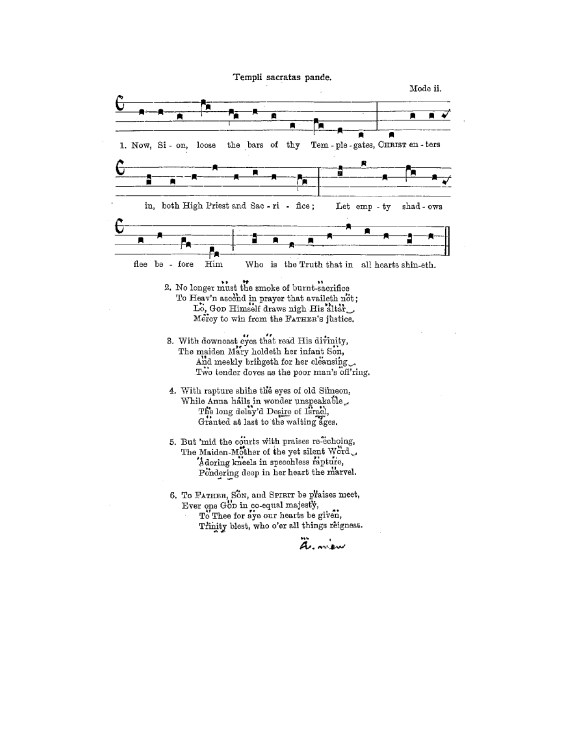
This morning’s sung Matins at St. Alban’s had some estraordinary hymns in addition to our readings from the Church Fathers. In addition to the Nunc Dimittis, our office hymn was the Plainchant version of  Templi sacratas pande (Mode II):Plainchant


Read Full Post »


Circumcision_PicEach year when I celebrate the Feast of the Circumcision, I am asked some variant of, “What’s up with this feast day?  Isn’t that kind of gross?”  For some reason, the modern mind, which is saturated with some pretty “earthy” images (and that’s just on awards programs), recoils at the mere mention of the circumcision of Christ.  I suppose I don’t understand the squeamishness, unless it is part of a general unease with a Christ Jesus who is too human, too real. Many would prefer a less vivid way to begin the year like commemorating the Holy Name, and avoiding all of that  messy blood spilling stuff.
Indeed, the modern secularist likes their Jesus hazy and indistinct, to the extent they pay any attention to Him at all.  A genuinely Incarnate Christ present in history might be evidence that all of that Christian stuff is true.  The God-Man is personal, all to real and might grow up to make claims upon a person, perhaps even call a soul to obedience and repentance in a very real way.  That’s precisely the point of marking this feast day.

There is a multi-layered theological message to this day.  One can approach it from the perspective of a fulfilling of the Old Law and the obedience inherent in a Bris. There is also a prefiguring of the shedding of blood that will result in mankind’s redemption at Calvary-a kind of first shedding of blood by Christ for us.  We are reminded that the shadow of the Cross falls across the Christmas Crib.  Well and good. These are powerful thoughts for the first day of a new year of our Lord 2016.

But, there is something much deeper that relates to the transformation of a Christian life.  It is the “circumcision of the heart”, the cutting away of sin that must accompany the truly transformed life in Christ.  To use a new year’s metaphor, it is out with the old in a visceral sense, and in with the new.  This morning’s Breviary readings address this in a  “Sermon by St. Ambrose the Bishop“:

So the Child is circumcised.  This is the Child of whom it is said: Unto us a Child is born, unto us a Son is given: or again: Made under the Law to redeem them that were under the Law: or again: To present him to the Lord.  In my commentary on Isaiah I have already explained what is meant by being presented to the Lord in Jerusalem, and therefore I will not enter into the subject again.  He that is circumcised in heart gaineth the protection of God, as it is written: The eyes of the Lord are over the righteous.  Ye will see that as all the ceremonies of the Old Law were types of realities in the New Law, so the circumcision of the body signified the cleansing of the heart from the guilt of sin.

But since the body and mind of man remain yet infected with a proneness to sin, the circumcision of the eighth day is meant to put us in mind of that complete cleansing from sin which we shall have at the resurrection. …

Today as we make (and possibly break) our new year’s resolutions, let’s take the message of this Feast of the Circumcision literally to heart and renew our work of circumcising from it the hardness of sin and look toward that complete cleansing-the washing that can only come by His most precious blood.

A blessed 2016 to all!

ALMIGHTY God, who madest thy blessed Son to be circumcised, and obedient to the law for man; Grant us the true circumcision of the Spirit; that, our hearts, and all our members, being mortified from all worldly and carnal lusts, we may in all things obey thy blessed will; through time same thy Son Jesus Christ our Lord. Amen.

Read Full Post »


Incarnatio

JOIN US FOR CHRISTMAS AT ST. ALBAN’S! 

 Just a few reminders. There will be weekday Matins sung on Christmas Day at 9:00 a.m. instead of 8:00 a.m. 

Been away from your parish home for awhile? This is a great opportunity to come home to the Christmas crib, worship the Incarnate Christ  and begin the new year with family!  

 CHRISTMAS EVE, DECEMBER 24, 2015

A SERVICE OF NINE LESSONS AND CAROLS-3:00 p.m. 

Make a joyful noise and join the choir and some outstanding musicians for the singing of traditional Christmas carols and the reading of the Christmas prophecies and the story of birth of Christ.

 VIGIL MASS AND HOLY EUCHARIST-10:00 p.m.

 CHRISTMAS DAY, DECEMBER 25, 2015

 Morning Prayer (sung)-9:00 a.m.Mass of Christmas Day (Holy Eucharist with Music)-10:00 a.m.

 Always remember that you’ve got a prayer at St. Alban’s…every weekday morning at 8:00 a.m.! 

 New Years confessions-please ring the Rector for an appointment. 


Read Full Post »


Wulfstan

Today, I’d like to share a sermon for the Second Sunday in Advent by Archbishop Wulfstan of York (d. 1023).

“There will be signs in the sun and the moon and the stars, etc.” This gospel says and makes clear that many portents must occur widely in the world, both in the heavenly stars and in earthly movements, before the judgment comes that is common to us all. And certainly, just as a flood came once before because of sin, so also a fire will come over mankind because of sin, and it is now coming very quickly. And therefore there are many and varied evil events occuring widely among people, and it is all because of sin. And yet more evils and afflictions will come, as the book says, than ever happened before anywhere in the world; that is, when Antichrist rages and terrifies all the world, and that is now coming very quickly. And therefore it is always the longer the worse in the world, as we ourselves know very well.

And it is also clear and to be seen within ourselves that we obey our Lord too weakly, and that we are too disbelieving of God’s might and his mercy, and that we anger him more often than we need to, and also that we keep good faith among ourselves too weakly in front of God and the world. And therefore many evil events injure and afflict us harshly, and foreigners and strangers severely oppress us, just as Christ clearly said must happen in his gospel. He said, “Nation will rise up against nation, etc.” That is in English, “nations will rise up,” he said, and become opposed, and strive violently and contend among themselves because of the injustice that has become too widespread among people on earth.”

Beloved people, this earth was clean at its creation, but we have since greatly fouled and defiled it with our sins. And our misdeeds also constantly accuse us, because we do not want to hold God’s law as we should, nor to grant to God what we should. Nor do we give tithes as is required of us, nor distribute alms as we need to, but in every way all that we should do in God’s grace lessens. And therefore much of creation also oppresses and strives against us, just as it is written: “the world will fight for God against insensible men.” That is in English, all the world strives greatly against proud people who will not obey God, because of their sins. Heaven strives against us when it sternly sends us storms that greatly injure cattle and land.

The earth strives against us when it withholds earthly fruits and sends us too many weeds. It is also written that the sun will grow dark before the world ends and the moon will darken and the stars fall because of the people’s sins, and that will be when Antichrist rages that it will be like as if it were so. It is said that the sun will grow dark; that is, when God will not reveal in Antichrist’s time his strength and his power as he often did before. Then it will be like as if the sun had grown dark. And the moon, it says, will darken. That is, that God’s saints will not perform any miracles then as they often did before. And the stars, it says, will fall from heaven. That is, that liars and false Christians will quickly fall from correct belief and eagerly bow down to Antichrist and honor his helpers with all their might. And then there will be the greatest terror that ever was, and the most widespread persecution in the world. Then kinsmen will not protect kinsmen any more than strangers.

And about that terrifying time Matthew the evangelist truly said thus: “In those days there will be such tribulations as have never been from the beginning of the world or afterwards.” That is in English, that such misery and affliction will then be in the world such as never before was nor ever again will be. And quickly afterwards all the hosts of heaven will be roused through divine might; and earthdwellers will be raised from death to the judgment. Then the one who before would not believe the truth will know that Christ in his majesty will repay each person for his earlier deeds.

Woe to the one who earlier earned the torments of hell! There are eternal flames grimly flickering and there is eternal horror; there is groaning and lamentation and perpetual wailing; there is each and every terror and a crowd of all the devils. Woe to the one who must dwell there in torment! It would be better for him if he had never become a man than that he come to this. For there is no one living who may tell of all the horrors that he must endure, he who falls entirely into that torment. And it is worst of all that no end at all will ever come for him in the world.

Alas, beloved people, let us do what is needful for us, protect ourselves earnestly against that terror and help ourselves while we may and might, lest we die when we least expect to. But let us love God above all other things and work his will as earnestly as we can: then he will repay us as will be most pleasing to us when we have the best need. To him be praise and glory in all the world, world without end, amen.

Read Full Post »


SPECIAL NOTICE-PARISH ANNUAL MEETING AND HOMECOMING DECEMBER 6, 2015
There will be a single service at 10:00 am followed by the annual meeting and all parish lunch.  Please plan to bring something for the lunch and let us know what you’s line to prepare either on the sign up sheet in the parish hall or by e-mail to stirenaeus@hotmail.com
Even if you have been away from your parish home for awhile, this is a great opportunity to catch up with “family” and learn of all the great things going on at St. Alban’s!  
 THANKSGIVING DAY-2015
Holy Eucharist-10:00 am
Parish Community Dinner-3:00 p.m.  Please bring a covered dish or a dessert.

Read Full Post »

A Powerful Sermon


St_-WillibrordOn this Seventh Day in the Octave of All Saints and the Feast of St. Willibroard, we do well to meditate on this powerful sermon by St. John Chrysostom, which is quoted in the Anglican Breviary.

“Whosoever wondereth, with reverent love, at the merits of the Saints, or whosoever speaketh, with oft much praise, on the glories of the Just, let him imitate their holy ways and their righteousness. For whoso findeth pleasure in the worthy deeds of any Saint should find pleasure in a like obedience in the service of God.

Wherefore, if he praise, let him imitate. If he will not imitate, let him cease from praising. For whoso praiseth another ought to make himself worthy of a like praise. And whoso admireth a Saint ought also to strive for to be admirable for a like holy living. If we love the righteous and faithful because we respect their righteousness and faith, we ought for that very reason to do what they did, in order that we may become what they are.

It is not an hard saying, that we imitate their good deeds. For we now have their examples, whereas they of old times had no foregoing examples; and so without being imitators of good examples, they nonetheless have become good examples to us. Thus, if we profit by them, others will profit by us, and Christ will ever be glorified, in a succession of servants of his holy Church. Begin at the beginning of the world, and consider these holy examples: Blameless Abel was slain; Enoch walked with God, and was seen no more, for God took him; Noah was found righteous; Abraham was proved faithful; Moses was the meekest of men ; Joshua was single-minded; David was mild; Elijah was taken up; Daniel was holy; and the Three Children were conquerors.

The Apostles, being disciples of Christ, are reckoned as the teachers of believers. Taught by them, the valiant Confessors give battle; the triumphant Martyrs excel in victory; and all the hosts of Christians, if they arm themselves with God, are ever vanquishing the devil. All these are men of like valour, though dissimilar in warfare, and so obtain glorious victories. Wherefore, O Christian, thou art an effeminate kind of soldier if thou thinkest to conquer without battling, or to triumph without struggling. Put forth thy strength. Contend like a man. Fight fiercely in thy battle. Know the warfare: the oath of loyalty thou hast taken; the conditions under which thou has been accepted; and the kind of war for which thou hast enlisted.

Read Full Post »


Flag_of_Jamaica_svg

Please join us at St. Alban’s on August 1 between 4:00 and 8:00 pm for a dinner sponsored by the Jamaican Association of Richmond.  Enjoy great Jamaican dishes such as jerk chicken and pork, curry chicken and curry goat and patties. There will be special desserts.  There is no charge, but donations for this wonderful meal are most welcome!

jerk chicken

Read Full Post »

No Ambiguity


ambiguity_road_signThe following is an homily preached by Abp. Mark Haverland at the recent International Catholic Congress in Ft. Worth, Texas.   Apparently, some in attendance were upset by it.  Perhaps, in a world of ambiguity, they were put off by the straightforward nature of the message.  As the Archbishop lays it out, there are “non-negotiables” in the catholic faith.  For all of the difficulties in continuing Anglicanism, we have stood fast in a time of change for the sake of change and an increasing ambiguity even in the case of those who claim orthodoxy or catholicity.  Particularly in the face of the increasing challenges facing orthodox Christians, the time is long past to compromise the Faith at any level.

Evensong, Forward-in-Faith/North America

15 July 2015

Psalm cxxxiii, verse 3 – Jerusalem is built as a city that is at unity in itself.

In the Name of the Father, and of the Son, and of the Holy Ghost.  Amen.

I was trained to believe that sermons are not meant primarily to prove or to instruct, much less to argue.  Rather sermons are primarily meant to proclaim:  to proclaim the Incarnation, the Cross, and the Resurrection of our Lord.  I hope this idea animates my Sunday Mass sermons.  But Evensong or Evensong and Benediction are somewhat different from Sunday morning.  We read in a delightful miscellany on the Church and clergy by A.N. Wilson of a priest who for forty years ‘preached on a variety of themes at his morning Mass, but thought it inappropriate, at…Benediction, to preach on any subject other than the Empress Josephine.’ (A.N. Wilson, ed., 1992, p. 240)   I don’t plan to be quite that bad.  But when Bishop Ackerman invited me last year to this event I told him that I would have to address what seems to me the central problem with most of the efforts of Forward-in-Faith and its precursors and now also with the ACNA.  I was invited nonetheless, so here is something with a bit of polemic in it, as promised.  I will not say with Trevor Huddleston that I have naught for your comfort.  But neither will I speak smooth things.

The central problem of which I just spoke is a lack of theological clarity and consistency and, to be blunt, catholicity.  That is a rather provocative assertion.  Let me offer an initial qualification, if not apology.  I know that the religious world is filled with huge problems which are of much greater apparent importance than the intramural fusses of soi-disant Anglo-Catholics.  In a world of resurgent and violent Islam and a secularizing America, our intramural differences may seem minor.  I do not wish to indulge in the sadism of small differences.  But then I happen to think that Anglicanism is central to the fate of the West, and that the near collapse of orthodox Anglicanism since the mid-20th century is at least indirectly tied to our wider troubles.  So, back to the question of theological clarity, which I do not think is in fact a minor problem.

The Anglican alternative to the paths taken by Forward-in-Faith and ACNA is Continuing Anglicanism.  Despite all of our checkered history and with all our failures, I think we Continuers have theological integrity.  That integrity is not a subjective or personal matter, but rests on an objective theological base, expressed clearly in the Affirmation of Saint Louis.  This foundation situates us irrevocably within the central Tradition of Catholic Christendom. All Anglican formularies are seen by the Affirmation through the lens of the central Tradition.  Anglican formularies are not a kind of Occam’s razor to limit what is acceptable in Catholic tradition for Anglicans.  Rather the Catholic consensus and central Tradition are the lens through which we read and appropriate our Anglicanism.  This central Tradition is found in the Fathers and the Seven Councils and in the consensus of East and West, ancient and modern and living still.  For us, the central problem of the Episcopal Church and of the Anglican Communion is not Gene Robinson or an error concerning any particular person or issue.  Rather the fundamental problem was an implicit assertion, decades ago, that the central Tradition of Christendom is at the disposal of Episcopalian Conventions or Anglican Synods or Lambeth Conferences.  It is not.  The Affirmation and my own Church’s formularies firmly, decisively, and forever reject doctrinal ambiguity, comprehensiveness, or the attempt to make our peculiarities decisive and determinative.  We are not Anglicans first and Catholics second.  We are members of the One Holy Catholic and Apostolic Church first, and Anglicans second.  We will vigorously pursue unity with all others who share this central belief.  No unity, at least no full or Eucharistic communion, is possible or desirable with those who do not share this starting point.

I congratulate the ACNA for leaving the Episcopal Church and Anglican Church of Canada.  Every one of you who made that change did a good thing and one, I hope, that you do not regret.  But that departure can only be a good first step.  For ACNA is really not a Church but a coalition of dioceses.  The coalition is for some purposes only, and the communion of the dioceses is impaired and imperfect.  The ACNA has retained the central flaw of the recent Lambeth Communion because it permits member dioceses to ordain women to the three-fold ministry, and therefore implicitly claims that the central Tradition is not decisive and may be set aside.  ACNA is not a return to orthodox Anglicanism, but only a return to the impaired state of the Lambeth Communion that began in 1975 and 1976.

Continued ambiguity or confusion about the central tradition and women’s ordination is very dangerous.  It is very dangerous because it encourages Catholic churchmen to compromise themselves in a variety of ways.  Perhaps just as bad, fine, bright, and consistent Catholics will perceive that there is no certain trumpet, no clear ecclesiology, and no real future in a world of such compromises – and so you will continue to suffer the death by a thousand cuts, as people go to Rome or Orthodoxy or the Continuing Church or just stay home.

There are excellent reasons to be both Catholic and Anglican.  Anglo-Catholics enjoy the great strengths of the Anglican patrimony.  We have the Authorized Version of the Bible and the classical Book of Common Prayer.  Together these are not only compelling literary and cultural monuments, but also provide us with an well-balanced spirituality.  In some Christian bodies the Bible is loosed from tradition and from the praying Church.  Of these bodies Richard Hooker wrote:

When they and their Bibles were alone together, what strange fantastical opinion soever at any time entered into their heads, their use was to think the Spirit taught it them.  (Laws, Preface, VIII.7)

The Prayer Book tradition in contrast provides an anchor, an objective interpretative lens, and a prayerful setting for traditional and orthodox interpretation of Scripture.  In other Christian bodies the sacraments have been loosed from Scripture and its constant fertilizing influence.  Scripture is neglected and the jewel of the Eucharist is pried loose from its golden setting in a round of offices centered on the systematic reading of Psalms and Scripture.  But for Anglican Catholics the sacraments are truly Scripture so prayed and read and presented as to be a large part of the very sacramental forms through which God pours forth his grace into our hearts.  In short, our tradition has an almost perfect balance of Bible and sacrament.  We begin with the Bible as presented in and with Common Prayer, but then add our Anglican patrimony of architecture, music, literature, spirituality, and theological method.  Those are formidable strengths.  How sad that so many neo-Anglicans have jettisoned the bulk of this patrimony by abandoning the classical Anglican liturgical tradition.

Dear friends, if you compromise with the ordination of women, and if you abandon the largest part of our Anglican patrimony by adopting modernist liturgy rooted in the Novus Ordo or, worse, in the Anglo-Baptist ideas of Sydney, there is little to hold people.  Then you can only trust in a kind of slightly more decorous imitation of Charles Stanley or the already-fading mega-churches.  You’ve given up both your Anglican past and also any future that can be meaningfully described as Anglican.

We must abandon all sectarian, provincial ideas that separate us from the central consensus of the Tradition of the great Churches.  We must take this duty seriously by systematically rooting our doctrine and practice in Catholic agreement.  Seven Councils, seven sacraments, invocation of the saints, objective sacramental efficacy, the Real Eucharistic Presence, clear moral teaching, male episcopate and priesthood and diaconate:  those are all matters of Catholic consensus.  That is what we must believe if we take seriously Archbishop Fisher’s assertion that we have no faith of our own.

The Catholic Movement in the Church of England began as an attempt to call all Anglicans back to the fullness of the Catholic Faith.  The goal was nothing less than the wholesale conversion of the entire Church to the fullness of the Faith.  The partial success of the Movement may have been its downfall.  When Anglo-Catholics became too successful to ignore or suppress, and were invited to the table to enjoy a share of the spoils – a percentage of the mitres and deaneries and professorships and plum parishes – Anglo-Catholics too often lowered their sights and quieted their voices.  From the conversion of the whole, we became satisfied with a slice of the pie, with a comfortable status as a recognized party.  But half-Catholic is as unreal as half-virgin.

If you still are in the Episcopal Church:  get out.  Get out today.  Anything else threatens your soul’s state.  Dear friends in ACNA:  you must present a clear and unmistakable demand.  The ordination of women must end, soon and completely, for it is directly contrary to Catholic doctrine.  No grand-fathering – or grand-mothering is possible – because such compromise leaves intact the central, revolutionary, and false implication that the deposit of the faith is negotiable and at our disposal.

Until there is such clarity, there will be no unity among those of us who like to think of ourselves as Catholic and Anglican Churchmen.  There will be no unity because you cannot be a pure cup of water in a dirty puddle.  That is the simple, basic message of the Continuing Church to the neo-Anglicans.  You have gone a very long way down a very wrong path, and that is true even if all the time you were avoiding a still worse path.  You have a journey home to make, things to unlearn and to remember and recover.  We want to welcome you at home.  But there can be no restored communion with us without hard decisions and firm actions from you.

Glory be to the Undivided Trinity.  Glory be to Jesus Christ on his throne of glory in heaven and in the Most Blessed Sacrament of the Altar.  All honor to the glorious and ever-Virgin Mother of our Lord.  Peace be to the Holy Churches of God.  May God forgive us our sins, which are many and great.  May God give us wisdom to discern a safe path forward.  May God grant us true humility and unshakable fidelity and great love.  May God bring our Church to glorious days and may he bring us to unity with all his holy people, so that Jerusalem may be as a city that is at unity in itself.

In the Name of the Father, and of the Son, and of the Holy Ghost.  Amen.

Read Full Post »


Tomorrow at St. Alban’s, a relic of the first class of St. Gregory Nazianzus will be on the altar from 0800-0900 during the morning office.  All are welcome for prayer and veneration of this extraordinary saint of the undivided Church. Gregory of Nazianzus also known as Gregory the Theologian or Gregory Nazianzen, was a 4th-century Archbishop of Constantinople. He is widely considered the most accomplished rhetorical stylist of the patristic age.[As a classically trained orator and philosopher he infused Hellenism into the early church, establishing the paradigm of Byzantine theologians and church officials. St. Gregory made a significant impact on the shape of Trinitarian theology among both Greek- and Latin-speaking theologians, and he is remembered as the “Trinitarian Theologian”. Along with the brothers St. Basil the Great and St. Gregory of Nyssa, he is known as one of the Cappadocian Fathers.

Almighty God, who hast revealed to thy Church thine eternal Being of glorious majesty and perfect love as one God in Trinity of Persons: Give us grace that, like thy bishop Gregory of Nazianzus, we may continue steadfast in the confession of this faith, and constant in our worship of thee, Father, Son and Holy Spirit, who livest and reignest for ever and ever.

gregory-of-nazianzus

Read Full Post »

« Newer Posts - Older Posts »