Feeds:
Posts
Comments

EXAMINATION OF CONSCIENCE


examination-of-conscience-for-littles

One of the great Anglican spiritual disciplines that has, sadly, fallen into disuse is the “examination of conscience”.  The daily examination of conscience, particularly during Lent, helps call to mind our sins and failings during a period of quiet reflection.  It is an essential before approaching the priest in Confession.

It’s important for a good examination of conscience to be thorough. This will help you learn about things that you may not be aware of. It’s also a chance to develop your conscience. To make an examination:

  • Set aside some quiet time for reflection.
  • Do not undertake an examination when you are overtired and/or at the very end of the day.
  • Start by praying to the Holy Ghost, asking for help in making a good examination to prepare for Confession.
  • Read through the items on this list and honestly reflect on your behavior for each item.
  • If necessary, take this list or some brief notes (keep them private!) to Confession to help you remember things.

A good examination of conscience traditionally follows the outline of the Ten Commandments or makes use of the outline of the deadly sins from your catechism.

Pride.

  1. Am I generally, or have I at any time allowed myself to be, proud of anything that I have, or of anything that I am, or of anything that I can do?
  2. Or have I tried with manly humility to remember thankfully that God has given me all that I have, and placed me in the position I occupy, and that to Him I owe such abilities as I possess?
  3. Have I despised any who are inferior in worldly possessions or social position, or in strength or ability, to myself?
  4. Have I been rude, contemptuous, or overbearing in my behavior towards such?
  5. Has pride hindered me in my worship of God, leading me to think that I am sufficient for myself and do not need Him, or by making me unwilling to humble myself before Him, by kneeling down in church, etc.?
  6. Have I taken God’s name in vain, or been guilty of swearing, or of using any profane or irreverent language?

Purity.

  1. Have I at any time defiled my mind by allowing any unclean thoughts to have place within it, or my lips by the use of any impure words or conversation, or my body by any indecent action of any kind?
  2. Have I indulged my appetite for food or drink, or any mere indulgence, beyond what is necessary and useful?

Anger.

  1. Have I quarreled with any one and not attempted to bring about a reconciliation?
  2. Am I generally apt to take offence, hasty in speech, and easily made angry?
  3. Am I accustomed to nurse my anger, and to remember in a revengeful spirit any wrong that has been done to me?
  4. Am I ill-tempered, cross, unkind, hard to please, and ready to condemn another?
  5. Am I harsh, domineering, vindictive, and slow to forgive?
  6. Have I hurt anybody either by taunting or scorn­ful words, or by blows, violence, or unkindness in any form?
  7. Have I been spiteful or uncharitable in feeling, in word, or in deed?
  8. Do I feel compassion for others when they are sick, or in need, in trouble, or in pain?
  9. Do I endeavour to do to all as I would that they should do to me?
  10. Have I ever taken pleasure in giving pain to any living thing?

Honesty and Truth.

  1. Have I been true and just in all my words, and in all my dealings?
  2. Have I kept my hands from picking and stealing, and my tongue from lying and slandering?
  3. Have I been guilty of any fraud or unfairness and if I have, have I made reparation for anything I may have gained in this way?
  4. Have I tried to keep out of debt, and if I have not been able to do this have I carefully and honestly paid my debts?
  5. Have I been guilty of gambling in any form?
  6. Do I put aside a portion of my pocket money for the relief of the poor, and the work of the Church?

Covetousness.

  1. Have I been discontented and allowed myself to reject God’s Providence? have I coveted the worldly position, the wealth, the talents, the strength, the prosperity, which God has granted to another but not to me?

Have I always tried to trust in Him, ant to soak in all things His guidance and blessing?

Envy.

  1. Have I been jealous of others who are more successful than myself?
  2. Have I slandered any one by saying of him that which is not true, or by misrepresenting him, or by exaggerating anything that I have heard of him?
  3. Have I imputed bad motives to another, or put a bad construction on anything he has done?

Sloth.

  1. Have I indulged myself in sleep and idleness more than is needful and right?
  2. Have I spent Sunday or a part of it in lying in bed, or in mere listless idleness?
  3. Have I done my work idly, carelessly, and there­fore badly, because I would not take the trouble to do it well?
  4. Have I often said my prayers sleepily and irre­verently because I would not rouse myself to go to bed, or to get up, in good time?

Obedience.

  1. Do I regard my father and mother with affec­tionate reverence, and is it my aim to comfort and gratify them in all things?
  2. Am I agreeable and forbearing with my brothers, gentle and courteous with my sisters, and unselfish and generous towards all?
  3. Am I respectful and obedient to those who direct me in my work, and do I endeavour to give them satisfaction and pleasure?
  4. Am I self-willed, obstinate, or willful?


Lent-Some Initial Thoughts


what-to-give-up-or-offer-for-lent


THE observance of Lent dates from very ancient times, and forms part of the devotional system of the Holy Catholic Church. It starts from the fact that the Incarnate Son of God spent forty days in retire­ment and fasting in the wilderness, fighting against evil, and overcoming temptations. The Church, therefore, calls upon her people to observe Lent that they may be true to their profession, which is “to follow the example of our Saviour Christ, and to be made like unto Him; that as He died and rose again for us, so should we, who are baptized, die from sin, and rise again unto righteousness; continually mortify­ing all our evil and corrupt affections, and daily pro­ceeding in all virtue and godliness of living.”

It is with a view to our attainment of this likeness to our Saviour that the chief events and incidents in His earthly life are passed before us, and made the occasion of prayers and teaching which may very largely help to bring about the accomplishment of this purpose.

At Christmas, for example, we are reminded that in Christ we too, being regenerate, are made God’s children by adoption and grace. At the Feast of the Circum­cision we are taught to pray that as He was circumcised so our hearts and all our members may be mortified from all worldly and carnal lusts.  At the Purification, again, we pray that as He was presented in the Temple in substance of our flesh, so we may be presented unto God with pure and clean hearts.  During Passiontide we pray that we may follow the example of His patience.  At Easter we are taught that we are dead, and buried, and also risen again, with Christ, that we may therefore set our affection on things above, and mortify our members which are upon the earth.  Finally, at the Ascension we pray that we may in heart and mind thither, ascend where He has gone, and with Him continually dwell.

So it is that in Lent we are taught to pray that as He fasted forty days and forty nights for our sakes, so we may have grace to use such abstinence, that our flesh may be subdued unto the spirit. We are, as it were, led by the hand in the path of obedience to His command­ments, and of conformity to His example. There are people in the world who follow the fashion by calling Him their Saviour, but who nevertheless think very little about His pre­cepts and example. This is because they have never really considered them as they really are, or because to obey those precepts, and to follow that example, demand an effort and a struggle which they have not the will, or perhaps the courage, to make and to maintain.

All who read the history contained in the Gospels confess with one accord that never has there been a truer, nobler, braver Man than He was. There­fore, it is that by following Him we may hope to become strong, and pure, and noble, too. If our aim in life is only to get as much enjoyment out of it as we can, or merely to get on in the world, or to gain praise for ourselves; if we have only such objects before us in life as these, then Christ’s precepts and example will not help us much: but if we want to be true men, generous, faithful, and happy, then to learn and to obey His precepts, and to follow His example, is the path that we must tread in order to fulfil this noble ambition and hope.

It may be said that others have followed Him with­out making any difference between Lent and other seasons of the year. This may be allowed, with the reservation, however, that they have almost certainly done, at other times chosen by themselves, that which the Church calls us to attempt in Lent.

How Do I Keep Lent?

With this penitential season comes the inevitable question, “In what way should I keep Lent?” This is a question which, as regards details, each one of us likely would answer differently. The Church plainly directs us to use abstinence; but the precise measure and manner of it she leaves with generous and trustful confidence to the good sense of each of us.

The idea of abstinence is associated in our minds chiefly with care and self-denial in the use of food; but it would be a mistake to limit it to this. For we may need also to curtail our amusements, if we find that they take up too much of our time and thoughts, or unfit us for our work.  It may be our duty to diminish our expenses in regard to any particular indulgence so as to guard against extravagance.  We may want to accustom our­selves to more activity in God’s worship, or in works of practical usefulness on behalf of others.

The end aimed at in fasting is that the flesh, that is, the evil within us, may be subdued to the spirit.  Thus, we may have greater command over our­selves, so as the more readily to resist temptation. If we thus hold under control our thoughts, our inclina­tions, our tempers, our words, we shall be spared may a bitter regret, and perhaps much sorrow.

It is not necessary, nor would it be right, that grow­ing young people (or any other persons) should diminish their strength and energy by taking too little food, even if they desired to do so.  However, they can and should deny themselves merely pleasant food and take that which is plainer, remembering that while no one has any need or right to injure his health all are called to refrain from indulging their appetite. As an ancient writer has said, we must sometimes deny ourselves with regard to things lawful, if we would control ourselves always with regard to things unlawful

In such matters it is well to consider, first, the end aimed at, and then the best means of attaining to it. If our aim is to subdue the evil of our own hearts, and to become more and more our own masters, so as to be ready to meet temptation whenever it may arise, we at once start with the fact that from the Apostles downwards those who have been most successful in doing this have used self-denial as a means of attaining to self-control. Isn’t it reasonable to believe that what they found so useful we cannot afford to neglect?

Only let all be done quietly and with the utmost simplicity; remembering also that the wishes of parents and friends must be treated with the utmost respect, for with God to obey is better than sacrifice.

Further, in the teaching of our Lord Jesus Christ almsgiving is connected with fasting. If we spend less upon ourselves, we should spend more for His sake upon the poor, whom He calls His brethren. Let the law of kindness be in all things our guide, and then not even self-discipline will be altogether irksome to us.

But, it will be said, it IS irksome.  Self-denial of any kind is not pleasant, it is neither childish nor manly. It is quite true that self-denial is not always pleasant; but that which is good is usually attained by doing and enduring things which in themselves we do not always feel to be the most agreeable. Neither learning, nor success in business, nor goodness and self-mastery, are gained by merely wishing for them. One doesn’t receive something for nothing.

A young person who desires to serve God, to do always that which is right, and to love his fellows generously and joyously, will not be melancholy, sentimental, dull, or slow. If he attempts to do all things for the glory of God, he will on that account do all as well as he can-his time at recreation as well as his daily prayers. Such a one will become more earnest and thorough in doing everything which it is good and right for him to do. His religion will make him a heartier friend, a more genial com­panion.

Why should he not be happy? Has he not reason for happiness? There will indeed be this dif­ference, that he will be his own master, so that his passions will not carry him away; nor will his mirth become excessive, and therefore foolish and unmanly.

Naturally we all wish to be happy, but happiness is the fruit of goodness alone; and if it should cost some effort, perhaps some tears, to attain more nearly to goodness of heart and life, we shall be well recompensed in the happiness that must follow.

Our sorrows and our joys are seldom far apart. Sorrow is the needful preparation for joy, so that there is little real joy where there has not been sorrow. The deeper the sorrow, the truer the joy. Lent is suc­ceeded by Easter; this life by the rest and blessedness of the life to come. Let me, then, offer these objects to be aimed at, and these rules to be observed, in this season of Lent.

Some Considerations for Keeping Lent

  1. Try to find out what there may be in you that is wrong and sinful, what your faults and failings are, hat is yourbesetting sin? Ask God to guide you by His Holy Spirit in making this inquiry.
  2. When you know what your faults are confess them to God. It is a chief part of your business in this life, by God’s grace, to overcome them and cast them out. Set yourself, therefore, resolutely to accomplish this.
  3. Try to find out in what you may be deficient; as, for example, in kindness to others, patience, and courage. When you know what it is that you lack, it is an­other chief part of your work in this life to gain it by prayer and earnest endeavour.
  4. Try to find out what temptation you are most exposed to, that you may be especially on your guard against it.
  5. Deny yourself by taking plainer food, and by refraining from merely nice things, that you may gain control over your appetite and inclinations, and be strong enough to follow always what is right rather than what you desire.
  6. If you spend a little less on indulgences, give a little more to the poor for the Lord Jesus Christ’s sake.
  7. Try whether you can manage to join a little oftener in the public worship of Christ’s Holy Church.
  8. Look upon Lent as a time of preparation for the Holy Communion at Easter, and all through Lent look forward to that great privilege.
  9. Remember that all must be done in the name of our Lord Jesus Christ, and that you are recommended to attend to these things for His glory, and also for your own profit, your own peace, and your own happiness, both here and hereafter.

There is another point on which I should say a few words. When we are anxious about ourselves, or when we want to do anything well, we all of us naturally ask the advice of someone who we think can help us, because he has given attention to that which makes us anxious, or has had experience in that which we wish to do. The more important the matter is, the more desirous are we not to lean to our own under­standing, but to take counsel with someone else.

Young people often drift into sinful ways and habits to a great extent through want of a word of warning or guidance. This might have helped them to keep themselves from the evil; but this warning is never given.  Why? Because no one who could give it knows that it is needed.

Sometimes, of course, the mischief to be guarded against is plain to others; but very often this is not the case. “Two,” Solomon says, “are better than one; because they have a good reward for their labour. For if one falls, the one will lift up his fellow; but woe to him that is alone when he falleth; for he hath not another to help him up.”

It might, therefore, be advantageous to you, if you took some priest or friend whom you can trust into your confidence, and allowed yourself to be influenced by their advice. You probably shrink from speaking about your feelings and your hopes.  If so it is well.  In truth, some people talk of such matters too freely. But if you wish to avoid making mistakes which may be serious, and if you wish to go the best way to work, you will probably overcome any reserve or timidity you may feel and seek advice, and not be above allowing yourself to be guided by it.

If your conscience is uneasy (and we are all more likely to err on the side of soothing it too readily than of allowing it to reprove us too much), the Church invites you, as you are looking forward to the Holy Communion, to open your grief to some discreet and learned minister of God’s Word. To those who do so, the Church offers “the benefit of absolution.” Less than this she could not do, if she would be faithful to her Lord’s commission, and more than this she need not do. It is not necessary to do this in order to obtain forgiveness; but, while most people are satisfied with the more ancient form of absolution in the service for the Holy Communion itself, restless consciences have by this means found peace.

-Adopted from Lent for Busy People and Young People

Lenten Reading


Sometimes the “old things” of this world find application to the modern world.  In fact, perhaps these items from days gone by never really went out of style.  They have languished for years on dusty shelves until rediscovered by a new generation.

This is precisely the case with a small book entitled Lent for Busy People and for The Young. In its pages are meditations, prayers, an history of the Lenten season and some rules for, and observations on fasting.

We will be serializing this work during Lent 2017 and reproducing the text with minimal, if any, change.  Some of the language may seem a bit Victorian because, well, the book was originally published during the reign of Victoria in the  year of our Lord 1884.  Some of the references may be a bit dated.  Yet, this little volume continues to inform and inspire more than 130 years since its publication in London.

We’ll begin with the book’s account of the history of Lent and tomorrow, Shrove Tuesday, we’ll follow with observations on, and rules for following, a fasting discipline.  I particularly commend this latter portion of of the introduction with the caveat that fastine is not meant to impair one’s health.  If you are having health issues, or even if you in peak condition, consulting a physician before beginning a fast is a :”best practice.”

“If any man serve Me, let him follow Me; and where I am, there shall also My servant be; if any man serve Me, him will My Father honour.”

Our solemn Lent has come again, A time for fast and prayer,

For all who, tempted like their Lord, His victory would share.

Fast crowding on our youthful hearts

Come mournful thoughts of Thee, Thoughts of Thy loneliness and pain,

Thy want, Thy misery.

And bitter thoughts of all the sin

That brought our Lord so low, When in the awful wilderness

Ho battled with our foe.

Those sinful tempers that arise,

Those words and deeds of ill,

Oh, how they pressed upon Him then,

Oh, how they grieve Him still

Jesus, our Saviour, can it be

That we should see Thee there,

See Thee in all that bitter grief,

Without a thought or care?

No, let us rather daily strive

Against besetting sin,

And look to Thee, our conquering Lord,

New victories to win.

The strength that made Thee triumph then,

The patience and the power,

The all-prevailing grace and love,

That brought nee through that hour;

These Thou dost promise unto us,

Whom Thou hest loved so well ;

We triumph in Thy victory won,

Thy conquest over hell. Amen.*

” Surely in what,place my  Lord the King shall be, whether in death or life, even there also will Thy servant be.”

This Week at St. Alban’s


ash wednesday

Tomorrow at St. Alban’s-February 28th-Shrove Tuesday
Confessions by appointment (please phone me as available times are scarce)
5:00 p.m.-Evening Prayer
5:30 p.m.-Pancake Supper-One last chance for pre-Lenten carbo-loading! We always have a great time at this event sponsored and cooked by the Men of St. Alban’s. (Ok. The guys may receive a wee bit of help from the ladies)
 
Ash Wednesday-March 1
10:00 a.m.-11:30 a.m. Confessions-Penance Chapel (Please call for a time slot if at all possible for you to do so.)
Noon-Mass and Imposition of Ashes
4:00 p.m.-6:00 p.m. Confessions-Penance Chapel (Please call for a time slot if at all possible for you to do so.)
6:30 p.m,-Mass and Imposition of Ashes
 
Fridays During Lent
Noon-Stations of the Cross
5:00 p.m.-Reparation Rosary followed by Evening Prayer
6:30 p.m.-Fasting meal (vegetable soup & bread) with Readings from the Church Fathers Please let us know if you are attending by Thursday evening so that we can provide food. Silence is to be kept by all other than the reader.
 
Weekdays Throughout the Year
8:00 a.m.-Sung Morning Prayer-Lent is a great time to begin the day with the morning office.  We begin with readings from the Saints and Church Fathers as appropriate to the day, and then we move on to the regular cycle of readings and prayers for the day.  WE know that many people have compressed schedules, but this is a great way to begin any day even if you are only able to attend part of the office.  All that we ask is that folks come and go as quietly as possible.

aaastlouistabernacle

Over the years, I have collected a great many books and pamphlets from the earliest phases of the Anglo-Catholic movement here and in Great Britain.  These were small enough to carry in a coat pocket and sufficiently inexpensive to entice even the most penurious.  One could read important, albeit brief, thoughts about the faith while commuting or even walking.  They needed no batteries to power them or wi-fi connection, but good reading glasses were necessary for some of the smaller typefaces.

The great tragedy, particularly with respect to teaching pamphlets and tracts, our apologetic began to gather dust on tract racks.  Eventually, these gems were relegated to a jumble in store room boxes, or worse, pitched out with the rubbish in favor of brightly colored adverts for cheery social justice themes, in-church raves, and providers of “wymyn’s health services”.

Perhaps the best of these cane from the great Anglo-Catholic Congresses and the spiritual and intellectual giants of the day-Darwell Stone, Francis Hall, and others.  In a few words, they gave a mind to the movement and provided precis if their larger and important works.  In the spirit of returning to our Anglo-Catholic “roots”, I have begun to scan and edit some of the surviving materials for a modern presentation. In the meantime, with the exception of some dated references, the documents still teach and exhort, so I will put them up here to get them out and circulating once again.

The first of these pamphlets is Reservation of the Blessed Sacrament by Darwell Stone, D.D., Principal of Pusey House, Oxford.  It was No. 28 in a series entitled “The Congress Books” edited by another great, Leonard Prestige for the Society of Ss. Peter and Paul, London. Published in 1923, it originally ran to 15 pages.  The price from a used bookseller was USD10.00 some 5 years ago, and worth every penny.  It is offered here for your use and dissemination.  Copies of the original in .pdf with the artwork are available from stirenaeus@hotmail.com, and we hope that paper versions will be republished in the spring.

Reservation of the Blessed Sacrament

The custom of reserving the Blessed Sacrament of the body and blood of our Lord and Saviour Jesus Christ was due in the first instance to the practical needs of the Church. And through all the later history of the practice the necessity of receiving grace and the gain by progress in spiritual life have been in view.

The solemn words of our Lord, ‘ Except ye eat the flesh of the Son of man, and drink his blood, ye have not life in yourselves ‘ (St. John vi. 53) have been understood in the Church as at least including a reference to the Blessed Sacrament. In consequence one chief duty of the Church’s ministers has been to secure opportunities of Communion for all those who may rightly receive it, whether in health or in sickness, whether during life or at the point of death. The provision of the First Ecumenical Council that a wide and generous indulgence should secure for the departing Christian in all right cases the reception of the last and most necessary Viaticum is but one instance of what the Church has always felt.

In the first ages of the Church there were different groups of persons who, if they were to receive Communion, had to receive it in some other place than that in which the Sacrament was consecrated. There were the sick and dying; there were those who were kept away by necessary occupations; there were those who were in prison, who during the times of persecution included many whose only offence was that they were Christians. In the altered circumstances of Church life there have been at all times corresponding groups. The needs thus existing have been met in different ways.

One method of administering Communion to those absent from the place of consecration has been by carrying the Blessed Sacrament directly from the celebration. In the middle of the second century there is record that after the Communion at the celebration the Sacra­ment was carried to those who were not present. A like provision was made as one of two alternatives in the English Prayer Book of A.D. 1549 and in the Latin Book of the English Church in A.D. 1560. In the last few years this method of giving Communion to the sick has often been practised in the English Church, the Sacrament being taken sometimes immediately after the service, sometimes after a brief interval, during which it has been reserved in church.

A second method of meeting the need has been by continuous reservation. In the early Church individual Christians were allowed to keep the Sacrament in their own houses for their Communion daily or from time to time. Later this custom fell into disuse, probably partly through the cessation of persecution, partly because Communion became ordinarily less frequent, partly because, as the Church grew, it would be difficult to prevent abuses if such a custom continued. A somewhat dif­ferent method was that by which the Sacra­ment has been reserved in the house of the priest. Possibly this existed in some instances in the early Church. It has been frequent among Roman Catholics in Ireland because of the distance at which the priest often lives from his church and the consequent danger of sacrilege and risk of delay in giving Com­munion to the dying if the Sacrament were in the church. The Irish Roman Catholic bishops possess faculties from the Pope by which they are allowed to give leave to priests to reserve the Blessed Sacrament in their houses.

But the ordinary place of continuous reservation has been the church. There are instances of this from Africa in the fourth century and from Constantinople in the fifth. This has been the unbroken practice of the Eastern Church since the first centuries, of the whole West until the sixteenth century, of the Church of Rome since the sixteenth century. In the English Church this practice fell into disuse in the sixteenth century; it was re­vived by the Nonjurors in the eighteenth century; it is the traditional method of the Scottish Church, and during the continuance of the penal laws from A.D. 1746 to A.D. 1792 probably most Communions both of the whole and of the sick in Scotland were made from the Sacrament so reserved ; and during the last thirty years of the nineteenth century and in the twentieth century it has been restored in many English churches.

A third way of meeting the need has been by consecrating the Blessed Sacrament in a private place. Of this method there are some occasional instances in the early Church, all apparently for some special reason. Apart from particular circumstances it was dis­couraged, and in the fourth and following centuries was forbidden. It was one of the two alternatives allowed in the English Church in A.D. 1549 and A.D. 1560 it was the only plan mentioned in the Prayer Book of A.D. 1552 and the later English Prayer Books; and it became the ordinary method in the Church of England, with the result that what had been exceptional in the early Church became usual, and what had been usual became exceptional.

The foregoing brief summary of historical facts opens the way for considering the practical needs of the English Church at the present time. These are of different kinds.

The giving of the Communion to the sick and dying is an anxious concern to the parish priest. Communion can be given more fre­quently to many chronic invalids if the re­served Sacrament is available. For many of them, and perhaps for most of those seriously ill, there will be less physical strain and more spiritual profit if they receive the Sacrament without a celebration at the time. At any rate, in large parishes a serious attempt to give Communion to the dying in all right cases will involve reservation. If the circumstances of the great war emphasized the need of reserva­tion in military hospitals and at the front, they only brought to wider notice, and laid a greater stress on, what had long been well known to many parish priests.

Again, emergencies through sudden dan­gerous illness and through accident are frequent. In many or most of such emergencies a cele­bration is out of the question. If in them Communion is to be given, it must be from the reserved Sacrament, and, it may be added, from the reserved Sacrament not in some distant neighbourhood but close at hand.

Thirdly, there are classes of persons for whom Communion is difficult or impossible at the ordinary times of celebration in church. Two obvious instances are those of hospital nurses and people engaged in agricultural work. Probably few except priests with knowledge of country life have any idea how many of those whose work has to do with cattle and the land fail to communicate from year to year much more because they have not oppor­tunity than because they are alienated from the Church. The possibility of giving Com­munion from the reserved Sacrament in the church to those who cannot come at the times of celebrations removes a most serious diffi­culty in practical work.

In the circumstances of to-day the practical need for reservation may well be greater than at any earlier time. If some kinds of violence are less than they once were, the massing of population in great towns and a new preva­lence of accidents are among the causes which increase a need always great. Consequently, the principle which underlay the practice of the past has increased force now. This prin­ciple was that the priest should always be able to give Communion to those who ought to receive it. The regulation of the Excerpts of Egbert in the eighth or ninth century “that the presbyter have the Eucharist always ready for the sick, lest they die without Communion” is a representative instance which shows the mind of the Church in its care for souls. If the Church at the present time is to be no less careful for the spiritual needs of its members, provision must be made that the Sacrament be always at hand, lest either the whole or the sick be deprived of their due. The custody of the sacraments in his parish is given to the parish priest at his institution; and it is his duty to see that he does not fail in any right care for the souls committed to his charge.

The Blessed Sacrament then is to be reserved in the parish church. In the treatment of it, again, there is a principle of present value contained in the regulations of the past. The Sacrament thus reserved is no other than the Sacrament which is on the altar after the con­secration in the Mass. It is the body of the Lord; it is the presence of him who is our God as well as our Saviour. This sacred and divine presence may not be treated as a common thing. The honourable place, the locked taber­nacle, the beautiful pyx, the fair veil, which old English regulations required, simply gave effect to the truth that what is reserved is the body of Christ.

The custody of the Eucharist, being an integral part of the cure of souls, is shared by the bishop of the diocese and the parish priest. It is the duty of the parish priest to reserve the Sacrament in the parish church for the purpose of Communion as described above; and it is the right of the bishop to make regulations concerning the method of reser­vation, in order to ensure due security and reverence, and also to decide whether the Sacrament may be reserved in churches and chapels other than the parish church, or not.

There is a further consequence of the truth that the reserved Sacra­ment is the body of Christ. Wher­ever the Lord manifests his presence he makes a demand. The soul of the Christian can at all times and in all places worship the incarnate Lord in his heavenly glory on the throne of God, just as at all times and in all places there can be worship of the Holy Trinity, Father, Son, and Holy Ghost. But the sacramental presence is a special manifestation of the Lord, and calls for a special response. Such a response is to be made by the worshippers at the offering of the Eucharistic sacrifice; it is to be made also by any who draw near to the reserved Sacrament.

In all the gifts of God there is a claim made on the soul of man. But the work of God does not end when he asks for worship, for love, for surrender. In his care for mankind, he links together the soul’s response to him and the soul’s own good. The adoration in the Mass strengthens the soul against temptation and for duty, and helps to equip it for the service of God. The worship of the Lord in the reserved Sacrament aids thanksgiving for Communions already received, enriches pre­paration for Communions which are yet to come, strengthens the sense of the abiding presence of God throughout his universe and the lasting union of the incarnate Lord with the Christian soul, is a means to deeper peni­tence and firmer resolve, and a stay for con­stant prayer. It is one of the resting places in the Eucharistic life of the devout com­municant; and it has appealed with a singular force to some who from sin are finding their way back to God.

Prayer before the Sacrament might help the soul even if the Sacrament were only a symbol. Even so, it might recall the memory of Christ, as the crucifix recalls his death for us and a picture recalls the fact of his incarnation. But, when it is acknowledged that the Sacrament is not only a symbol but also the living pres­ence of the Lord himself, then there is a special claim on the soul’s allegiance and a special gift for the soul’s life. Prayer to the Lord in the reserved Sacrament has its own meaning for the servant of God.

The devout use of the reserved Sacrament is very prominent in the present practice of the Church of Rome, inheriting a long tradition of Western Christendom. To enter a Roman Catholic church for prayer is naturally associated with, though not wholly confined to, the incarnate Lord in his Sacrament.

In addition to the private prayers of indi­viduals, services of common worship are frequent among Roman Catholics. There are processions in which the Blessed Sacrament is carried as an act of faith and reparation, to elicit the adoration of the faithful and to seek the blessing of the Lord; there is exposition in which the Blessed Sacrament is shown to the people in the monstrance that they may worship and pray; there is benediction in which the people are blessed by the priest holding the monstrance containing the Sacra­ment. In part these forms of devotion follow practices current in the West during the Middle Ages; in part they are due to the Counter-Reformation of the sixteenth and seventeenth centuries. The extent to which they are used differs considerably in different parts of the Roman Catholic Church; by some Roman Catholics they are but slightly valued, while from others they draw out great en­thusiasm and love.

n all ways the use of the reserved Sacra­ment in the East is very different from that in the Church of Rome. The Roman Catholic on entering a church naturally thinks first of the reserved Sacrament and the presence of the incarnate Lord. To the Eastern, although the Sacrament is reserved equally in his churches, the chief attraction is the eikon, the sacred

The last ninety years have seen a great transformation in the Church of England. The many changes which have taken place have had their centre in the Eucharist. The restoration by the Tractarians of a Eucharistic doctrine which was well-nigh lost led by a natural sequence to many changes in practice. Celebrations which had been infrequent became frequent. In many places where three times a year or once a month had formed a standard, one celebration or more daily have become the established custom. In many places the Mass, from being almost out of sight for the general congregation, has come to be acknowledged as the principal service. Where Communions were made by tens they are now made in great numbers. And step by step there has come to be a widespread recognition of the need for the reserved Sacrament and for its devotional use.

In accordance with English descent and associations the development in the use of the reserved Sacrament has naturally proceeded on Western lines. Not unnaturally, too, some in the Church of England whose Eucharistic doctrine is without suspicion, have felt the tradition of Eastern Christianity to afford a reason against the adoption in the Church of England of practices distinctively Western. It may well be that for some time to come not all who are agreed as to Eucharistic doctrine will be altogether agreed as to its results in practice. At any rate, there is room here for a wide and a wise toleration. The fatal mistake would be to mar spiritual life by wrong ways of controversy or to crush it by a wrong rigidity.

In every restoration of what has been wholly or partially lost there are dangers. There is the danger lest enthusiasm for what is regained may tend to obscure what has always been possessed. There is danger lest the balance and proportion in thought and worship and life be not rightly preserved. There is danger lest the very intensity of some movements of the soul may hamper or dwarf or make unreal other not less needed sides of life. No religious progress can be free from dangers such as these. It may not be expected that the stirring of life in the English Church can be without them. But the dangers are to be met, not by abandoning what is true and right but by seeing that it is in its proper place and that it has its proper complements.

A great responsibility rests on all who value the reserved Sacrament. If stress has been laid in this paper on reservation as the duty of the priest and on the devout use of the reserved Sacrament as the response of the Christian to the claim of our Lord, it is because the writer believes that these are among the aspects which ought to be emphasized. To the priest the custody of the Sacraments is a very solemn thing. To the lay people the approach to the reserved Sacrament is only less solemn than the approach to Communion and the offering of the sacrifice. As this solemnity is recognized, the reserved Sacrament may take its place in the whole sphere of Christian life. For it will be seen that the Christian life is a harmony in which the outward is supported and sustained by the inward, and the inward by the outward, and in which both outward and inward share the task of promoting the imitation of Christ.

A Note on Holy Laughter


george_macdonald_1860s

Some thoughts relating to the Wedding Feast of Cana by George MacDonald from THE MIRACLES OF OUR LORD

“I wonder how many Christians there are who so thoroughly believe God made them that they can laugh in God’s name; who understand that God invented laughter and gave it to his children. Such belief would add a keenness to the zest in their enjoyment, and slay that sneering laughter of which a man grimaces to the fiends, as well as that feeble laughter in which neither heart nor intellect has a share. It would help them also to understand the depth of this miracle.

The Lord of gladness delights in the laughter of a merry heart. These wedding guests could have done without wine, surely without more wine and better wine. But the Father looks with no esteem upon a bare existence, and is ever working, even by suffering, to render life more rich and plentiful. His gifts are to the overflowing of the cup; but when the cup would overflow, he deepens its hollow, and widens its brim. Our Lord is profuse like his Father, yea, will, at his own sternest cost, be lavish to his brethren. He will give them wine indeed.”

Four Last Things


heaven-hell

Over Advent, we have been pondering the “Four Last Things”-Death, Judgment Heaven and Hell.  I have been asked to post at least the sermon on Heaven which will be heard this morning, and Hell, which is next’ week’s topic.

I have never been keen on posting my sermon notes, as, frequently, the words come out in a very different form than the text. I learned years ago that if the Holy Spirit wants a different homily than the text I have prepared, I do best to go with His promptings. However, here is the written text for today, with no warranty express or implied.

SERMON FOR THE THIRD SUNDAY IN ADVENT-2016

(Given at St. Alban’s, Richmond, Virginia)


“Verily I say unto you, Among them that are born of women there hath not risen a greater than John the Baptist: notwithstanding he that is least in the kingdom of heaven is greater than he.”

-St. Matthew 11:11


Here we are at last on Rose Sunday, the Third Sunday in Advent which used to be called “Gaudete Sunday.” Gaudete is the Latin word that means “rejoice,” but with the ending that makes it a command. So we are really being commanded to rejoice.

But, we human beings have a fairly ambiguous attitude towards life after death. There is the story of a fellow talking with a woman whose close relative had only recently died. Trying to be sympathetic, the man asked this lady, “What do you suppose has become of her? The woman replied, Oh I’m sure she’s enjoying everlasting bliss – but I wish you wouldn’t talk about such unpleasant things!”

You know, you have to be sure you really want to go to heaven. People who have not much cared for God in this life – why should they want to be closer to him in the next?

Certainly in heaven there will be God and I am certain the music of Bach.  Even this will cause trouble, because a lot of people will prefer Lady Ga Ga to Bach. If heaven means we all get rewarded with the things we love best, it looks as if heaven and hell will have to be the same place: for one man’s meat is another man’s poison.

There are so many difficulties here. In fact, it’s just about impossible to form a picture of heaven, because we are bound to think in terms of space and time. Heaven is not in time and it isn’t a place. It is beyond time and space: eternal. When we think of our lives, our being, we have to think of being somewhere and at a particular time. But truly when we die and leave this world, we leave space and time too. So being, life, existence in heaven must be very different from what they are down here.

Heaven won’t be like going to church all the time. There is a lovely hymn in the English Book Hymns Ancient & Modern where it says: “So, Lord, at length when Sacraments shall cease.”  Yes, even the Sacraments will come to an end.

As you know from your Catechism in the Book of Common Prayer (page 581), “A Sacrament is an outward and visible sign of an inward and spiritual grace. So when we are in that eternal state of spiritual grace, we shall not require the outward and visible sign.”

When we speak of heaven, we are attempting to speak about our spiritual state of being beyond time and space.  So, all our language necessarily has to be metaphorical. We just can’t express supernatural realities directly in natural language.

Even Scripture itself is limited to soaring metaphors and the difficulties of expression of the most Divine in human words. We get incredible pictures of beasts with hundreds of eyes, angels and archangels, the Tree of Life and a stream flowing from the throne of God. The Bible is written in natural language, so not even the Bible can tell us completely what heaven is like and all of its glories.

There is another way of knowing. Think of this: if heaven is beyond time and space, if it is infinite, then there is a sense – though our language here is close to breaking down – in which we are there already. Or, if I may so put it, a sense in which we have been there. For if heaven is an eternal state, then to be there is to be there eternally.

We have intuitions of this truth-what the poet William Wordsworth called intimations of immortality:

Our birth is but a sleep and a forgetting: The Soul that rises with us, our life’s Star, Hath had elsewhere its setting, And cometh from afar: Not in entire forgetfulness, And not in utter nakedness, But trailing clouds of glory do we come From God, who is our home

Trailing clouds of glory.  Because God made this material world and because he was incarnate in it in his Son, we must expect the material world to contain something of the eternal world, heaven, God’s everlasting abode. This universe of ours is material, but it is not merely material.  As poet and priest Gerard Manley Hopkins put it:

The world is charged with the grandeur of God…. Because the Holy Ghost over the bent World broods with warm breast and with ah! bright wings.

Remember Our Lord promised that the Holy Ghost would bring all things to your remembrance.

This experience is not just for poets. Beloved in Christ, let me  ask you to reflect on the fact that you and I, each one of us, knows it in ourselves. Imagine you are on a weekend out in the Shenandoah Valley—out in the country near to the mountains. You awake in the pale dawn light in a silent room. It is a high room with oak beams. You go downstairs and open the door. You feel the rush of the fragrant air and from as far as you can see into that mist and the dampness clinging to the fields, there comes the calling of birdsong.

You can barely make out the watery colors of the landscape can hardly be made out. The pale disc of the sun lies behind the racing clouds.

What do you feel?  Doesn’t this give you an exquisite sensation– something like joy, something like peace: but you can’t quite put it into words exactly.  Coming at you out of the beauty of the scene, there is something like recollection.  Such experiences I think are gifts of God sent for our encouragement; they are intimations of immortality.   They are the natural presences which both hide and reveal the eternal presence of God.

Shortly after my mom passed away, I was wandering around my parent’s house one afternoon, just after lunch.  I went upstairs into the front bedroom. It was very quiet, and her things were still there.   I noticed the sunlight on the dressing table, and I had a warm, reassuring sense of presence again.  I didn’t want to leave the bedroom. As Fr. Hopkins said, it was the sense of deep down things. A reality beyond appearances.

Beloved in Christ, God leaves his footprints and fingerprints all over the place. Why do we know that music is not just melody, rhythm and harmony – but there’s something hanging around in there that excites us, that thrills us or even makes us cry? You know the feeling of these encounters. It’s one like this: “Your hair’s standing up on end, shivers going down your spine, a lump coming into your throat, even tears running down your eyes.”  It’s called an appoggiatura, from the Italian word “to lean.” And while it’s tough to define, it’s not unlike a grace note, a note in many forms of music that is ornamental yet produces beauty.

We may react like this to the Bach Double Violin Concerto. The slow movement of Schubert’s String Quintet in C – where Schubert almost stops the music altogether. The utterly sublime music of Purcell and the words from the 1662 Prayer Book that go with it: Thou knowest Lord, the secrets of our hearts: shut not thy merciful ears to our prayer.

Human beings have a need to express what is beyond them. We are possessed of a deep sense of the mysterious. This is why we developed all the arts including poetry and music. So look at one of the most famous and earliest experiences of the divine mystery; Isaiah’s vision of God in the temple when he saw the Lord high and lifted up. Isaiah’s response is to utter a few words in a certain rhythm:

Holy, holy, holy is the Lord of Hosts: the whole earth is full of his glory.

          And out of this little utterance the Church developed the most ecstatic prayer in the Mass:

Sanctus, Sanctus, Sanctus Dominus Deus Sabaoth: pleni sunt coeli, et terra Gloria tua

Holy, Holy, Holy Lord God of Hosts: heaven and earth are full of thy glory.

And these few words in a certain rhythm have captivated the great composers for centuries.

Miraculously in such works we find that what we thought inexpressible is expressed. And we understand through being overwhelmed – exactly as Isaiah was overwhelmed in his original vision. You remember his response:

Woe is me, for I am undone

We find these intimations of the eternal world everywhere. In just a line of music: sounds and sweet airs that give delight and hurt not. Or, we may find it in the voice of the hidden waterfall or the laughter of children in the yard or that feeling when you love really someone.

The presence of God is subtle. The reality of eternity is half hidden and half revealed.  Remember the couple on their way to Emmaus on the first Easter Day?  Their eyes were holden that they should not know him. Until later: He took bread and blessed it and brake and gave to them…and he was known of them in breaking of bread.

In all these ways, God seeks to reassure us and show us the reality of heaven, half hidden, half revealed in the things of this earth. As usual, St Augustine puts it better than anyone:

But, what do I love, when I love Thee? Not the prettiness of a body, not the graceful rhythm, not the brightness of light (that friend of these eyes), not the sweet melodies of songs in every style, not the fragrance of flowers and ointments and spices, not manna and honey, not limbs which can be grasped in fleshly embraces – these I do not love, when I love my God. Yet I do love something like a light, a voice, a fragrance, food, embrace of my inner man, wherein for my soul a light shines, and place does not encompass it, where there is a sound which time does not sweep away, where there is a fragrance which the breeze does not disperse, where there is a flavor which eating does not diminish, and where there is a clinging which satiety does not disentwine. This is what I love, when I love my God.

Then we find ourselves in Heaven.

Let us pray (John Donne),

Bring us, O Lord God, at our last awakening into the house and gate of heaven, to enter into that gate and dwell in that house, where there shall be no darkness nor dazzling, but one equal light; no noise nor silence, but one equal music; no fears nor hopes, but one equal possession; no ends nor beginnings, but one equal eternity; in the habitations of thy glory and dominion, world without end. Amen.


The Rev. Canon Charles H. Nalls


Let Your Light So Shine


imagesCAOYT9DF

With the evening hours coming earlier and the darkness of the world that seems encroach at an ever-increasing degree, I thought a word or two about light, or lights in the church might be appropriate. Light is something that most people take granted. Absent the effects of a storm, we hardly give it a second thought. The need for light is fundamental, and there can be no life without light. Indeed images of light and darkness recur throughout the Bible.

In the beginning “The earth was without form and void, and darkness was on the face of the deep.” The very first action of God in creation was to say, “‘Let there be light’; and there was light and God saw that the light was good.” (Genesis 1:2-3)

In the New Testament, light is a key image particularly in the Gospel according to St. John where he describes Our Lord as “the light.” Not the light created by God, but the Creator Himself! Our Lord, too, uses the image of light to teach His disciples, when He says that we should shine as lights exposed on hilltops, and not hide our faith under buckets.  So it is appropriate that light, or lights, forma a significant part of our liturgy in the Church in accordance with Holy Scripture.

Candles in Church

Let’s begin with the Pascal Candle which can be found in most churches, and it is easy to identify. It is likely to be taller and of greater circumference than  any other candle in the church, but it the only candle to be decorated either with a decal or by being painted. From Easter to Pentecost, or Whitsunday, it will be in a prominent position in the Sanctuary near the High Altar.

The Pascal Candle is named after the PASCH, the passion, death and resurrection of the Lord. The candle is blessed at the Easter Vigil, and represents Christ the light of the world. The Easter Vigil includes the first Eucharist of Easter, and is a dramatic re- presentation of the mysteries of creation and redemption. It begins in total darkness, but ends in a flood of candle-lit glory!

Two of the Vigil ceremonies are of particular interest. First, immediately after lighting, the Pascal Candle is carried in procession through the darkened church. As the Pascal Candle approaches the Choir, the priests and congregation in turn light candles they are holding from the Pascal Candle, and, in turn, from each other. This is a powerful image of evangelism-the way in which we come to share in the living light of Christ, and also fulfill our commission to spread that light throughout the world.

Secondly, the Pascal Candle is taken in procession to the font, where, using the candle as a symbol of Christ, waters of Baptism are blessed as the candle is dipped three times into the font. This reminds us that in Baptism we enter into the tomb of death with Christ, only to rise again with Him, whose Resurrection we are about to celebrate.

After Pentecost the Pascal Candle is generally is set aside in the Baptistry for use during Baptism.  It will make another appearance in the Sanctuary from Christmas Vigil through the Epiphany.

Altar Candles and Processional Lights.

The number of candles used to decorate altars varies, but traditionally they are in combinations of two, four and six. A useful rule of thumb is that the more candles, the more important the altar is likely to be. Side, chapel and Lady Chapel altars normally have two, or sometimes four candles (two being lit for low mass, all four only being lit on high feast days). The High Altar would have anything up to six candles.  A seventh candle appears when a bishop is present.

The obvious symbolism is that the altar represents the throne of God, from which the light of Christ shines upon His gathered people. You may also find it helpful to meditate upon what the number and arrangement of the candles might suggest.

Candles carried in procession are a simple, but effective way of honoring both the cross which they accompany, and also the priest as he represents the person of Christ. Their use adds both dignity and color to the Church’s worship.

Baptism Candles

Many priests in the Anglican Catholic Church present a lighted candle to the newly baptized person or their God parents at a certain point during the rite.  The baptismal candle is lit from the Pascal Candle symbolizing that, through Holy Baptism, the newly baptized person shares in the life of the Risen Lord, represented by the Pascal Candle. The words which accompany the giving of the candle can also point out an important meaning: “Receive the light of Christ, that when the bridegroom cometh thou mayest go forth with all the Saints to meet Him … ”

Sanctus Light, or Presence Lamp

 This is a light that burns when there is any “reserved sacrament” near the altar in the Tabernacle, which is located in the center of the Altar at St. Alban’s.  The presence light is near to the Altar at the left or Gospel side. The presence light is extinguished on Good Friday after the Mass of the Pre-Sanctified as there is no reserved Sacrament in the Tabernacle.

 Prayer or Votive Candles

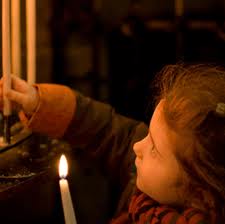
Many parishes have a stand for holding votive or prayer. If you do, or when you go into a church that does, one will usually be found near a statue/shrine of a Saint or near to the Reserved Sacrament. Lighting a candle in prayer is a powerful symbol, full of meanings.

Here are some “bright” ideas:

  • The lit candle reminds us of our Baptism, and the way that we share in the life of Christ by sharing in the life of the Church. When we depart from the place leaving the burning candle behind, we are reminded that our souls never leave the presence of God, in company with His Saints.
  • Prayer is not self-centered, it is God centered, and an important element is prayer for other people and causes. When lighting your candle, it is a good idea to light a candle for those others you want to pray for.

The candle is absolutely not a substitute for the prayer of your heart, but an accompaniment. It is a small offering which, in honoring a Saint and giving glory to God, speaks both from the heart and to the heart. Lighting votive candles in church, when asking the prayers of the Saints and thereby to the greater glory of God, is growing in popularity in the Anglican Catholic Church.

It is a devotional practice in which many millions of Christians the world over have found inspiration.

-with thanks to All Saints (ACC) Janesville, WI


church-business-meeting-68179

First, my thanks to all who worked so hard to put together the parish annual meeting, and congratulations to our new vestry members and synod delegates.  As well, to all who provided for an extraordinary post-meeting lunch, what a wonderful meal you provided.  It was a great time of fellowship and renewal for the coming calendar year of work for Christ in our parish community.

For parish news, meditations and upcoming events, please click on the link to our parish newsletter The Verger. verger12

cartoon-length


Serialized


classic-books

Over the last few years, I have begun a series of book manuscripts with the best of intentions. Several of these are re-writes or updates of old favorites such as Why I am an Anglo-Catholic, and others are entirely new.  With the exception of Prayer: A Field Guide which has been on the market for some years now and a just completed version of The Book of Occasional Offices, these all have languished unfinished despite my best intentions. (Or, at least some sort of intentions!)

I suppose that I could find endless reasons to keep procrastinating.  There is the usual stuff of the busy life: “I have a parish to look after.”  “I have chores to do.”  (Those who have seen the lawn at St. Swithun’s rectory will understand the absurdity of this latter one.) In my case, the excuses can be even more unusual, such as publisher of my last book disappointing me and my potential readers by having the audacity to to bankrupt the day of the announced release date.  I can only hope it was not my manuscript that pushed them over the edge!

So, I was staring at the directory containing these various gems in the rough and vowing to “get down to it.”  But, after a number of cups of coffee and several rounds of solitaire, nothing was happening on the old keyboard.  Along about the time I actually considered going to the gym to escape the writer’s block, a well-meaning friend send me an aphorism by St. Augustine of Hippo, “God has promised forgiveness to your repentance, but He has not promised tomorrow to your procrastination.”   Quite convicting, that, in a real and very theological way.

So, I am looking at the catalogue and deciding which of these long delayed books to put out in serial form here on the blog.   Of course, there are dire warnings about sales of the finished product being impaired, the threat of stolen ideas and any number of reasons that would lead to further procrastination.  As Nina Amir notes in Blog Your Book, the process of writing a serial version of the manuscript forces one to get the job done.  Additional or new content can make the blogged version salable in print if that is the end game.  Here, the end game is to get some of this work finished at long last, but, if there is a royalty or two, they would be most welcome.

In any event, these works will be done under the auspices of the Bp. Charles C. Grafton Institute, a tax-exempt organization.  In the next several weeks, PayPal links will appear here and on a new Grafton site if people wish to support the work with deductible contributions.  In turn, the sums received can go to bringing out print versions of the books and to defray the expenses of the websites themselves or to support other programs such as continuing clergy education or traveling seminars for parishes.

So watch this space.  Please remember that the material is copyrighted and respect the author’s work, and we’ll see whether that copy of Blog Your Book was worth the price!