Feeds:
Posts
Comments

Jesu, Son of Mary


Carmina.jpg

A prayer today from the Carmina Gadelica, which is a treasure trove of ancient Christian hymns and prayers from throughout the British Isles.

JESU, Thou Son of Mary,

Have mercy upon us,

              Amen.

Jesu, Thou Son of Mary,

Make peace with us,

              Amen.

Oh, with us and for us

Where we shall longest be,

              Amen.

Be about the morning of our course,

Be about the closing of our life, 

              Amen.

Be at the dawning of our life,

And oh! at the dark’ning of our day,

              Amen.

Be for us and with us,

Merciful God of all,

              Amen.

Consecrate us

Condition and lot,

Thou King of kings,

Thou God of all,

              Amen.

Consecrate us

Rights and means,

Thou King of kings,

Thou God of all,

              Amen. 

Consecrate us

Heart and body,

Thou King of kings,

Thou God of all,

              Amen.

Each heart and body,

Each day to Thyself,

Each night accordingly,

Thou King of kings,

Thou God of all,

              Amen.


supreme-humility

Shortly after coming to St. Alban’s nearly seven years ago, I built a small chapel in an unused classroom on the far side of the building.  Over the years it has been used as a penance chapel as it has our confessional, as well as a tabernacle for the Reserved Sacrament (Altar of Repose) during Holy Week.  Otherwise, it has gone largely unnoticed.

Several weeks ago, Fr. Seraphim came from St. Simeon’s skete in Kentucky to lead our pre-Advent retreat for the diocese here at St. Alban’s.  He brought to us the powerful teachings of the Remnant Rosary. Information about this teaching, which is at once a devotion, meditation and spiritual discipline, can be found on the pages of the  Nazareth House Apostolate, of which the skete is the physical part.  It is a must visit site, and I urge all who follow the like to carefully read all of the pages and then make a generous contribution to this extraordinary work of Christ.

Now, that I have gotten the advertisement past, I want to note that a number of the retreat participants already have adopted the Remnant Rosary into their spiritual practice.  It is not easy at first to do so, but nothing that really builds one up is.  Surely, the prayers of the beads are not hard to learn, but the difficulty comes in their convicting nature.  In this upcoming season of Advent, the enormity of the Incarnation is not easy to face if taken seriously, and the Remnant Rosary calls those who sincerely pray it squarely into the sheer power of the event and of the race that Jesus would run for us-a race that led up Calvary to the Cross and beyond the grave.

So it was, over these last two weeks, I sort of “fiddled about” with the beads that Fr. Seraphim had given me and the small booklet that accompanied them.  One can “breeze” through a regular Rosary in a way that can become quite wrote and perfunctory. (One should not, of course, but familiarity can result in laxity.)  However, the Remnant Rosary invites the person that prays it into a deeply personal entry in to the Holy Mysteries.  One is called to internalize the Mysteries and to “take in” Jesus in a way that is quite profound-Eucharistic in a very meaningful way.  It is that sort of intimacy, I believe many people are uncomfortable with even though Christ invites us into that level of relationship.  One need only to examine how many people receive the Sacrament in a perfunctory manner to get my point here. (Here, I invite you to think about the “receive and run” folks who don’t even wait for the Benediction to head for the parking lot.  If, however, this describes you, stop it!)

So, after Matins, I felt sufficiently prepared to take on and engage the Remnant Rosary, and, for some reason, was drawn to the little chapel for a first attempt.  If you already pray the Rosary, the Mysteries are familiar.  The depth of the meditations, though, are not.  Taken seriously, this combination of prayer and meditation moves one swiftly from chronos (actual time) to kairos, (God time), just as the Remnant Rosary book notes.  To borrow from Fr. Seraphim, “Ultimately [this] Rosary has no goal, only depth.  The mysteries are a shoreless ocean, we are a wave ant the Rosary is the current rooted in the depths….Here we ‘see the works of the Lord and His wonders in the deep’ (Ps. 107:24).”

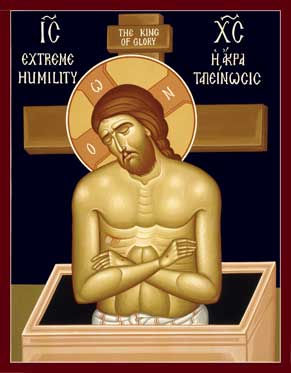
As I prayed the Joyful Mysteries, I happened to glance at the icon of Supreme Humility and that sense of depth cane home with incredible force.  It is a sense that the shadow of the Cross hangs across the Christmas crib, and both bind Heaven and earth together in the life of Christ.  Advent heralds Good Friday which, in torn, anticipates the Resurrection, all bound up in the life of the Master expressed throughout in Supreme Humility.

This Advent, I would invite you either to “try out” Remnant Rosary or to pray the familiar Rosary with a new attention to its depth.  Include short meditations on each bead, rather than breeze through the devoting to rest satisfied in the fact that you simply have “gotten through” another set of Mysteries.  Personalize each bead, and take in the enormity of each event.  Any worry of time spent (which should not be a concern in prayer) will simply disappear when you let down your spiritual net into the depths for a draught.  And always keep before you the vision of the Supreme Humility that has redeemed the world.


Approaching the Incarnation


st-athanasius

On the Sunday Next Before Advent, we began a new Sunday study I have tentatively called “Approaching the Incarnation.” Amid the incredible noise of the commercial “holiday season”, we do well to step back into the quiet of a darkened hillside and contemplate the enormity of the coming Feast of the Incarnation. As God breaks into the world, we should be humbled and brought to our knees by his very purpose in doing so.

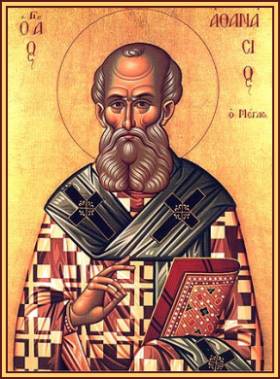
In On the Incarnation, our main Advent study text, St. Athanasius succinctly gives us the real news of Advent: “The Lord did not come to make a display. He came to heal and to teach suffering men. For one who wanted to make a display the thing would have been just to appear and dazzle the beholders. But for Him Who came to heal and to teach the way was not merely to dwell here, but to put Himself at the disposal of those who needed Him”  What a powerful thing to contemplate this Advent!  Our Lord came to put Himself at our disposal as the ones who need him most.

The saint goes on to say that the result is that,  “The Self-revealing of the Word is in every dimension – above, in creation; below, in the Incarnation; in the depth, in Hades; in the breadth, throughout the world. All things have been filled with the knowledge of God.”  Will we spend another Advent season oblivious to that total penetration of the world by the knowledge of God, and, instead, squander these weeks with the mundane, the banal or the material?

Truly, Advent is a time to understand that we have an Incarnate, living Jesus.  Truly, ours is a “…Savior [who] is working mightily among men, every day He is invisibly persuading numbers of people all over the world, …to accept His faith and be obedient to His teaching. Can anyone, in face of this, still doubt that He has risen and lives, or rather that He is Himself the Life? Does a dead man prick the consciences of men, so that they throw all the traditions of their fathers to the winds and bow down before the teaching of Christ?”

So, today, in addition to the Angelus, let us offer a Prayer of Thanks for the Incarnation

Jesus, You came to earth from heaven to take on flesh and dwell among us. You became the supreme example of God in the flesh, pouring out Your grace upon grace. In Your humanness You were victorious in the raging battle against the spiritual forces of evil when faced with temptations and trials common to all people. We stand in glorious victory as we follow Your example and hold to Your unchanging truths. We come alongside those who are grieving loss and enduring heartache in the midst of this glorious season, for it is in keeping with the season of giving, that we give ourselves in faithful prayer toward these in grief. It is in the loving name of Jesus that we pray. Amen. 

Texts for St. Alban’s Advent Study: Main-On the Incarnation, St. Athanasius; Supplemental-Living Jesus, Luke Timothy Johnson.


Thoughts on Second Peter


2-peter

Our Wednesday Bible study has moved from First to Second Peter as we approach Advent.  Verses 5-11 of the first chapter form an interesting “ladder” describing growth in the spiritual life.

The text begins, of course, in verse 5 with faith to which we are to add virtue.  To virtue, we are to add knowledge.  In turn, St. Peter admonishes that we add temperance to knowledge, patience to temperance and Godliness to patience.

This progression allows the believer to break through to “brotherly kindness”, and, finally to charity.

Keeping to this pattern leads to growth, particularly in the knowledge of our Lord Jesus Christ. Finally, as knowledge enhanced by the cardinal virtues grows, we return to the “everlasting kingdom of our Lord and Saviour Jesus Christ.”


faith-and-politics

On Tuesday, November 8th, we will go to the polls in a national and local elections.  I have been repeatedly asked to address the question of the election and the candidates. Up  to today,  I have not done so from the pulpit, but have simply urged you to remember that one doesn’t take off one’s faith at the door of the polling place.  However, simply urging people to “vote their conscience” is neither helpful, nor very brave.  It is merely a lukewarm approach that, in the end, says nothing. After much prayer and thought on the matter, I feel that I must say something more to the parish given the matters at stake in the life of our nation this year.

In 2010, I began to rewrite an old and not well-known book The Kingdom of God and American Life.  One day, it may be completed, if not published. However, I would share with you a portion of a manuscript I pray will be helpful in this mean season.

Our politics for the past several years are a thing few of us in America can be proud of. While one may still cherish faith in American citizenship, the people have become weary of mere politics and “business as usual”. A quickened conscience among many has recognized that, even under democratic forms and methods, there have somehow arisen conditions that are palpably undemocratic, and is manifesting a push in some quarters toward the control of “human well-being”, or at least a particular notion of what may constitute human well-being.

Meanwhile, masses of our people are stirring in vague unrest and striving often aimlessly after they know not what—they know only that something is wrong and they are angry. On the other hand, many persons are only bewildered spectators.

We are wise to face the fact that the social question is ultimately a moral question. It is time to recognize that its solution lies not in biological analogies, not in the exaltation of the State at the expense of the individual, nor again in the destruction of government, but in that Gospel of the Kingdom of God which means the realization of certain ideals through the highest and fullest development of our Christian personality.  There are straightforward answers and approaches open to us.

As traditional Anglican Catholics, our movement was established with, and adheres to, the Affirmation of St. Louis. In 1977 an international congress of nearly 2000 Anglican bishops, clergy, and lay people met in St. Louis, Missouri in response to actions taken by the Episcopal Church (USA), that represented a move away from the apostolic faith as understood within the Anglican tradition. The object of this Congress was to determine the actions necessary to establish an orthodox jurisdiction in which traditional Anglicanism would be maintained. Indeed, we are privileged to have as a member of St Alban’s Dr. Robert Strippy, one of the drafters of the Affirmation. The Anglican Catholic Church, along with other “continuing” Anglican bodies uphold and maintain the belief and practice set out in this important document.

Of particular importance in the upcoming election is Article III of the Affirmation setting forth Principles of Morality.  I, as a priest, can offer you nothing more succinct or useful than to reiterate the language of this section, albeit with some emphasis here and there.

First, “[t] he conscience, as the inherent knowledge of right and wrong, cannot stand alone as a sovereign arbiter of morals. Every Christian is obligated to form his conscience by the Divine Moral Law and the Mind of Christ as revealed in Holy Scriptures, and by the teaching and Tradition of the Church. We hold that when the Christian conscience is thus properly informed and ruled, it must affirm the following moral principles:

Accordingly, from the perspective of individual responsibility, “All people, individually and collectively, are responsible to their Creator for their acts, motives, thoughts and words, since ‘we must all appear before the judgment seat of Christ . . .’” This is inescapable truth.

Next, we are to uphold the Sanctity of Human Life. As the Affirmation notes, “Every human being, from the time of his conception, is a creature and child of God, made in His image and likeness, an infinitely precious soul; and that the unjustifiable or inexcusable taking of life is always sinful.”  In this and all other regards, [a]All people are bound by the dictates of the Natural Law and by the revealed Will of God, insofar as they can discern them.” There can be no compromise.

These principles carry over into all aspects of family life, the family being the cornerstone of our community and nation.  There can be nothing clearer than the statement that, “The God-given sacramental bond in marriage between one man and one woman is God’s loving provision for procreation and family life, and sexual activity is to be practiced only within the bonds of Holy Matrimony.” Again, there can be no compromise.

Do we fall short?  Of course we do. “We recognize that man, as inheritor of original sin, is ‘very far gone from original righteousness,’ and as a rebel against God’s authority is liable to His righteous judgment.”  We also recognize, though, “that God loves His children and particularly has shown it forth in the redemptive work of our Lord Jesus Christ, and that man cannot be saved by any effort of his own, but by the Grace of God, through repentance and acceptance of God’s forgiveness.”

Ultimately, it is the Christian’s abiding duty to be moral.  “We believe, therefore, it is the duty of the Church and her members to bear witness to Christian Morality, to follow it in their lives, and to reject the false standards of the world.”

Beloved in Christ, nothing could be more straightforward than this.  Are economic issues of importance?  Of course they are.  However, for far too many years we have, as a nation, been led to focus on the aphorism, “It’s the economy, stupid.”  In fact, it is not.  Rather, “It is the morality.”  Without a good, decent and moral people, there can be no just political and economic system.

Personalities are personalities, and people come ant they go.  That is the nature of the human condition, private and civil.  They cannot, and must not be our guide. I can only urge you to examine the moral principles set forth in the Affirmation, to examine your hearts, and to pray.  We must ask an honest question of any candidate for political office and any political party. Do they stand for or against those principles? Let that be the end of inquiry.

I believe that there are singular and great destinies awaiting our country if, in the face of any and every doubt, difficulty and discouragement, our people return and remain true to the ideals and purposes of the Kingdom of God.

In Christ,

Canon Charles H. Nalls

On Entering Church


cellphone-11

Here is a little something that can be copied and put into larger form.  It is derived from a notice in an English parish circa 1950, so the more things change, the more they stay the same.

On Entering Church

This is church where the Faith once-delivered is taught, and where the Sacraments of the One Holy Catholic and Apostolic Church are administered according to the Rites and Ceremonies of the Anglican Catholic Church.

The Blessed Sacrament is reserved in this church for the needs of the Faithful.  You will see a white light burning in the place of Reservation.  There Jesus Christ, God and Man, is sacramentally present, and therefore you will see others reverence and say their prayers before Mass or other services.  So we ask that you behave with great reverence here.

On entering the church before services, please use a low voice and converse only as necessary.  Many are at prayer before the liturgy, and we ask that all be mindful of undue noise.

Please turn off mobile phones.  If your occupation requires that you maintain contact, please silence your mobile device.

During the service, please refrain from conversation. We make every effort to keep our services beautiful and dignified, particularly because of the Presence of Jesus Christ in the Sacrament of the Altar and for benefit of all who join together here in as a community and in the Body of the Church.

If you are a visitor, welcome and blessings! Please sign the register and join us for fellowship after the service.  If you have any questions, please contact the Rector at 804-262-6100 or through the church website http://www.stalbansacc.org


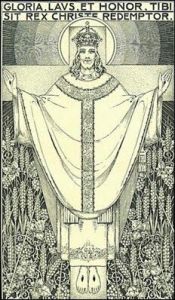
christus-2

I have had a number of requests for my homily from Christ the King Sunday.   I rarely post my homilies for three basic reasons.  First, I have always thought it prideful to do so.  Second, there are much better preachers from whom to learn. And, third, sermons and homilies are (or had better be) a work of the Holy Spirit in the preacher who has prayed and read into the works, particularly of the Fathers.  They are for a moment in God’s time, and may not have a permanence to them.

I offer the text with the following caveats. I rarely stick to any text and, indeed, have been known to preach ex tempore if I am so led. I also prepare texts more as notes, so that there likely will be typographical errors and emphasis marks within the notes.   If you use the text or (Heaven forbid) have a desire to quote from it, you can do so freely in this case. If you’d like to include an attribution, that’s fine.

SERMON FOR CHRIST THE KING SUNDAY-2016 (Given at St. Alban’s, Richmond, Virginia)

“We give thanks unto the Father, which hath made us meet to be partakers of the inheritance of the saints in light: Who hath delivered us from the power of darkness, and hath translated us into the kingdom of his dear Son” –Colossians i:12

Today is Christ the King Sunday–almost the last Sunday after Whitsunday-the Pentecost. We are drawing close to the end of those many, many “green” Sundays in Trinitytide and all of the moral teachings that have led us through the summer and early fall. Soon (and it doesn’t seem possible) we will begin anew with the First Sunday of Advent. But here we are, still in Trinity and preparing to commemorate All Saints Day and the solemn remembrance of All Souls.

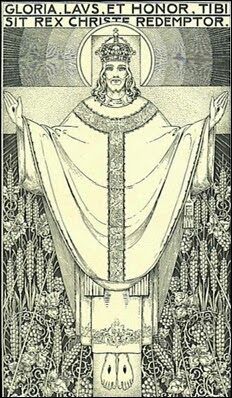
Christ the King is not universally commemorated these days. But here in this parish, a part of the traditional Anglican-Catholic expression, I think that we do well to pause think a little bit about kings and kingship.

I had always imagined that the feast day of Christ the King came out of the medieval history of the Church, from a time when kingship was common and all the images of royalty would have been vibrant and meaningful for common Christians. I thought it might have arisen as a grand Feast Day.

Instead, I was surprised to read that the feast didn’t really did come to be generally celebrated until after 1925 when was formally placed on the calendar. Were there any powerful kings left in the world in 1925? I don’t know. Perhaps there were a few, but the feast came to be formally celebrated at a time when the governments of nations, particularly newly Communist Russia and our neighbor Mexico, were grossly abusing power and their people.

In Mexico, for example, a totalitarian regime gained control, and it tried vigorously to suppress the Church. To resist the regime, many Christians took up the cry, “Viva Cristo Rey! Long live Christ the King!” They called themselves “Cristeros,” the most famous being a young Jesuit priest named Padre Miguel Pro. Using various disguises, the good father Padre Pro ministered to the people of Mexico City. Finally, though the government arrested him and sentenced him to public execution. The president of Mexico (the improbably-named Plutarco Calles) thought that Padre Pro would beg for mercy, so he invited the international press to the execution.

The priest did not plead for his life, but instead knelt holding a crucifix. When he finished his prayer, he kissed the crucifix and stood up. Holding the crucifix in his right hand, he extended his arms and shouted, “Viva Cristo Rey.” At that moment the soldiers fired their deadly volley. It is a moment frozen in time, captured in the photographs of the journalists. If you look up “Padre Pro” or “Saint Miguel Pro” on the Internet, you can see that picture.

As in the Gospel today, Padre Pro died acknowledging Jesus as King. Hopefully you and I will die with the name of Jesus on our lips and in our hearts. But, more importantly, we will live today, this day, acknowledging Christ as our King.

This might seem the Church is just not “with it” or “up to date” celebrating a holy day based upon symbols and images that seem out of date, images of kings and royalty. But, you know, I suppose we could say it is the Church at hers best when even something as seemingly anachronistic as feast day about kings has the power to teach and inspire. Christ the King Sunday does teach and it does inspire.  It speaks to the practical point of our life in Christ.

My beloved, if a government overreaches itself, if it demands a submission that we as Christians cannot give, we have a simple, direct response: Jesus is our king. He is the King over all kings.  We follow his teachings and submit to his rule.

But it is puzzling, isn’t it?  “King” is a word we might not normally use to describe Jesus.  We associate the word “king” and all of its trappings with power and majesty, but Christ Jesus did not display that kind of power or majesty. In fact, if you were a contemporary and heard someone describing Jesus as king you might reply, “but he was born in a stable,” or isn’t he the carpenter’s boy?

It is true. Jesus was not the kingly, majestic type. Recall the beginning of Christ’s earthly ministry. When Satan showed Jesus all the kingdoms of the world and said they could all be his if Jesus worshiped him (Luke 4:5-7), Jesus replied that only God is to be worshiped (Luke 4:8). Satan offered a temptation to display power. But Jesus resisted that temptation always. He avoided the shows of earthly power and authority.

Beloved in Christ, the irony is that Jesus was a king because he has a kingdom, but his kingdom is totally at odds with any display of power in this world. Some people like to dominate others, they abuse their power, and they manipulate others through lies and even violence. Oh, how we see this in this mean season, this electoral season!

But those behaviors have no place in Jesus’ kingdom. Those with power can and do unfortunately abuse their power in so many ways. We see that each and every day.  But Jesus?  Jesus is totally powerless on the cross; he cannot, it seems, even save himself. Remember the mocking words, “He saved others; let him save himself, if he be Christ, the chosen of God.” (Luke 23:35)

The values in Jesus’ kingdom are service and humility. If we want to be great, then we must be like children (Luke 18:17). We are to carry our cross after Jesus every day (Luke 14:27). There is no place for violence or retribution in Jesus’ kingdom. There is no place for abuse of power. There is no place for deceit and manipulation.

Jesus, King of Kings, certainly did not abuse His power, and he is our model. Jesus, the humble king, stands as an example and a stern rebuke to those who abuse or thirst for power of any sort. It just has no place in the Kingdom of God, Jesus’ kingdom. In fact, if we follow Christ’s example, there is no envy or greed or lust for power in us.

So, in many ways we see that Jesus’ kingdom is totally at odds with any display of power in this world, particularly political power. Christ kept company with tax-collectors, sinners and prostitutes, so much so that the authorities, political and religious, described Jesus as “a glutton and a drunkard, a friend of tax-collectors and sinners.” (Luke 7:34)

You would expect kings to receive important people and dignitaries but Jesus received the lowly and rejected people of his time. You might expect a king to receive a gifts but Jesus gave gifts: he restored health to those who were sick, he raised the dead, he gave the gift of Eternal Life. Jesus was not the kingly type according to our understanding of king; he is a seemingly powerless king!

But, kings wear crowns.  The King of Kings too wore a crown. What sort of crown did Jesus wear? It was a crown of thorns. And, kings have thrones?  Jesus had a throne here on earth. What throne do we see Jesus sitting on in the Gospel today? (Luke 23:35-43) Look there.  It is the cross. Kings have armies don’t they? Knights, and soldiers, archers and standard bearers.  Yet, instead of an army, there were people beneath his cross asking him to come down if he was indeed the Son of God (Luke 23:35). So Jesus’ idea of king and power is totally opposite to the world’s idea of a king and power. That is why the preface to one Eucharistic Prayer describes Jesus’ kingdom as

a kingdom of truth and life

a kingdom of holiness and grace

a kingdom of justice, love and peace.

So it is that (Luke 23:35-43) we will find Jesus sitting on the most unusual throne of the Cross. “King of the Jews” was written over it.  It is there on the superscription.  But that moment of pain and humiliation was passing, and then Jesus assumed his real throne at the right hand side of his Father.

Beloved in Christ, this can teach us something-to bring about the kingdom of God we may have to abandon what the world considers important.  We may even have to be prepared to be ridiculed as Jesus was on the cross. We may even have to give all.   We may have to give our lives.

It was not easy for Christ to begin establishing His kingdom with values at odds to those of the world; it cost him his life. It certainly is not easy for the Church now trying to establish that kingdom in a society growing daily more secular and pagan. It is not easy for those of your who would dare to carry the Cross.  But for those who die to themselves, who truly open themselves to Jesus, the reward is a share in Jesus’ kingdom.  It is the promise to the penitent thief, “Indeed I promise you, today, you will be with me in paradise.” (Luke 23:43)

Particularly as we approach another national election, this feast is an invitation to all those who have power or authority of any kind to compare their use of power or authority with Jesus Christ. Indeed, we pray this in the second prayer for the President and those in Authority in Morning and Evening prayer.  When you have a moment this week, open the Prayer Book and read that prayer on page 18 with an accent on the word “thy”.

“Grant to THE PRESIDENT OF THE UNITED STATES, and to all in Authority, wisdom and strength to know and to do thy will. Fill them with the love of truth and righteousness; and make them ever mindful of their calling to serve this people in thy fear;”

Here’s the litmus test. Are those in authority using their power to serve others or to manipulate? Are these people using their power for the building up of a more just society or simply to feather their own nests? Are they using their power in any way that might cause pain to others or in a way that could help to alleviate pain?  Are they seeking the things of Christ?

In the prayer Jesus taught us, we pray, “thy kingdom come.” Jesus has shown how to bring about that kingdom. Let us pray that nations and individuals will be humble enough to look at how Jesus used power and bring about the kingdom of God.

As for us, we have our own questions this day. Will we crown this most unusual King to be our Lord? Will we grant him the authority and power to rule in our lives?  Will we acknowledge the authority of one who gave his life for ours? Will we submit to the power of one whose rule is one of love and reconciliation? Will we give up service to earthly powers and serve the one who is
King of heaven?

If so, crown him as your king.  Grant him power and  authority in your life, so that he may rule and guide your hearts and your minds and your souls. In the words of the hymn, “Crown him with many crowns!”

In the name of the Father, and of the Son and of the Holy Ghost. Amen. 

The Rev. Canon Charles H. Nalls, Obl.S.B.


A Short Litany


celtic-knot

Today from the Carmina Gadelica, we have a very early Celtic litany.  There is a flavor of the Eastern Church to it, I think.  Whatever the case, it is short, beautiful and powerful.  As well, just a reminder: the study of Celtic Christianity continues this Sunday at 9:30 a.m. int he parish library.

JESU, Thou Son of Mary,
Have mercy upon us,
Amen.
Jesu, Thou Son of Mary,
Make peace with us,
Amen.
Oh, with us and for us
Where we shall longest be,
Amen.
Be about the morning of our course,
Be about the closing of our life,    [world
Amen.
Be at the dawning of our life,
And oh! at the dark’ning of our day,
Amen.
Be for us and with us,
Merciful God of all,
Amen.
Consecrate us
Condition and lot,
Thou King of kings,
Thou God of all,
Amen.
Consecrate us
Rights and means,
Thou King of kings,
Thou God of all,
Amen.

Consecrate us
Heart and body,
Thou King of kings,
Thou God of all,
Amen.
Each heart and body,
Each day to Thyself,
Each night accordingly,
Thou King of kings,
Thou God of all,
Amen.


DIA liom a laighe,
Dia liom ag eirigh,
Dia liom anus gach rath soluis,
Is gun mi rath son as aonais,
Gun non rath as aonais.

Criosda liom a cadal,
Criosda liom a dusgadh,
Criosda liom a caithris,
Gach la agus oidhche,
Gach aon la is oidhche.

Dia liom a comhnadh
Domhnach liom a riaghladh,
Spiorad liom a treoradh,
Gu soir agus siorruidh,
Soir agus siorruidh, Amen.
Triath nan triath, Amen

GOD with me lying down,
God with me rising up,
God with me in each ray of light,
Nor I a ray of joy without Him,
Nor one ray without Him.

Christ with me sleeping,
Christ with me waking,
Christ with me watching,
Every day and night,
Each day and night.

God with me protecting,
The Lord with me directing,
The Spirit with me strengthening,
For ever and for evermore,
Ever and evermore, Amen.
Chief of chiefs, Amen.

As we work up to our next session on Celtic Christianity, I thought I’s begin to post a few prayers and hymns from the Carmina Gadelica, a 19th century collection of poems, hymns and prayers from the Wales, Scotland, Ireland and Britain.  Many of these hearken back to the earliest days of Christianity in the British isles and show the keen sense of a God present and active in His world and in the lives of His people.

This perception of the active presence of Christ is wonderfully expressed in the hymn, St. Patrick’s Breastplate, which is also a wonderful expression of the Holy Trinity.

The two volumes are online in various places, but the text version in a real book is somehow more satisfying.

510T0r9fVnL._SX330_BO1,204,203,200_


The Value of Faith


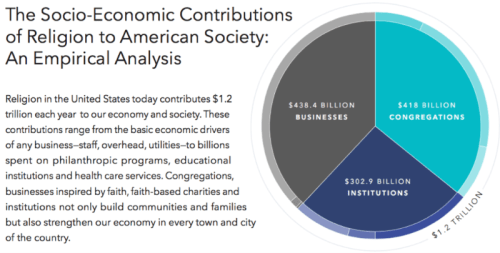
statsAmid the election uproar, an important economic study issued quietly concerning the “value” of faith expressed in cash terms.  Those leading the jihad against Christianity would do well to read it and then figure out how they will replace the more than USD 1 trillion plus in economic benefits currently provided by the faithful.

Of course, the statist solution would be to continue the economic plunder of the nation and simply adding to the staggering deficit.  After all, what’s another trillion dollars, right?

I have reproduced the press release below and, I hope, the links to the study.  It is free for the viewing over at the website of the authors’ foundation-Faith Counts.

New study values faith in America at over one trillion dollars

–First-ever national research highlighting the impact of religion on U.S. economy– National Press Club, Washington, D.C. — In a panel today, Dr. Brian Grim and Melissa Grim, J.D., unveiled their groundbreaking new study: “The Socio-economic Contribution of Religion to American Society: An Empirical Analysis.” The first-of-its-kind study analyzed the economic impact of 344,000 religious congregations around the country, in addition to quantifying the economic impact of religious institutions and religion-related businesses. Through this study, Dr. Grim found the total economic contribution of religion in America to be nearly $1.2 trillion, equal to the world’s 15th largest economy.


Dr. Grim presented his research at a panel event at the National Press Club. The panel included Dr. William Galston, Senior Fellow in the Brookings Institution’s Governance Studies Program, and Dr. Ram Cnaan, Professor and Program Director of the Program for Religion and Social Policy Research at the University of Pennsylvania. “For the first time, we have been able to quantify what religious institutions, faith-based charities, and even businesses inspired by faith contribute to our country,” said Dr. Grim. He continued: “In an age where there’s a growing belief that religion is not a positive for American society, adding up the numbers is a tangible reminder of the impact of religion. Every single day individuals and organizations of faith quietly serve their communities as part of religious congregations, faith-based charities, and businesses inspired by religion.”   Despite prolonged economic hardship in many communities, the amount of money spent annually by religious congregations on social programs has tripled in the past 15 years. Some examples of the social issues addressed by these congregations and religiously-oriented charity groups include:

  • Alcohol and drug abuse recovery—130,000 programs
  • Veteran and veterans’ families support—94,000 programs
  • Prevention or support for people with HIV/AIDS—26,000 programs
  • Support or skills training for unemployed adults—121,000 programs

Operating alongside these charity groups and religious institutions sit faith-based and inspired businesses, which employ people in every field and industry. This fills the marketplace with goods and services used by people of all faiths, plus those with no faith at all.  At the same time, religious schools educate millions of students from pre-K to the post-graduate level. The study is sponsored in part by Faith Counts, a multi-faith campaign aimed at promoting the value of faith.  Kerry Troup, spokeswoman for Faith Counts, states, “From our work with diverse faith communities across the U.S., we know that despite differences among individual religions, there are many more things that bring us together. This study shows that faith is still a cornerstone of our economy and society, and we’re actively working together to celebrate and promote its value.”

For more information, including the full study and a video summary of the research, please visit www.FaithCounts.com/Report.

About Faith Counts   Faith Counts is a nonprofit, nondenominational organization comprised of many religious communities who represent nearly 80 million Americans.  The mission of Faith Counts is simple:  to promote the value of faith.  The centerpiece of Faith Counts is a social media campaign that tells powerful stories about how faith counts—how it inspires, empowers, motivates, and comforts billions of people.

Data from: “The Socio-economic Contribution of Religion to American Society: An Empirical Analysis”, a 2016 study by Brian J. Grim (Georgetown University’s Religious Freedom Project) and Melissa E. Grim (Newseum Institute’s Religious Freedom Center), published in the peer-reviewed journal, Interdisciplinary Journal of Research on Religion, Volume 12, Article 3.