Feeds:
Posts
Comments

Tuesday in Holy Week


Tuesday in Holy Week

A leave-taking has generally something of sadness about it; but more so if anyone has from pure love and affectionate interest been striving for the good of others. However, if they have persistently rejected his endeavors and scornfully refused his aid, the sorrow with which he parts from them in their misguided blindness, will be great indeed. Such was the sorrow which the Lord Jesus felt. We hear that “He departed and did hide Himself from them.”

First, however, He spoke to them solemnly and plainly of their hypocrisy, hardness of heart, selfishness, and spiritual pride. He pronounced woe again and again upon the scribes and Pharisees on account of these faults.

His burning words passed at length into tones of the most tender compassion. “O Jerusalem, Jerusalem,” He exclaimed, “how often would I have gathered thy children together, and ye would not.” He would have gathered them, and they would not be gathered. Even now He pursues with tender entreaties and solemn warnings: “Ye shall not see Me henceforth, till ye shall say, Blessed is He that cometh in the name of the Lord.” Then, He turned sadly away and departed. He had still much teaching for His disciples, but as regards the people His ministry of teaching was now over. He would have gathered them, but they would not be gathered.

A day will come when, if I have never sought Him, He will thus turn away from me also. I may be as they were, moral, respectable, and outwardly religious. Yet, He turned away from them, and He may turn away from me. He turned away from them because their religion did not consist in the love of God and of man. He turned away because they were incapable of faith and moral earnestness. Finally, He turned away because they had the form of godliness only, and while they cared much for the praise of men they thought little of the glory of God.

Prayer

Draw me, O Lord Jesu Christ, that I may seek Thee with my whole heart, and fill me with truth and love, I beseech Thee. Amen.

From Lent for Busy People © 2017 Fr. Charles H. Nalls


MondayThe barren fig-tree on which our Lord passed sentence to-day was typical of the Jewish people, and, besides them, on the many who profess themselves His disciples now. True, the time was not the season of the year in which figs might most naturally be expected to be on a fig-tree. But this being so, why did it have leaves?

The leaves were enough to create an expectation that at least some of the winter figs might be still hanging upon the tree. The tree, however, produced nothing but leaves, plenty of them, but no fruit. No fruit, therefore, was it permitted to yield henceforth and for evermore.

Now, the fig-tree did no harm, but then, again, it did no good. It did not produce any fruit, either hurtful or useful. It was perhaps, to some slight extent, an ornament to the landscape, but it was of no practical use. The hungry looked to it in vain.

How is it with us? We have some means, time, abilities-what fruit are they bearing? Any or none? Are there any who are made happier or better by our respective endeavors? Let each of us think, am I like the barren fig-tree?

Among the parables which our Lord spoke on this day in the temple, the first is of husbandmen to whom had been committed a vineyard, but who used all the fruits of it for themselves. The vineyard of the Lord of Hosts is the house of Israel. If that is the case, the individuals of that house were such also, or at least part of the one vineyard.

Again we each face pointed questions. What am I doing with my little part of the vineyard, that is, myself? Am I bringing forth fruit unto God? What is such fruit? The fruit of the Spirit is love, joy, peace, long-suffering, gentleness, goodness, faith, meekness, and temperance. Are these the fruits of my life? Am I like these husband-men, ready to cast the only Son out of His own vineyard, that is, out of my heart, that I may keep all for myself, my own indulgence and gratification? It is written of those husbandmen, “He will miserably destroy those wicked men,” and the sentence was executed on Israel. Let each of us keep that firmly in mind.

Prayer

O God the Holy Ghost, be Thou my guide and helper, I beseech Thee, that through Thy grace I may bring forth good fruit abundantly, and so glorify Thy Name. Amen.

From Lent for Busy People © 2017 Fr. Charles H. Nalls


Elizabeth Barton

We have finished our “mini-retreat” a bit early today.  My special thanks to Bernard Riley and David Wheeler for the wonderful Lenten repast-a savory, fresh tomato and corn soup. We meditated on the theme of humility, particularly the humility of the Cross.  As well, our prayers were directed to seeking to the grace to bear our own crosses in the imitation of Christ and anticipating the Passion narratives of Holy Week.

Present with us today were the holy relics of Ss. Thomas of Canterbury, Columbae, Bede the Venerable, Cuthbert and Edmund.  We blessed the new icons of English Saints Augustine of Canterbury, Ethelbert and  Thomas, as well as that of Blessed Elizabeth Barton.  These reached us here in the States good offices of the Royal Mail and Bp. Damien Mead of the Anglican Catholic Church in the U.K.  Many thanks, your grace!

The lessons for our retreat were made manifest in the life of Blessed Elizabeth Barton.  For those of you who don’t know her. Known as “The Nun of Kent”, “The Holy Maid of London”, or “The Holy Maid of Kent”, she was an English Catholic Benedictine nun executed as a result of her prophecies against the marriage of King Henry VIII of England to Anne Boleyn.  She urged devotion to the Blessed Virgin Mary and for people to undertake pilgrimages. Thousands believed in her prophecies and both Archbishop William Warham and Bishop John Fisher attested to her pious life.

When Henry sought his first annulment and began siezing the properties of the Church, Sister Elizabeth opposed him.  She was condemned by a bill of attainder (25 Henry VIII, c. 12); an Act of Parliament authorising punishment without trial.  She was hanged and beheaded for treason at Tyburn along with five of her chief supporters, and buried at Greyfriars Church in Newgate.  Her head was put on a spike on London Bridge, the only woman in history accorded that humiliation.

For Palm Sunday


Almighty and everlasting God, who of thy tender love towards mankind, hast sent thy Son, our Saviour Jesus Christ, to take upon him our flesh, and to suffer death upon the cross, that all mankind should follow the example of his great humility; Mercifully grant, that we may both follow the example of his patience, and also be made partakers of his resurrection; through the same Jesus Christ our Lord. Amen.

-Collect for Palm Sunday, 1928 Book of Common Prayer


palm sundayTomorrow we shall be commemorating our Lord’s triumphal entry into Jerusalem. It was the one hour of anything resembling triumph in His earthly life. Yet, His eyes were dimmed with tears, even though shouts of a joyous and apparently believing welcome were sounding around Him. He comes as the Savior, meek and lowly, desiring to be received for our sake rather than His own. He is weeping because of His rejection, not merely because of that rejection, but because those who reject Him know not the things which belong unto their peace.
When He entered Jerusalem He went first to the temple, and looked round on all things. He marked the prayers and thanksgivings which devout souls were offering, and the Hosannas of the children who were singing there His praises.

He marked also the traffic and noise which rose in one of its courts, which had been set apart as a place of prayer for the Gentiles, as though it did not matter if their prayers were disturbed provided the convenience of the people of Israel was carefully provided for. When He saw it all He could not but feel indignation.

He will thus come to look round on all things in the temple of our hearts; and, if we will have it so, to cast out all that is wrong, all that is ruinous ourselves, and therefore displeasing to Him.

If He finds there a lack of charity for others; if He finds there irreverence for anything that pertains to God, His Name, or His house; if He finds that the business and traffic of this world so possesses us as to disturb our prayers and to indispose us for His holy worship; if He finds that anything like greed and covetousness is growing within us also, then, again, as of old, He will be grieved.

Shall we not implore Him to drive it all out? He may need to use a scourge. It may be that only through some suffering these can be driven out, but better so than that they should not be driven out at all.

Prayer

Yea, O Lord Jesu Christ, cleanse, I pray Thee, the temple of my heart and soul, that I may be a dwelling-place for Thee for evermore. Amen.

From Lent for Busy People © 2017 Fr. Charles H. Nalls


during-the-lenten-season-meme

What is life? No one can tell entirely, though all know something of what it is to live. Again, what is death? No one knows what it is to die. We only know that death consists in the separation of the soul from the body. The latter is buried in peace, but the soul liveth for evermore, passing at the moment of death into the place of departed spirits. There it waits until soul and body shall be again united, and those who were dead shall arise from the dead and live forever.

The Gospel for the week teaches us that those who keep the word of the Lord Jesus shall never see death. Yes, for by His death, He destroyed death, and by His rising to life again He restored to us everlasting life. He died that we might not die eternally. He rose again that in Him we might have eternal life.

We all die, indeed, for we have all sinned. The sting of death is sin, and in the case of those whose sins are all forgiven for His sake, that sting has been taken away. They depart with the sure and certain hope of rising again through Him, and at His bidding, to an everlasting life of blessedness and glory. This life, however, must be begun now.

In Baptism I was born again in Christ of water and the Holy Ghost. I was made a member of Christ. If I feel that this is really the case I shall hardly need to be entreated to keep myself pure in heart and thought, in word and act. I should be willing to live as He lived in all obedience to the will of God. I should love all men in obedience to His commandments. For if I live in union with Christ, I must of course in some degree live the life of Christ.

In my childhood I shall endeavor to live the life of His boyhood. At that time of His life, He was brave and submissive, thoroughly in earnest in all that He did, anxious to be doing His work, devout, open, sincere, gentle, and obedient. Such a life will last on into eternity, and will be increasingly blessed.

Prayer

Grant me, O God, the help of Thy Holy Spirit, I humbly beseech Thee, and lead me in the path of obedience to the, example of Thy Blessed Son, our Saviour, Jesus Christ, for His sake. Amen.

From Lent for Busy People © 2017 Fr. Charles H. Nalls


atonement2

On the day of atonement the high priest of Israel received two young goats, and having slain one of them in the outer count, passed with its blood and with incense into the Holy of Holies, there to sprinkle the blood upon the mercy-seat. Having done this, he returned, and laying his hands upon the other goat confessed over it, “the iniquities of the children of Israel, and all their transgressions in all their sins;” and this goat was then sent away into the wilderness “to bear their sins into a land not inhabited.”

The first goat was a type of the Lord Jesus, offering Himself in death for our sins. The other was a figure of Him as the Lamb of God bearing and taking away the sins of the world; while as the high priest passed into the Holy of Holies there to sprinkle the blood before the mercy-seat. So we are taught He has passed with His own Blood into Heaven itself, there to appear in the presence of God for us.

For in the Epistle for this week, we are taught that He is the High Priest of good things to come, whom the high priests of Israel in all their ministrations typified and prefigured.

While the high priest was thus ministering within the Holy of Holies, the people were mourning and praying without, and in like manner the acceptance of all our prayers and thanksgivings depends on the intercession of the eternal High Priest appearing for us in the presence of God in Heaven.

As He intercedes for me, so should I learn from His example to intercede in His name for others also. If previously I have not remembered this, let me learn in this Passion Week. In this week when the Church turns our thoughts towards Him, that I, too, am called as a member of His Body, the Church, to have a little share with Him in His work of intercession.

In church we can scarcely help recognizing this, because many of the prayers which are offered there are of this intercessory character; but I ought to make my private prayers to some extent intercessory also.

Prayer

O Lord Jesu Christ, grant me grace that in union with Thee I may in this also follow Thine example. Amen.

From Lent for Busy People © 2017 Fr. Charles H. Nalls


leper

In the Epistle for this week, the death of the Lord Jesus Christ is contrasted with the sacrifices of the law of Moses. These, we are told, had an outward efficacy, sanctifying to the purifying of the flesh. The leper, for example, was cleansed from the ceremonial uncleanness which clung to him while he remained a leper, so that when the sacrificial blood had been sprinkled by the priest seven times upon him, and he had washed his clothes and fulfilled other obligations of the like kind, he was free to return again to his home, and to go up again to the courts of the house of the Lord.

The unhappy leper, as a type of the sinner, was treated as the impenitent sinner must be treated. He was bidden to depart from God’s presence, and from all communion with God’s people. The blood which restored him was typical also of the atoning and cleansing Blood of Christ.

But the leprosy was not in itself a moral but a physical disease, which resided in his flesh. The blood which restored him, therefore, sanctified only to the purifying of the flesh. On the other hand, the sacrifice of the Lord Jesus Christ was the sacrifice of an obedient will, and for this and other reasons His Blood has a spiritual power, and purges the conscience of him who believes in Him from dead works.

But what are dead works? They are the works which issue in death, that is, they are sins, and from these the Blood of Christ cleanses the conscience of those who come to Him by faith and prayer. We may well ask, “Is it so with me?”

Of the great multitude whom St. John saw in the courts of Heaven it is said that they washed their robes, and (also) made them white in the Blood of the Lamb. They made their robes white, allowing no little spots of pride, or selfishness, or impurity, or ill-temper, or untruthfulness, to retain upon them and mar their beautiful whiteness. Such must be our aim also through prayer and perseverance “to wear the white flower of a blameless life.”

Prayer

O Holy Spirit of God, teach me, and lead me in the path of holiness, I beseech Thee. Amen.

From Lent for Busy People © 2017 Fr. Charles H. Nalls

Tuesday in Passion Week


lamb

Again in the holy Gospel for this week, the Lord Jesus solemnly challenges His foes to find in Hun any fault if they could: “Which of you convinceth Me of sin.” To this challenge there was no reply, and never at any time did His bitterest enemies lay any moral fault to His charge. The most they could do was to attempt to fasten upon Him an accusation of a political nature, and to accuse Him of sedition. But this was obviously so untrue that Pilate refused to entertain it. “I find,” he said, “no fault in Him; no, nor yet Herod.” His only fault, even in the eyes of His accusers, was that He had claimed to be the Son of God and the Messiah of Israel.

It was necessary that the sacrifice for sin should be God, for if He were not God His sacrifice of Himself would not be a sacrifice of sufficient value to atone for the sins of all men. It was necessary that the sacrifice for sin should be man, for God cannot suffer and die. As it was man who had sinned, it was just that man should make atonement for sin.

It was necessary also that the man who would make this atonement should be a sinless man, for otherwise ho would have been among those who needed that that atonement should be made. Moreover, if the Lord Jesus had been guilty of sin, this would have contradicted the truth of His Godhead. So, we see, therefore, that it was necessary that He should be unstained by sin. “The wages of sin is death,” and if He had deserved to die for His own sin His death could not have been an atonement for the sins of oven one other man.

It may be thought that if He was thus sinless His temptation was unreal. On the contrary, this made His temptations so much the more painful to Him. The purer in heart any man may be, the more painful will temptation he to him. To the perfectly holy soul of the Lord Jesus all temptations to sin were more horrible and painful than they are to our sin-stained souls.

Prayer

Lord Jesus, help me to be holy because Thou art the most Holy, and to follow Thee day by day. Amen.

From Lent for Busy People © 2017 Fr. Charles H. Nalls

Monday in Passion Week


Church

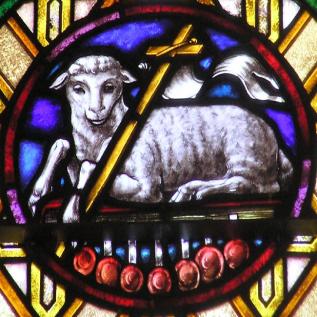
In the holy Gospel for this week, the truth that our Lord and Saviour is God is plainly set forth. “Before Abraham was, I am.” There is with Him neither past nor future. The words “I am” express the truth of His eternal being.

Yet He laid aside His Divine glory, which He had with the Father before the world was, and humbled Himself to be made man, that He might be truly and perfectly both God and Man. As man He chose the last and the lowest place. His mother was a maiden of somewhat lowly station. He was born in the stable of an inn. He grew up as a carpenter at Nazareth. He had not anywhere to lay His head, and was among His disciples as he that serveth.

His will was not only to be tempted in all points like as we are, but also to know the fellowship of our infirmities, that He might feel the sorrows of all, and so be able to sympathize with all. His desire was to be poor that He might know by experience something of the grinding hardness of poverty. He was to labor with hard toil that, though sinless Himself, He might taste and bear the curse of sin which was partly expressed in the words, “In the sweat of thy brow shalt thou eat bread.”

He was young as many regular men, active, vigorous, and of high spirit, like myself. But He was without sin, “a Son that never did amiss,” brave and patient, but at the same time kind and gentle towards all, loving above all things the courts of His Father’s house.

Temptation assailed Him, but He conquered it. Sometimes it came from the great tempter himself, sometimes from the mistaken kindness of some dear friend, and sometimes from the cruel taunts of bitter foes. In spite of all, though He was sometimes weighed down and depressed by it all, He kept the straight path of obedience to the will of God. At last, when He had perfected His obedience in life He offered Himself in death a sacrifice for our sins.

Prayer

Lord Jesus, teach me truly to believe in Thee, that I may the better know Thy love, and so may the more heartily love and follow Thee all the days of my life. Amen.

From Lent for Busy People © 2017 Fr. Charles H. Nalls


confession-drawing-01
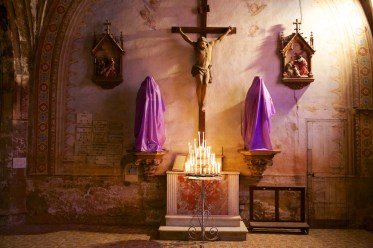
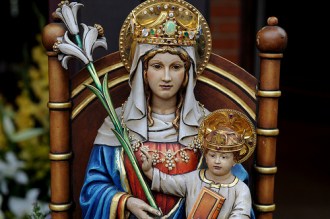
On Passion Sunday the sense of mourning is intensified by the veiling of all crucifixes, devotional statues, and pictures–the Church is hiding her glory as she mourns the price of our salvation. The Stations of the Cross, however, remain uncovered; and well so, for throughout Lent, but more so as the Passion is approached, they are one of the chief forms of devotion both for corporate and for individual acts of worship.

During Passiontide, in Masses of the Season, the Glory be is not heard. The Preface of Lent is replaced by that of the Holy Cross which reminds us that the tree of Calvary repaired the damage caused by the tree of Eden: “Who by the tree of the Cross didst give salvation unto mankind; that whence death arose, thence life might rise again: and that he [i.e. the devil] who by a tree overcame, might also by a tree be overcome.”

The words of the daily Masses reflect the approach of the Passion, the Gospel on Saturday in Passion Week ending with the significant words “These things spake Jesus, and departed, and did hide himself from them.” It is he who will regulate the pace of the drama. Tomorrow, but not before, he will go up to Jerusalem; on Friday, but not before, he will ascend the Cross.

Prayer

We beseech thee, Almighty God, mercifully to look upon thy people; that by thy great goodness they may be governed and preserved evermore, both in body and soul; through Jesus Christ our Lord. Amen.-Collect for Passion Sunday, 1928 Book of Common Prayer

From Lent for Busy People © 2017 Fr. Charles H. Nalls