Feeds:
Posts
Comments

St. Ita of Kileedy


Ita

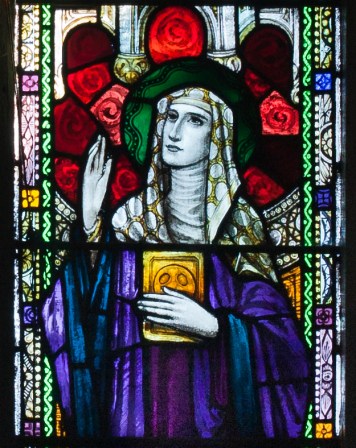
Today, I learned of a great Irish saint, St. Ita of Kileedy (Ite ingen Chinn Fhalad) (d. 570/577).  She was an early Irish nun and patron saint of Killeedy. She was known as the “foster mother of the saints of Erin”. The name “Ita” (“thirst for holiness”) was conferred on her because of her saintly qualities. I missed her feast day on 15 January, but will keep it next year.  I sent for her icon today, which has just been released for purchase.

Her legend is worth noting today.  Called the “Brigid of Munster”, Ita was born in 480 in the present County Waterford.  Her father was Cennfoelad or Confhaola (try pronouncing that) and her mother was Necta.

An account of Ita’s life in the Codex Kilkenniensis, follows the example of Brigit in describing the opposition Íte meets in pursuit of her vocation. She was baptised as Deirdre and grew up in Drum, County Waterford. Ita was said to embody the six virtues of Irish womanhood – wisdom, purity, beauty, musical ability, gentle speech and needle skills. She is also reported to have rejected a prestigious marriage for a life as a consecrated woman religious.

At the age of sixteen she moved to Cluain Credhail, a place-name that has ever since been known as Killeedy – meaning “Church of St. Ita” – in County Limerick, where she founded a small community of nuns and resided for the remainder of her life, in community with other consecrated women. Bishop Declan of Ardmore conferred the veil on her.

Legend has it that Ita was led to Killeedy by three heavenly lights. The first was at the top of the Galtee mountains, the second on the Mullaghareirk mountains and the third at Cluain Creadhail, which is nowadays Killeedy. Her sister Fiona also went to Killeedy with her and became a member of the community.

A strongly individualistic character is glimpsed in the stories that surround her life. When she decided to settle in Killeedy, a chieftain offered her a large grant of land to support the convent. But Ita would accept only four acres, which she cultivated intensively. The community group seems to have had a school for little boys where they were taught “Faith in God with purity of heart; simplicity of life with religion; generosity with love”. Her pupils are said to have included Saint Brendan the Navigator, whom Bishop Erc gave to Ita in fosterage when he was a year old. St. Ita kept him until he was six.  He later visited her between his voyages and always deferred to her counsel. Brendan is believed to have asked her what three things God loved best. “True faith in God and a pure heart, a simple life with a religious spirit and open-handedness inspired by charity,” she answered.

She noted at one point the three things God most detested: a scowling face, obstinacy in wrongdoing, and too great a confidence in the power of money. She dedicated herself to prayer, fasting, simplicity and cultivating a gift for spiritual discernment. She was also endowed with the gift of prophecy and was held in great veneration by a large number of contemporary saints, men as well as women.

Ita was said to have a gift for guiding people in holiness. She was much sought after as a spiritual director. During this period of Christianity, the Celtic Church was more advanced than other churches at the time in recognizing qualities of spiritual leadership in women and in encouraging women in this role. It is thought that Ita may have been abbess of a double monastery of men and women.

Her legend places a great deal of emphasis on her austerity, as told by St. Cuimin of County Down, and numerous miracles are recorded of her. She is also said to be the originator of an Irish lullaby for the infant Jesus, an English version of which was set for voice and piano by the American composer Samuel Barber. She probably died of cancer, though contemporary chroniclers describe how her side was consumed by a beetle that eventually grew to the size of a pig. When she felt her end approaching she sent for her community of nuns, and invoked the blessing of heaven on the clergy and laity of the district around Kileedy. Ita died sometime around 570.

Her grave, frequently decorated with flowers, is in the ruins of Cill Ide, a Romanesque church at Killeedy where her monastery once stood. It was destroyed by Viking invaders in the ninth century. A Romanesque church was later built over its ruins, but that too failed to survive. The site, however, remains a place of pilgrimage today. A holy well nearby, almost invisible now, was known for centuries for curing smallpox in children and other diseases as well.  Another village in County Limerick, Kilmeedy (In Irish – Cill m’Ide, or church of my Ita) has links with the saint as well – having first set up a church in Kilmeedy before the one in Killeedy.

Not only was St. Ita a saint, but she was the foster-mother of many saints, including St. Brendan the Navigator, St. Pulcherius (Mochoemog) and Cummian. At the request of Bishop Butler of Limerick, Pope Pius IX granted a special Office and Mass for the feast of St. Ita, which is kept on 15 January. Although not on the Roman calendar of saints, her feast is celebrated as an optional memorial in Ireland.

St Ita is the patron saint of Killeedy, Ireland,[4] and along with St. Munchin is co-patron of the Diocese of Limerick. She is reportedly a good intercessor in terms of pregnancy and eye illnesses.

Sexagesima 2018


Missal

I have had a number of requests to post the order of the Mass for the upcoming Sunday so that folks can practice the hymns.  Given scheduling, this may appear earlier or later in the week, but I hope to have it here on the blog in sufficient time for folks to warm up those vocal cords.

HOLY EUCHARIST- February 4, 2018

Hymnal (11:00 am)  

Prelude
315   Processional Hymn (Kremser)
Introit (Insert)
Collect for Purity
701   Decalogue (Merbecke)
702   Kyrie eleison (Merbecke)
Collect
Epistle (II Corinthians xi.19)
Gradual (see insert)
Gospel (St. Luke viii.4)
Nicene Creed
401   Sermon Hymn (Weymouth)
Sermon—The Rev. Canon Charles H. Nalls
OFFERTORY
Offertory (see insert)
298   Offertory Hymn (Tallis Ordinal)
560   Doxology (Pentecost)
Intercessions of the Faithful
General Confession 75
Absolution & Comfortable Words 76
CONSECRATION
Sursum Corda
706/796 Sanctus & Benedictus (Merbecke)
Canon of Consecration
Lord’s Prayer
FRACTION
Peace of the Lord
706 Agnus Dei (Merbecke)
Prayer of Humble Access
211 Communion Hymn (Jesu, Joy); 212 (Bread of Heaven)
Post-communion Thanksgiving
Communio (Insert)
Dismissal & Blessing
The Last Gospel (Response: “Thanks be to God!)
287 Recessional Hymn (Elbing)
Postlude


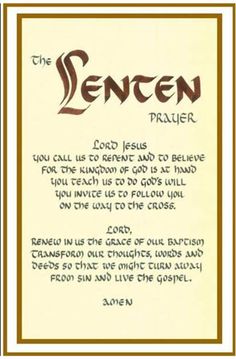
lenten-prayer

LENTEN DAILY PRAYERS.

Morning.
Earnest, regular prayer If you are unaccustomed to keeping the Daily Offices, here are some patterns of prayer that you can use during Lent. It is a desirable thing that you learn to take on Morning and Evening Prayer as a regular discipline, but, these patterns and prayers are a good place to start and, for the really busy person, they form a sufficient pattern of prayer for the day.
Do not allow yourself to be rushed. Get out of bed early enough that you can say your prayers with attention and clarity. Kneel down, and try to put away for the moment all other thoughts, and to feel that you are in God’s presence.

Lord, have mercy upon me.
Christ, have mercy upon me.
Lord, have mercy upon me.
Our Father, &c.
The Collect or Collects for the week (or for the day, if it be a holy day or feast day).

Praised be the Lord daily;
Even the God who helpeth us, and poureth His benefits upon us.
I laid me down and slept, and rose up again:
For the Lord sustained me.

Glory be to the Father, &c.
As it was in the beginning, &c.
Lord, hear my prayer,
And let my cry come unto Thee.

ALMIGHTY GOD, our Heavenly Father, who hath graciously preserved me during the past night, have mercy, upon me, I pray Thee, and vouchsafe to
cleanse me from all stain of sin in the precious blood of the Lord Jesus Christ, our Saviour; keep me, I beseech Thee, from all harm and evil during this day, and grant that through the grace of Thy Holy Spirit I may truly love, and serve, and warship, Thee, O God, to the glory of Thy Name, both this and all the days of my life, through Jesus Christ our Lord. Amen.

PRAYERS.

O LORD JESUS CHRIST, Son of the living God, and Saviour of the world, who west made man, and nailed to the bitter Cross to save us from sin and to redeem us from death; help me, I humbly beseech Thee, O My Lord and Saviour, to resist all tempta¬tions, and to overcome all my faults, to be watchful over myself, and to follow Thee in the blessed steps of Thy most holy life, who livest and reignest with the Father and the Holy Ghost, One God, world without end. Amen.

Read over, quietly and thoughtfully, the reading for the day in the Lectionary of the Book of Common Prayer; and when you rise and go to your occupation, remember that the love of God should be in all things our motive, and that the fear of God is always a great protection against temptation.

Midday.

If your occupations afford you the opportunity, try to secure a few moments for a short prayer at mid¬day. Thus:
O Saviour of the world, who by Thy cross and precious blood hath redeemed us; save me, and help me, I humbly beseech Thee, O Lord.
Our Father, &c.
The grace of our Lord Jesus Christ, and the love of God, and. the fellowship of the Holy Ghost, be with us all evermore. Amen.

Evening.

Kneel down, clear you mind and try to forget everything else, and say: O God, Thou searcher of our hearts, I am in Thy presence, have mercy upon me and help me truly to examine myself, I beseech Thee.
1. Did I get up in proper time this morning, and did I say my prayers reverently and carefully?
2. Have I done all things to-day faithfully and well that I might please God, and glorify His name?
3. Have I today done, or said, or thought anything I am ashamed of; anything that I know and feel must offend God, and. grieve His Holy Spirit? (Don’t hurry over this question, but think well before you answer it)
4. Have I today done any wrong to any one, or led any one to do wrong?
5. Have I any reason to think that I am growing better, and living more and more according to God’s Will.
Then confess to God the sins and faults which your self-examination may have brought to light, and pray for forgiveness. You may use some such form as this:

O GOD, the FATHER, the Son, and the HOLY GHOST, I am sorry that I have sinned against Thee, and I confess unto Thee my faults; I confess that I have sinned, that I have . . . O Heavenly Father, I beseech Thee to pardon me for His sake who bore our sins in His own body on the cross, and now ever liveth to make intercession for us: make me, I pray Thee, more sorry. for my faults, and help me by Thy Holy Spirit to over. come them all, through the Same Jesus Christ our Lord. Amen.

(If your examination and confession are made in a merely formal way without any earnest feeling, it may do you no good, and you will not receive pardon from God.)
OUR FATHER, &C.
Unto Thee, O LORD, will I pay my vows;
Unto Thee do I give thanks.
I will lay me down in peace and take my rest;
For it is Thou, Lord, only that makest me dwell in
safety.

Glory be to the Father, &c.
As it was in the beginning, &c.
Lord, hear my prayer.
And let my cry come unto Thee.
ALMIGHTY God, our Heavenly Father, who halt given us the day for work and the night for rest, I humbly beseech Thee to take me under Thy gracious care during this night, and to grant that as Thy holy angels always do Thee service in heaven, so by Thy ap¬pointment they may succour and defend us on earth, through Jesus Christ our Lord. Amen.

ADDITIONAL PRAYERS

O GOD, with whom the darkness is as clear as the light, and who art about our path and about our bed, keep me, I beseech Thee, that in nothing I may offend Thee; and grant that at morning light I may rise refreshed and glad to enjoy Thy mercies, and by Thy grace to do Thee service, through Jesus Christ our Lord. Amen.

O GOD, whom I desire to love and obey, grant, I beseech Thee, that, abiding by faith in Thy blessed Son our Saviour Jesus Christ, I may be evermore guided, strengthened, and sanctified by Thy Holy Spirit, that so I may in all things do Thy will, through the same Jesus Christ our Lord. Amen.

I thank Thee, O God, for the blessings of the day past, and of this life in general ; and for my creation, redemption, and regeneration, for Thy grace, and for my faith in Thee, I desire most humbly to thank Thee, the Father, the Son, and the Holy Ghost, beseeching Thee graciously to hear my prayers, and to grant me Thy peace and Thy blessing, both this night and for evermore. Amen.

You may add prayers for other blessings in your own words. The following are suggested as blessings which you will always do well to pray for, although of course you need not pray for them all at any one time.

• That you may have grace to purify yourself in thought, word, and deed, even as the Lord Jesus Christ is pure; and that you may grow more and more like unto Him in all things.
• That you may be sanctified in body, soul, and spirit, through the grace of the Holy Ghost, the Comforter.
• That God will teach you to pray, and also to do His will.
• That He will help you to worship Him in spirit and in truth, and to obey His commandments.
• That He will help you, fighting manfully under Christ’s banner, to conqueryour besetting sin, and to cast it from you.
• That He will give you grace to watch and pray, and to resist all the temptations by which you may be assailed.
• That you may increase in every Christian grace, and persevere in every good word and work.
• That you may be able to live peaceably with all, and that you may have grace always to do to all as you would have them do to you.
• That you may do all your work honestly, diligently, and faithfully.
• That you may have strength and energy to do all things thoroughly and well.
• That you may be prospered in all things according to God’s will.
• That you may always set before you your duty, and be enabled always to do that which is right.
• That you may be blessed with health and strength, with vigour and activity.
• That God will pour upon your father and mother His grace and heavenly benediction.
• That He will keep your brothers and sisters from all harm and evil, and guide and prosper them in all things.
• That to all your relations and friends He will grant His mercy, and His grace according to the need of each of them.
• That you and your daily companions may live in brotherly love, helping one another in all good things.
• That God will guide and strengthen your Bishop and Clergy, and prosper their work according to His will.
• That He will comfort and succour the sick, the sor¬rowful, and all who are in need, or danger.
• That He will strengthen and encourage the faint¬hearted, the desponding, and all who are sorely tempted.
• That He will awaken the sinful and the careless, and lead them to repentance.
• That the heathen may everywhere be gathered into the fold of Jesus Christ our Lord.


Requiescat

We are saddened to announce the passing of Dr. Robert Moore Strippy in the early morning hours of Wednesday, January 31, 2018 in Richmond, Virginia. He had been recuperating at Manor Care (Brookdale-Imperial Plaza) following a fall the previous week.

Dr. Strippy was the son of the late Clarence G. and Ruth (Moore) Strippy. He spent his early years in Massachusetts, and attended Episcopal Academy in Devon, Pennsylvania. A professor emeritus at the University of Pennsylvania, he held multiple doctorates, including doctorates of music the Universities of Paris and Rome. In retirement, he was an instructor at the University of Virginia.

In addition to his academic career, “Dr. Bob” worked in advertising in Chicago in the late 1950s and was a speechwriter for President Dwight Eisenhower. In the 1960s, he traveled extensively in Europe and played the organ in a number of great churches and cathedrals, including a time spent studying with renowned French organist Maurice Duruflé.

Dr. Bob’s career also had its serendipitous moments such as his role in the making of “The Abominable Dr. Phibes”, a 1971 British comedy horror film directed by Robert Fuest and starring Vincent Price and Joseph Cotten. The music that Phibes (Price) plays on the organ at the beginning of the film is “War March of the Priests” from Felix Mendelssohn’s incidental music to Racine’s play Athalie. The organ used was the grand New York Paramount theater organ, now in the Century II Center in Wichita, Kansas. The actual organist was none other than Dr. Robert Moore Strippy, then of Chicago!

Dr. Strippy was a devoted, traditional Anglican catholic. Recognizing the coming disintegration of the Protestant Episcopal, Dr. Strippy wrote extensively to sound a call to action. In the 1976 work A House Divided by Fr. Robert Harvey, Strippy provided a cogent and prescient analysis of the destructive result of the impending liberalization and “de-sacramentalization” of the Church. For example, he pointed out that,

[W]hen the question of women’s ordination is settled to the liberals’ satisfaction, they intend to attack the Eucharistic doctrine through a revised liturgy that will have no real meaning, and in which a spiritualist, a Buddhist and an agnostic could participate with equal satisfaction. When so updated, the Eucharist will have ceased to be a representation of Christ’s sacrifice upon the Cross.

He went on to note that, when the Eucharist has been “rearranged” to the liberals’ satisfaction, “[t]hey will then take their second step in the updating of Christian initiation. They will attack the doctrine of baptism by contending that it is untrue that humanity is excluded from God’s family unless they are baptized. The liberals will then replace Jesus’ doctrine with their own: that the entire universe is covered by a baptism of desire, and that physical baptism is superfluous.” This is precisely what has occurred.

Dr. Strippy served a delegate to the 1977 Congress of St. Louis, an international gathering of nearly 2,000 Anglicans united in their rejection of theological changes introduced by the Anglican Church of Canada and by the Episcopal Church in the United States of America in its General Convention of 1976. Indeed, Dr. Strippy was one of several scribes and authors of the Affirmation of St. Louis that would emerge as the basis for “continuing” Anglicanism in the United States. He recalled working around the clock in an hotel room with the late Perry Laukoff to revise and type the edits to the Affirmation as they were sent up from the Debates and discussions in the Congress. Dr. Strippy was always very direct in emphasizing the catholicity of the finished work.

Dr. Strippy relocated to Richmond, Virginia in 2011, where he began to attend St. Alban’s Anglican-Catholic parish and occasionally substitute as organist there. He took an apartment at Imperial Plaza literally around the corner from the parish, and remained a dedicated member, although failing health precluded his regular attendance. He remained a very active member in MENSA.

Dr. Strippy received the Last Rites of the Church from Canon Charles Nalls, Rector of St. Alban’s, on January 31st. No immediate survivors have been located. As soon as funeral arrangements can be made, a requiem Mass will be scheduled at St. Alban’s. Contributions to provide for those arrangements and interment should be made to St. Alban’s Parish, with the annotation “Dr. Strippy Fund”.

“I have fought a good fight, I have finished my course, I have kept the faith,…”-II Timothy 4:7

May his soul with those of the faithful departed rest in peace, + and May Light Perpetual shine upon him.

Speech or Silence?


Banx-Cartoons-Punch-1983-03-02-47

Today, in a lengthy selection from Book II, Chapter 4 of St. Gregory the Great’s treatise entitled Pastoral Care. This section exhorts the “ruler” to be discreet in keeping silence, profitable in speech. Perhaps it is best summed up in the aphorism attributed to the 16th President of the United States, Abraham Lincoln, that it is, “Better to remain silent and be thought a fool than to speak out and remove all doubt.” Likewise, there is a warning to the bishop or priest who fails to speak the truth, particularly to curry favor with others.
Finally, St. Gregory cautions against the clergyman who preaches without knowledge. All of these things tear down the community of the faithful. It seems that, in the life of the Church, the more things change the more they stay the same.

I have taken the liberty of placing emphasis on the portions of the tract that seem particularly germane in light of pronouncements made in various corners of Christendom great and small.

The ruler (bishop or priest) should be discreet in keeping silence, profitable in speech, unless he either say what ought to be suppressed or suppress what he ought to be saying.

As incautious speaking leads into error, so indiscreet silence leaves in error those who might have been instructed. Too often improvident rulers, fearing to lose human favour, shrink timidly from speaking freely the things that are right. According to the voice of the Truth, they serve the flock by no means with the zeal of shepherds, but in the way of hirelings. (John 10:12) since they fly when the wolf comes if they hide themselves under silence.

So it is that the Lord through the prophet upbraids them, saying, “Dumb dogs, that cannot bark.” (Isaiah 56:10. Again He complains, saying, “You have not gone up against the enemy, neither opposed a wall for the house of Israel, to stand in the battle in the day of the Lord.” (Ezekiel 13:5) Now to go up against the enemy is to go with free voice against the powers of this world for defense of the flock; and to stand in the battle in the day of the Lord is out of love of justice to resist bad men when they contend against us.

For a shepherd to have feared to say what is right, what else is it but to have turned his back in keeping silence? But surely, if he puts himself in front for the flock, he opposes a wall against the enemy for the house of Israel. Hence again to the sinful people it is said, “Your prophets have seen false and foolish things for you: neither did they discover your iniquity, to provoke you to repentance.” (Lamentations 2:14)

In sacred language teachers are sometimes called prophets, in that, by pointing out how fleeting are present things, they make manifest the things that are to come. Such the divine discourse convinces of seeing false things, because, while fearing to reprove faults, they vainly flatter evil doers by promising security. Similarly, they do not at all discover the iniquity of sinners, since they refrain their voice from chiding.

The language of reproof is the key of discovery, because by chiding it discloses the fault of which even he who has committed it is often himself unaware. Thus, St. Paul says, “That he may be able by sound doctrine even to convince the gainsayers.” (Titus 1:9)
Likewise, through Malachi it is said, “The priest’s lips keep knowledge, and they shall seek the law at his mouth. (Malachi 2:7) Again, through the prophet Isaiah the Lord admonishes, saying, “Cry aloud, spare not, lift up your voice like a trumpet.” (Isaiah 58:1)

It is true that whosoever enters on the priesthood undertakes the office of a herald, so as to walk, himself crying aloud, before the coming of the judge who follows terribly. Wherefore, if the priest knows not how to preach, what voice of a loud cry shall the mute herald utter? So it is that the Holy Spirit sat upon the first pastors under the appearance of tongues (Acts 2:3); because whomsoever He has filled, He himself at once makes eloquent.

So it is that it was enjoined on Moses that when the priest goes into the tabernacle he shall be encompassed with bells. (Exodus 28:33); that is, that he shall have about him the sounds of preaching, lest he provoke by his silence the judgment of Him Who beholds him from above. For it is written, “That his sound may be heard when he goes in unto the holy place before the Lord and when he comes out, that he die not.” (Exodus 28:35)For the priest, when he goes in or comes out, dies if a sound is not heard from him, because he provokes the wrath of the hidden judge, if he goes without the sound of preaching.

Aptly also are the bells described as inserted in his vestments. For what else ought we to take the vestments of the priest to be but righteous works; as the prophet attests when he says, Let Your priests be clothed with righteousness Psalm 131:9? The bells, therefore, are inherent in his vestments to signify that the very works of the priest should also proclaim the way of life together with the sound of his tongue.

When the ruler prepares himself for speaking, let him bear in mind with what studious caution he ought to speak, lest, if he be hurried inordinately into speaking, the hearts of hearers be smitten with the wound of error and, while he perchance desires to seem wise he unwisely sever the bond of unity. For on this account the Truth says, “Have salt in yourselves, and have peace one with another.” (Mark 9:49)

By salt is denoted the word of wisdom. Let him, therefore, who strives to speak wisely fear greatly, lest by his eloquence the unity of his hearers be disturbed.
So it is that St. Paul says, “Not to be more wise than behooves to be wise, but to be wise unto sobriety.” Romans 12:3. Thus, in the priest’s vestment, according to Divine precept, to bells are added pomegranates. (Exodus 28:34) For what is signified by pomegranates but the unity of the faith? For, as within a pomegranate many seeds are protected by one outer rind, so the unity of the faith comprehends the innumerable peoples of holy Church, whom a diversity of merits retains within her.

So, then, a ruler should be unadvisedly hurried into speaking, the Truth in person proclaims to His disciples this which we have already cited, “r3Have salt in yourselves, and have peace one with another. (Mark 9:49) It is as though He should say in a figure through the dress of the priest: Join pomegranates to bells, that in all you say you may with cautious watchfulness keep the unity of the faith.

Rulers ought also to guard with anxious thought not only against saying in any way what is wrong, but against uttering even what is right overmuch and inordinately; since the good effect of things spoken is often lost, when enfeebled to the hearts of hearers by the incautious importunity of loquacity; and this same loquacity, which knows not how to serve for the profit of the hearers, also defiles the speaker. So, it is well said through Moses, “The man that has a flux of seed shall be unclean Leviticus (15:2) For the quality of the speech that is heard is the seed of the thought which follows, since, while speech is conceived through the ear, thought is engendered in the mind. Consequently, also by the wise of this world the excellent preacher was called a sower of words (seminiverbius). (Acts 17:18)

So it is that he that suffers from a flux of seed is pronounced unclean, because, being addicted to much speaking, he defiles himself by that which, had it been orderly issued, might have produced the offspring of right thought in the hearts of hearers. While he incautiously spends himself in loquacity, he sheds his seed not so as to serve for generation, but unto uncleanness. Thus, St. Paul also, in admonishing his disciple to be instant in preaching, says, “I charge you before God and Christ Jesus, Who shall judge the quick and the dead by His appearing and His kingdom, preach the word, be instant opportunely, importunely.’” (II Timothy 4:1) In truth importunity mars itself to the mind of the hearer by its own very cheapness, if it knows not how to observe opportunity.


January

We welcome our local chapter of the Society for Creative Anachronism!  We have agreed on an initial basis to host their meetings in the parish hall on Tuesdays (parish events excepting) from 1800-2100. The SCA is a non-profit (501(c)(3)), educational group that re-creates the Western European Middle Ages in pre-1600 times.

They say “re-create” because instead of re-enacting specific historical events, they choose aspects of pre-1600 life to re-create through the use of a “persona”: a character that they create that could have lived in the Middle Ages.

People in the SCA study and re-create martial activities including armored combat, fencing, archery, siege weapons and more. Their artisans research, create and teach music, poetry, cooking, singing, dancing, metal-smithing, tailoring, armoring, etc. Through the hard work of dozens and even hundreds of volunteers, SCA hosts events all over the country every weekend. You can find out more about them here http://atlantia.sca.org/offices/chatelain/welcome-to-the-sca


Fulton

Today, we resume Book II (Ch. 3) of St. Gregory the Great’s treatise entitled Pastoral Care. The subheading of this book spells out its contents, “Of the Life of the Pastor.” Here, the saint explores the idea that the ruler as bishop should be always “chief in action”. While some of the language is a bit stilted, the St. Gregory’s meaning is clear and reinforced by the image of the vestments to be “put on” by the ruler: the bishop should be an example in his way of life to clergy and lay people alike.  Absent a godly life and personal example, clothes do not make the man.

The ruler should always be chief in action that by his living he may point out the way of life to those that are put under him. His life should stand as an example so that the flock, which follows the voice and manners of the shepherd, may learn how to walk better through example than through words. He who is required by the necessity of his position to speak the highest things is compelled by the same necessity to exhibit the highest things. The voice that more readily penetrates the hearer’s heart is that which the speaker’s life commends, because what he commands by speaking he helps the doing of by showing.

It is said through the prophet, “Get you up into the high mountain, you that bringest good tidings to Sion.” (Isaiah 40:9) This means that he who is engaged in heavenly preaching should already have forsaken the low level of earthly works, and appear as standing on the summit of things. In this way he will so much the more easily should draw those who are under him to better things as by the merit of his life he cries aloud from heights above. So it is that under the divine law the priest receives the shoulder for sacrifice, and this the right one and separate to signify that his action should be not only profitable, but even singular. (Exodus 29:22) He should not merely do what is right among bad men, but transcend even the well-doers among those that are under him in the virtue of his conduct.

The breast also together with the shoulder is assigned to him for eating, that he may learn to immolate to the Giver of all that of himself which he is enjoined to take of the Sacrifice. He is empowered not only in his breast to entertain right thoughts, but with the shoulder of work invite those who behold him to things on high. He may covet no prosperity of the present life, and fear no adversity; that, having regard to the fear within him, he may despise the charm of the world, but considering the charm of inward sweetness, may despise its terrors.

Wherefore by command of the supernal voice (Exodus 29:5) the bishop or priest is braced on each shoulder with the robe of the ephod that he may be always guarded against prosperity and adversity by the ornament of virtues. Walking, as St. Paul says II Corinthians 6:7, in the armor of righteousness on the right hand and on the left, he strives only after those things which are before. He may decline on neither side to low delight.

Neither should prosperity elate nor adversity perturb him. Neither let smooth things coax him to the surrender of his will, nor rough things press him down to despair; so that, while he humbles the bent of his mind to no passions, he may show with how great beauty of the ephod he is covered on each shoulder. This ephod is also rightly ordered to be made of gold, blue, purple, twice dyed scarlet, and flue twined linen. (Exodus 28:8) As a result, it may be shown by how great diversity of virtues the priest ought to be distinguished. In the priest’s robe before all things gold glitters, to show that he should shine forth principally in the understanding of wisdom.

With gold there is blue, which is resplendent with aerial color, is conjoined, to show that through all that he penetrates with his understanding he should rise above earthly favors to the love of celestial things. This is a reminder lest, while caught unawares by his own praises, he be emptied of his very understanding of the truth. With gold and blue, purple also is mingled, which means, that the priest’s heart, while hoping for the high things which he preaches, should repress in itself even the suggestions of vice. It is if by virtue of a royal power, he may rebut them, in that he has regard ever to the nobility of inward regeneration. Accordingly, his manners guard his right to the robe of the heavenly kingdom. For it is of this nobility of the spirit that it is said through St. Peter, “You are a chosen generation, a royal priesthood.” (I Peter 2:9) With respect also to this power, whereby we subdue vices, we are fortified by the voice of St. John, who says, “As many as received Him, to them gave He power to become the sons of God. (St.John 1:12)

This dignity of fortitude the Psalmist has in view when he says, “But with me greatly honored have been Your friends, O God; greatly strengthened has been their principality.” (Psalm 138:17) For truly the mind of saints is exalted to princely eminence while outwardly they are seen to suffer abasement.

With gold, blue, and purple, twice died scarlet is conjoined, to show that all excellences of virtue should be adorned with charity in the eyes of the judge within; and that whatever glitters before men may be lighted up in sight of the hidden arbiter with the flame of inward love. Further, this charity, since it consists in love at once of God and of our neighbor, has the luster of a double dye.

He then who so pants after the beauty of his Maker as to neglect the care of his neighbors, or so attends to the care of his neighbors as to grow languid in divine love, whichever of these two things it may be that he neglects, knows not what it is to have twice dyed scarlet in the adornment of his ephod. But, while the mind is intent on the precepts of charity, it undoubtedly remains that the flesh be macerated through abstinence.

So, with twice dyed scarlet fine twined linen is conjoined. For fine linen (byssus) springs from the earth with glittering show: and what is designated by fine linen but bodily chastity shining white in the comeliness of purity? It is also twisted for being interwoven into the beauty of the ephod, since the habit of chastity then attains to the perfect whiteness of purity when the flesh is worn by abstinence. Since the merit of affliction of the flesh profits among the other virtues, fine twined linen shows white, as it were, in the diverse beauty of the ephod.

Walking the Walk


armor

Here is one of the thornier parts of Book II of St. Gregory the Great’s treatise entitled Pastoral Care, in which the saint explores the appropriate conduct and life for the man who has the attributes of a bishop and has been consecrated.  Given recent sad experiences in the Church, West, East and Via Media, these are important admonitions for bishop and priest alike.  The armor imagery is particularly apt, particularly when considered in light of the Epistle of St. Paul to the Ephesians.  In sum, if you are going to talk the talk, you had best walk the walk, and that with the appropriate spiritual

“up-armor”.

That the ruler should be pure in thought.

The ruler should always be pure in thought. No impurity ought to pollute him who has undertaken the office of wiping away the stains of pollution in the hearts of others also. The hand that would cleanse from dirt must needs be clean, lest, being itself sordid with clinging mire, it soil whatever it touches all the more.

On this account it is said through the prophet, “Be clean that bear the vessels of the Lord Isaiah.” (52:11) They bear the vessels of the Lord who undertake, on the surety of their own conversation, to conduct the souls of their neighbors to the eternal sanctuary. Let them therefore perceive within themselves how purified they ought to be who carry in the bosom of their own personal responsibility living vessels to the temple of eternity.

Thus, by the divine voice it is enjoined that on the breast of Aaron the breastplate of judgment should be closely pressed by binding fillets. (Exodus 28:15) “Lax cogitations” should by no means possess the priestly heart, but reason alone constrain it. The ruler should not cogitate anything indiscreet or unprofitable. He is who constituted to be example to others, ought to show in the gravity of his life what store of reason he carries in his breast. On his breastplate, the names of the twelve patriarchs should be engraved.

To carry always the fathers registered on the breast is to think without intermission on the lives of the ancients.

The bishop or priest walks blamelessly when he pores continually on the examples of the fathers that went before him, when he considers without cease the footsteps of the Saints, and keeps down unlawful thoughts, lest he advance the foot of his conduct beyond the limit of order.

It is also well called the breastplate of judgment, because the ruler ought ever with subtle scrutiny to discern between good and evil. He should studiously consider what things are suitable for what, and when and how. He should not seek anything for himself, but esteem his neighbors’ good as his own advantage. So it is in the same place it is written, “But you shall put in the breastplate of Aaron doctrine and truth , which shall be upon Aaron’s breast, when he goes in before the Lord, and he shall bear the judgment of the children of Israel upon his breast in the sight of the Lord continually.” (Exodus 18:30) For the priest’s bearing the judgment of the children of Israel on his breast before the face of the Lord means his examining the causes of his subjects with regard only to the mind of the judge within, so that no admixture of humanity cleave to him in what he dispenses as standing in God’s stead, lest private vexation should exasperate the keenness of his censure.

While the ruler shows himself zealous against the vices of others, let him get rid of his own lest either latent grudge vitiate the calmness of his judgment, or headlong anger disturb it. When the terror of Him who presides over all things is considered (that is to say of the judge within), not without great fear may subjects be governed. Such fear indeed purges, while it humiliates, the mind of the ruler, guarding it against being either lifted up by presumption of spirit, or defiled by delight of the flesh, or obscured by importunity of dusty thought through lust for earthly things. These things cannot but knock at the ruler’s mind. It is necessary, however, to make haste to overcome them by resistance, lest the vice which tempts by suggestion should subdue by the softness of delight, and, this being tardily expelled from the mind, should slay with the sword of consent.

Now That You’re There


bishops

Today, we come to Book II of St. Gregory the Great’s treatise entitled Pastoral Care. The subheading of this book spells out its contents, “Of the Life of the Pastor.” Here, the saint explores the appropriate conduct and life for the man who has the attributes of a bishop and has been consecrated. It is both a practical and moral treatise.

How one who has in due order arrived at a place of rule ought to demean himself in it.

The conduct of a prelate ought so far to transcend the conduct of the people as the life of a shepherd is wont to exalt him above the flock. For one whose estimation is such that the people are called his flock is bound anxiously to consider what great necessity is laid upon him to maintain rectitude.

It is necessary, then, that in thought he should be pure, in action chief; discreet in keeping silence, profitable in speech; a near neighbor to everyone in sympathy, exalted above all in contemplation; and a familiar friend of good livers through humility. He should be unbending against the vices of evil-doers through zeal for righteousness. He should never relax in his care for what is inward from being occupied in outward things, nor neglect to provide for outward things in his solicitude for what is inward.
Now, let us unfold and discuss more at length the things which we have touched on briefly so far.


Fulton

A Good Bishop


In today’s lengthy selections from St. Gregory the Great’s treatise entitled Pastoral Care, we get down to basics as we come to the end of Book I. First, St. Gregory discusses the attributes of the man who ought to be bishop. These clearly have their basis in I Timothy iii.1, et seq. and are echoed in “The Form for Ordaining or Consecrating a Bishop”, 1928 Book of Common Prayer, p. 549. The list is extensive, although not exhaustive. (Book I, Ch. 10)

The saint follows this chapter with a tract on the man who should not be elevated to the episcopate. (Book I, Ch. 11) The very same admonitions turn up in the negative, like a reversed image in a glass. Take care in reading these somewhat colorful physical and medical descriptions. St. Gregory casts the negative attributes in mostly physical terms, but they are but outward signs of deficiencies, sins and analogous spiritual illnesses in the inner man.

What manner of man ought to come to rule.

The man who ought to ascend to the episcopacy should by all means be an example of good living who already lives spiritually, dying to all passions of the flesh. He should disregard worldly prosperity, and should be afraid of no adversity. The proper candidate should desire only inward wealth, and whose intention the body, in good accord with it, thwarts not at all by its frailness, nor the spirit greatly by its disdain. He is one who is not led to covet the things of others, but gives freely of his own.

With respect to justice, the man who ought to rule is, through the bowels of compassion, quickly moved to pardon, yet is never bent down from the fortress of rectitude by pardoning more than is proper. He perpetrates no unlawful deeds, but deplores those perpetrated by others as though they were his own. Out of affection of heart, he sympathizes with another’s infirmity, and so rejoices in the good of his neighbo


r as though it were his own advantage.

The strong candidate so insinuates himself as an example to others in all he does that among them he has nothing, at any rate of his own past deeds, to blush for. The man who ought to be bishop43e studies so to live that he may be able to water even dry hearts with the streams of doctrine. As a “prayer warrior”, he lready learned by the use and trial of prayer that he can obtain what he has requested from the Lord, having had already said to him, as it were, through the voice of experience, “While you are yet speaking, I will say, Here am.” (I Isaiah 58:9)

If perchance any one should come to us asking us to intercede for him with some great man, who was incensed against him, but to us unknown, we should at once reply, “We cannot go to intercede for you, since we have no familiar acquaintance with that man.” If, then, a man blushes to become an intercessor with another man on whom he has no claim, with what idea can anyone grasp the post of intercession with God for the people, who does not know himself to be in favour with Him through the merit of his own life?
Essentially, how can a man ask of Him pardon for others while ignorant whether towards himself He is appeased? In this matter there is yet another thing to be more anxiously feared; namely, lest one who is supposed to be competent to appease wrath should himself provoke it on account of guilt of his own. For we all know well that, when one who is in disfavor is sent to intercede with an incensed person, the mind of the latter is provoked to greater severity. Wherefore let one who is still tied and bound with earthly desires beware lest by more grievously incensing the strict judge, while he delights himself in his place of honour, he become the cause of ruin to his subordinates.

What manner of man ought not to come to rule.

Wherefore let everyone measure himself wisely, lest he venture to assume a place of rule, while in himself vice still reigns unto condemnation; lest one whom his own guilt depraves desire to become an intercessor for the faults of others. For on this account it is said to Moses by the supernal voice, “Speak unto Aaron; Whosoever he be of your seed throughout their generations that has a blemish, he shall not offer loaves of bread to the Lord his God.” (Leviticus 21:17).

With respect to physical infirmities, if he be blind, if he be lame, if he have either a small or a large and crooked nose, if he be broken-footed or broken-handed, if he be hunchbacked, if he be blear-eyed (lippus), if he have a white speck (albuginem) in his eye, if chronic scabies, if impetigo in his body, or if he be ruptured. (ponderosus). (Leviticus 21:18) That man is indeed blind who is unacquainted with the light of supernal contemplation, who, whelmed in the darkness of the present life, while he beholds not at all by loving it the light to come. Such an one knows not whither he is advancing the steps of his conduct. So it was that Hannah, prophesying, “He will keep the feet of his saints, and the wicked shall be silent in darkness.” (I Kings 2:9)

The man who is lame who does indeed see in what direction he ought to go, but, through infirmity of purpose, is unable to keep perfectly the way of life which he sees, because, while unstable habit rises not to a settled state of virtue, the steps of conduct do not follow with effect the aim of desire. So it is that St. Paul says, “Lift up the hands which hang down, and the feeble knees, and make straight paths for your feet, lest that which is lame be turned out of the way; but let it rather be healed.” (Hebrews 12:12-13)

One with a small nose is he who is not adapted for keeping the measure of discernment. For with the nose we discern sweet odours and stenches: and so by the nose is properly expressed discernment, through which we choose virtues and eschew sins. Whence also it is said in praise of the bride, “Your nose is as the tower which is in Lebanon.” (Canticles 7:4) Why? Because Holy Church, by discernment, espies assaults issuing from this or that quarter, and detects from an eminence the coming wars of vices.
However, there are some who, not liking to be thought dull, busy themselves often more than needs in various investigations, and by reason of too great subtlety are deceived. Wherefore this also is added, Or have a large and crooked nose. For a large and crooked nose is excessive subtlety of discernment, which, having become unduly excrescent, itself confuses the correctness of its own operation. But one with broken foot or hand is he who cannot walk in the way of God at all, and is utterly without part or lot in good deeds, to such degree that he does not, like the lame man, maintain them however weakly, but remains altogether apart from them.

The hunchbacked is he whom the weight of earthly care bows down, so that he never looks up to the things that are above, but is intent only on what is trodden on among the lowest. Should he ever hear anything of the good things of the heavenly country, is so pressed down by the weight of perverse custom, that he lifts not the face of his heart to it, being unable to erect the posture of his thought, which the habit of earthly care keeps downward bent. Of this kind of man the Psalmist says, “I am bent down and am brought low continually.” (Psalm 38:8) The fault of such as these the Truth in person reprobates, saying, “But the seed which fell among thorns are they which, when they have heard the word, go forth, and are choked with cares and riches and pleasures of life, and bear no fruit.” (Luke 8:14) The blear-eyed is he whose native wit flashes out for cognition of the truth, and yet carnal works obscure it. For in the blear-eyed the pupils are sound; but the eyelids, weakened, become gross; and even the brightness of the pupils is impaired, because they are worn continually by the flux upon them. The blear-eyed, then, is one whose sense nature has made keen, but whom a depraved habit of life confuses. To him it is well said through the angel, “Anoint your eyes with eye salve that you may see.” (Revelation 3:18) For we may be said to anoint our eyes with eye salve that we may see, when we aid the eye of our understanding for perceiving the clearness of the true light with the medicament of good conduct.

The man who has a white speck in his eye is not permitted to see the light of truth, in that he is blinded by the arrogant assumption of wisdom or of righteousness. For the pupil of the eye, when black, sees; but, when it bears a white speck, sees nothing. By analogy, we may understand that the perceiving sense of human thought, if a man understands himself to be a fool and a sinner, becomes cognizant of the clearness of inmost light. If it attributes to itself the whiteness of righteousness or wisdom, it excludes itself from the light of knowledge from above, and by so much the more fails entirely to penetrate the clearness of the true light, as it exalts itself within itself through arrogance.

As of some it is said, “Professing themselves to be wise, they became fools.” (Romans 1:22) That man who has chronic scabies whom the wantonness of the flesh without cease overmasters. For in scabies the violent heat of the bowels is drawn to the skin; whereby lechery is rightly designated, since, if the heart’s temptation shoots forth into action. It may be truly said that violent internal heat breaks out into scabies of the skin. It now wounds the body outwardly, because, while sensuality is not repressed in thought, it gains the mastery also in action. St. Paul had a care to cleanse away this itch of the skin when he said, “Let no temptation take you but such as is human.” (I Corinthians 10:13) It is as if it is human to suffer temptation in the heart; but it is devilish, in the struggle of temptation, to be also overcome in action.

He who has impetigo in his body whosoever is ravaged in the mind by avarice; which, if not restrained in small things, does indeed dilate itself without measure. For, as impetigo invades the body without pain, and, spreading with no annoyance to him whom it invades, disfigures the comeliness of the members. So avarice, too, exulcerates, while it pleases, the mind of one who is captive to it. As it offers to the thought one thing after another to be gained, it kindles the fire of enmities, and gives no pain with the wounds it causes, because it promises to the fevered mind abundance out of sin.
The comeliness of the members is destroyed, because the beauty of other virtues is also hereby marred. It exulcerates as it were the whole body, in that it corrupts the mind with vices of all kinds. As St. Paul attests, saying, “The love of money is the root of all evils.” (I Timothy 6:10)

The ruptured one is he who does not carry turpitude into action, but yet is immoderately weighed down by it in mind through continual cogitation. One who is indeed by no means carried away to the extent of nefarious conduct; but his mind still delights itself without prick of repugnance in the pleasure of lechery. For he may be said to be ruptured who, letting all his thoughts flow down to lasciviousness, bears in his heart a weight of turpitude; and, though not actually doing deeds of shame, nevertheless in mind is not withdrawn from them. Nor has he power to rise to the practice of good living before the eyes of men, because, hidden within him, the shameful weight presses him down.

Whosoever, therefore, is subjected to any one of these diseases is forbidden to offer loaves of bread to the Lord, lest in truth he should be of no avail for expiating the sins of others, being one who is still ravaged by his own.

And now, having briefly shown after what manner one who is worthy should come to pastoral authority, and after what manner one who is unworthy should be greatly afraid, let us now demonstrate after what manner one who has attained to it worthily should live in it.